American Iguana (Green Iguana)
Iguana iguana
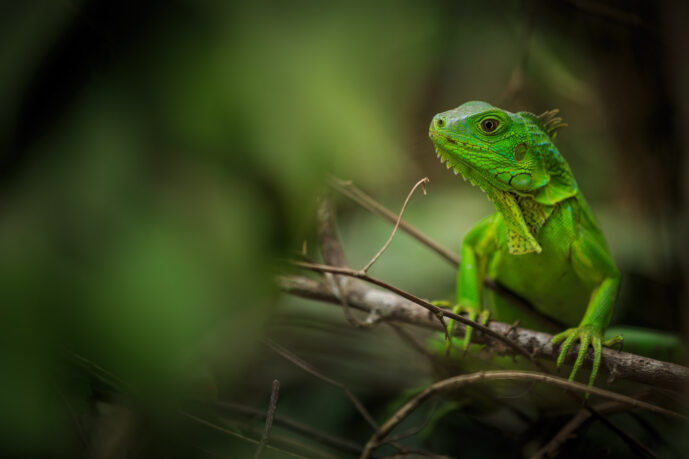
Quick Facts
- Scientific Name: Iguana iguana
- Family: Iguanidae
- Known Nicknames: Green Iguana, Common Green Iguana, American Iguana
- Average Length: 120–170 cm / 47–67 in
- Average Weight: 4–9 kg / 8.8–20 lb
- Wingspan: N/A
- Key Feature: Large pendulous dewlap, a row of elongated spines along the back and tail, and a parietal eye
- Primary Diet: Herbivore (Folivore)
- Range: Southern Mexico to Central Brazil, Paraguay, and various Caribbean islands
- Habitat: Arboreal; tropical rainforests, mangroves, and gallery forests near water sources
- Social Structure: Solitary, though semi-gregarious during basking and communal nesting
- Nesting/Breeding: Subterranean burrows in sandy or soft soil
- Statut de conservation : Préoccupation mineure (LC)
- Population Trend: Decreasing
The American Iguana, more commonly known as the Green Iguana (*Iguana iguana*), is one of the most iconic and recognizable reptiles in the Western Hemisphere, distinguished by its impressive size and prehistoric appearance. Reaching lengths of up to six feet, these primarily arboreal lizards boast a vibrant palette ranging from brilliant emerald to dusty orange, accented by a majestic crest of serrated spines running from the neck to a powerful, whip-like tail used for defense. Among their most fascinating biological features is the "parietal eye" located on top of the head—a light-sensitive organ that helps detect overhead predators—and a large, circular scale on the cheek known as the subtympanic plate. Despite their formidable look, these agile climbers are dedicated herbivores and exceptional swimmers, often leaping from high branches into the water to escape danger, making them a truly versatile marvel of the tropical canopy.
Habitats et répartition
This species is native to a broad geographical range that extends from southern Mexico through Central America and into central South America, reaching as far as southern Brazil and Paraguay. It is also indigenous to numerous islands across the Caribbean. Due to the pet trade and accidental introductions, it has established significant invasive populations in southern Florida, Hawaii, Puerto Rico, and various islands throughout the Pacific. These reptiles primarily inhabit tropical rainforests at low elevations, where they lead a largely arboreal lifestyle within the forest canopy. They show a strong preference for habitats located near permanent water sources, such as rivers, lakes, and mangrove swamps, which provide both hydration and a means of escape from predators. While they favor dense vegetation, they are highly adaptable and can also be found in more open landscapes, including coastal cliffs, agricultural areas, and suburban gardens.
Comportements & Reproduction
Green iguanas exhibit a complex social hierarchy, particularly among males who use visual displays such as head bobbing, dewlap extension, and color changes to defend territories and establish dominance. While adults are largely solitary and arboreal, juveniles often stay in small groups to increase their chances of survival against predators. During the breeding season, dominant males become highly territorial, shifting their coloration to more vibrant shades of orange or gold to attract multiple females within their established range. The reproductive cycle is typically synchronized with the dry season to ensure hatchlings emerge when food is most abundant. Following a polygynous mating system, females migrate to communal nesting sites where they excavate deep burrows in sandy soil. A single female can lay between 20 and 70 eggs, which she buries and abandons, providing no further parental care. The eggs incubate for about ten to fifteen weeks, relying entirely on environmental temperatures to develop until the precocial young emerge and begin their independent lives.
Alimentation
The Green Iguana is primarily a herbivorous reptile, specifically classified as a folivore, meaning its natural diet consists almost entirely of leaves, flowers, and fruits from a wide variety of tropical plants. They are known to consume over 100 different plant species, showing a particular preference for leafy greens, hibiscus flowers, and various wild berries. A fascinating aspect of their digestive system is that they are hindgut fermenters, relying on specialized microflora in their large intestine to break down tough plant cellulose, a process that requires high external temperatures to function effectively. While it was long suspected that juveniles were insectivorous, modern research indicates that they are strictly herbivorous from a very young age, though they may occasionally ingest small insects or carrion incidentally. Furthermore, because their plant-based diet can be high in minerals, these iguanas possess unique salt glands in their noses that allow them to "sneeze" out excess potassium and sodium, which often leaves a white, crusty residue around their nostrils.
Couleurs
The Green Iguana typically displays varying shades of green, though adults often shift toward grayish-brown or subtle orange hues. Their bodies and long tails are marked with dark vertical bands that provide disruptive camouflage within dense canopy foliage. Distinctive markings include a large, circular subtympanic scale on the cheek and a serrated row of dorsal spines, while juveniles often possess bright neon-green coloration to blend seamlessly into lush vegetation.
Faits amusants
Green iguanas possess a specialized "third eye" on top of their heads known as a parietal eye, which helps them detect changes in light and shadow to spot predators from above. To regulate their internal salt levels, they frequently "sneeze" excess minerals out of their nostrils, often leaving white crusty patches on their snouts. These lizards are also master acrobats that can survive a 50-foot fall onto solid ground without injury and are capable of detaching their own tails to escape a predator's grasp. Furthermore, they are excellent swimmers and can hold their breath underwater for up to thirty minutes while using their powerful tails as rudders.