Condor des Andes
Vultur gryphus
Quick Facts
- Scientific Name: Vultur gryphus
- Family: Cathartidae
- Known Nicknames: Condor of the Andes, South American Condor
- Average Length: 100–130 cm / 39–51 in
- Average Weight: 7.7–15 kg / 17–33 lb
- Wingspan: 270–320 cm / 106–126 in
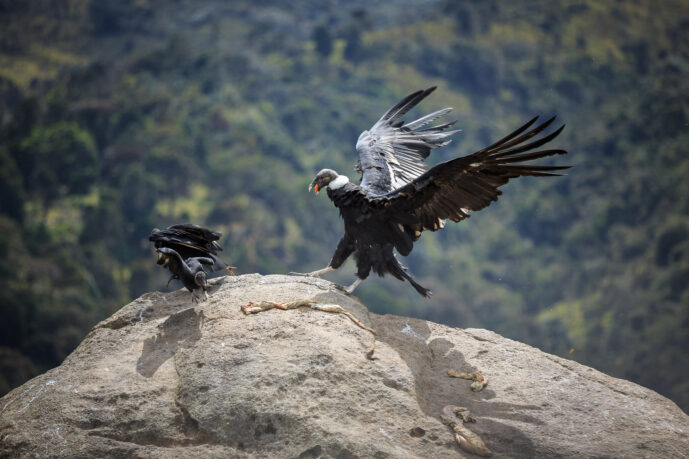
- Key Feature: Massive wingspan, white feather ruff at the neck base, and a prominent fleshy caruncle (comb) on the male's head
- Primary Diet: Scavenger (Obligate carnivore consuming large mammalian carrion)
- Range: Andes Mountains and adjacent Pacific coasts of western South America
- Habitat: High-altitude montane grasslands, alpine regions up to 5,000 m (16,000 ft), and coastal cliffs
- Social Structure: Gregarious at carcasses and communal roosts; strictly monogamous breeding pairs
- Nesting/Breeding: Inaccessible rock ledges, crevices, or caves on steep cliff faces
- Conservation Status: Vulnerable (VU)
- Population Trend: Decreasing
The Andean Condor (*Vultur gryphus*) is a majestic symbol of the South American Andes and ranks among the largest flying birds in the world, boasting a massive wingspan that can reach over ten feet. This impressive scavenger is easily recognized by its striking black plumage contrasted with a fluffy white ruff around its neck and, in males, a prominent fleshy crest called a caruncle atop its featherless, reddish-pink head. Uniquely adapted for high-altitude soaring, the condor utilizes thermal air currents to glide effortlessly for hours without flapping its wings, scanning the rugged terrain below with exceptionally keen eyesight. As a long-lived species that can survive for over 70 years, it plays a vital ecological role as nature’s cleanup crew and holds profound cultural significance as the "King of the Skies" in indigenous Andean mythology.
Habitats et répartition
This species is distributed throughout the Andes Mountains of South America, stretching from Venezuela and Colombia in the north to Tierra del Fuego at the southern tip of the continent. While its presence is more sparse and fragmented in the northern part of its range, it remains more common in the southern regions of Chile and Argentina. In these southern latitudes, the bird often expands its territory from the high mountains down to the sea-level cliffs of the Atlantic and Pacific coasts. The bird primarily inhabits high-altitude open spaces, including alpine tundras, grasslands, and montane regions up to 5,000 meters above sea level. It favors vast landscapes such as the páramo and pampas, where it utilizes thermal updrafts to soar while searching for food. For nesting and communal roosting, it relies on inaccessible rocky ledges and steep cliff faces that provide safety from terrestrial predators and unobstructed access to the air.
Comportements & Reproduction
These birds maintain a strict social hierarchy, often determined by sex and age, where males typically dominate females and adults hold seniority over juveniles at communal feeding sites and roosts. They are monogamous and form long-term pair bonds that can last for many years. Courtship is a visual spectacle involving the male spreading his wings, inflating his neck, and emitting various hissing sounds while the skin on his head and neck changes color to signify readiness. Reproduction is characterized by an exceptionally slow pace, with pairs typically producing only one egg every second year. They do not build traditional nests, instead laying their single egg directly on inaccessible cliff ledges or in small caves. Both parents share the responsibilities of incubation and feeding the chick. Because the young take a long time to develop, they often remain dependent on their parents for up to two years, a strategy that ensures high survival rates despite the low frequency of offspring.
Alimentation
The Andean Condor is an obligate scavenger, meaning its diet consists almost exclusively of carrion from large mammals. In their mountainous habitats, they primarily feed on the remains of wild animals like guanacos and deer, as well as domesticated livestock such as cattle and sheep, while those living near the coast may scavenge on dead seals or whales. These birds play a vital ecological role by consuming decaying carcasses, which helps prevent the spread of diseases within their environment. Interestingly, unlike some other vulture species, Andean Condors lack a highly developed sense of smell and instead rely on their keen eyesight and the behavior of other scavengers to locate food. Because food sources can be unpredictable, they are capable of fasting for several days, but when a carcass is found, they can consume several pounds of meat in a single meal, sometimes becoming so gorged that they are temporarily unable to take flight.
Couleurs
The Andean Condor is primarily clad in black plumage, accented by a distinctive white downy ruff at the base of the neck and large white patches on the upper wings. Its featherless head and neck exhibit skin tones ranging from pale pink to deep reddish-orange, which can change hue to signal emotional states. Males are distinguished by a large dark red fleshy crest, while juveniles lack these bold contrasts, sporting a uniform brownish-gray coloration for subtle camouflage until maturity.
Faits amusants
The Andean Condor is a master of the skies that can soar for over 100 miles without a single wingbeat, relying almost entirely on thermal updrafts to stay aloft. To keep cool, these giants practice urohidrosis, a behavior where they purposefully defecate on their own legs to lower their body temperature through evaporation. They are also surprisingly silent because they lack a syrinx—the vocal organ of birds—meaning they can only produce hisses or clucking sounds. Furthermore, their bare facial skin acts as a biological mood ring, flushing different shades of pink or yellow to communicate emotional shifts during social interactions.