Black-collated Hawk
Busarellus nigricollis
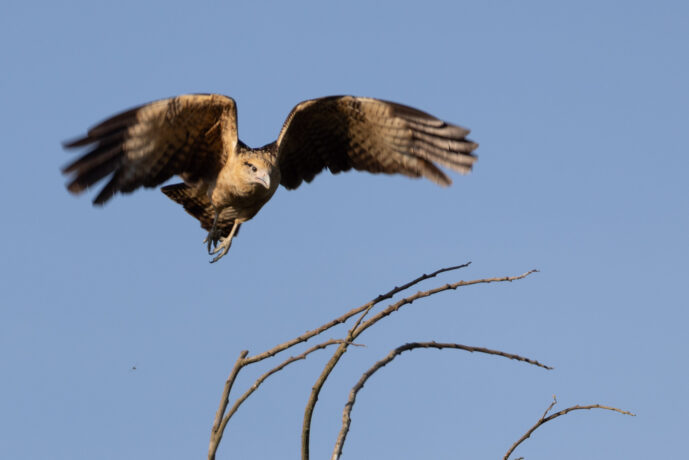
Quick Facts
- Scientific Name: Busarellus nigricollis
- Family: Accipitridae
- Known Nicknames: Black-collared Hawk, Fishing Hawk, Gavião-belo, Gavilán colorado
- Average Length: 45–51 cm / 18–20 in
- Average Weight: 390–825 g / 13.8–29.1 oz
- Wingspan: 115–143 cm / 45–56 in
- Key Feature: Bright rufous-cinnamon plumage with a prominent black crescent-shaped collar on the upper breast and a whitish head
- Primary Diet: Piscivore (primarily fish, supplemented by aquatic insects and snails)
- Range: Central and South America, from central Mexico south to northern Argentina and Uruguay
- Habitat: Lowland freshwater wetlands, marshes, swamps, and mangrove edges
- Social Structure: Solitary or in monogamous pairs
- Nesting/Breeding: Bulky stick nests constructed in trees or mangroves, typically over or near water
- Statut de conservation : Préoccupation mineure (LC)
- Population Trend: Decreasing
The Black-collared Hawk (*Busarellus nigricollis*) is a striking raptor of the Neotropical wetlands, easily identified by its vibrant chestnut-orange plumage, creamy-white head, and the distinct black crescent-shaped "collar" across its upper breast. Perfectly adapted for a life near the water, this hawk is a specialized fisherman; it possesses unique, sand-paper-like spicules on the soles of its feet—similar to those of an Osprey—which provide a non-slip grip on its slimy, aquatic prey. With unusually broad wings and a short, squared tail, it excels at low-altitude maneuvers over marshes and mangroves, where it can be seen perched prominently before plunging its talons into the water to snatch a meal, making it both a visual standout and a master of its watery domain.
Habitats et répartition
This species is primarily found in lowland wetland environments, favoring areas with slow-moving or stagnant water. Its typical habitats include freshwater marshes, swamps, wet savannas, mangrove edges, and the margins of large rivers and lagoons. It requires open landscapes with scattered trees or bushes that provide suitable perching sites for hunting and nesting near the water's surface. Geographically, its range spans the Neotropics, extending from central Mexico southward through Central America. In South America, it is widely distributed east of the Andes, reaching as far south as northern Argentina, Uruguay, and southern Brazil. While widespread across these regions, it remains closely tied to permanent water sources throughout its extensive territory.
Comportements & Reproduction
This raptor is primarily solitary or observed in monogamous pairs, spending much of its time perched on low branches overhanging water to hunt fish. Its specialized feet, equipped with small spines called spicules, allow it to securely grasp slippery prey, a behavior often followed by returning to a favored perch to consume the catch. During the breeding season, pairs engage in aerial displays and vocalizations to maintain their bond and defend their territory against intruders. Reproduction typically involves constructing a bulky stick nest lined with green leaves, situated high in a tree or mangrove overlooking a swamp or marsh. The female usually lays a single egg, though clutches of two are possible, which are incubated by both parents. The timing of their reproductive cycle is often synchronized with local seasonal flooding, ensuring that high concentrations of fish are available to sustain the offspring during their most demanding growth phases.
Alimentation
The Black-collared Hawk is a specialized piscivore that primarily feeds on small to medium-sized fish found near the surface of freshwater marshes, swamps, and mangroves. While its diet is heavily dominated by fish, it occasionally supplements its intake with aquatic insects, snails, frogs, and small lizards. One of the most fascinating aspects of its hunting biology is the presence of specialized, rough scales called spicules on the undersides of its toes, an evolutionary adaptation similar to that of the Osprey which allows it to maintain a firm grip on slippery, wriggling prey. This raptor typically employs a "sit-and-wait" hunting strategy, scanning the water from a low-hanging branch before executing a swift, shallow dive to snatch its meal with its talons without ever fully submerging its body.
Couleurs
The Black-collared Hawk is characterized by a vibrant cinnamon-rufous body and a pale, whitish head marked by a prominent black crescent-shaped "collar" on the lower throat. Its flight feathers and tail are primarily black, with the latter featuring thin reddish bands, while fine dark streaks often pattern its crown. This bold, high-contrast plumage makes it easily identifiable against the open, marshy landscapes where it hunts.
Faits amusants
This specialized fisherman features sandpaper-like spikes on the soles of its feet called spicules, a rare adaptation shared with Ospreys that provides a non-slip grip on slimy, wriggling fish. Unlike many raptors with strongly curved talons, this hawk possesses unusually long, straight claws that act like gaff hooks to snatch prey directly from the water's surface. It is also known for its patient hunting style, often perching on low branches just inches above the water and occasionally using its broad wings to shade the surface, a behavior that reduces glare and allows it to peer deeper into the murky wetlands for its next meal.