Black-headed parrot
Pionites melanocephalus
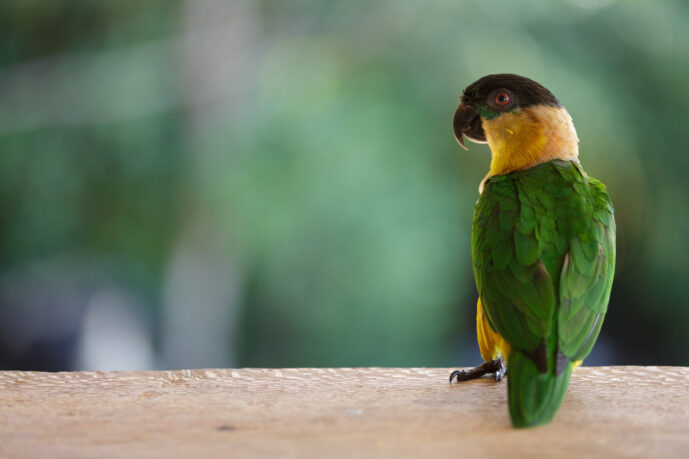
Quick Facts
- Scientific Name: Pionites melanocephalus
- Family: Psittacidae
- Known Nicknames: Black-headed Caique, Black-capped Caique, Seven-colored Parrot
- Average Length: 23–25 cm / 9–10 in
- Average Weight: 130–170 g / 4.6–6.0 oz
- Wingspan: 45–50 cm / 18–20 in
- Key Feature: Distinctive black crown and forehead with a white breast and orange-yellow thighs
- Primary Diet: Primarily Frugivore and Granivore
- Range: Amazon Basin north of the Amazon River, including parts of Brazil, Colombia, Ecuador, Peru, Venezuela, and the Guianas
- Habitat: Lowland Tropical Rainforest Canopy and Forest Edges
- Social Structure: Highly Social, typically found in pairs or small noisy flocks
- Nesting/Breeding: Tree Hollows
- Statut de conservation : Préoccupation mineure (LC)
- Population Trend: Decreasing
The Black-headed parrot (*Pionites melanocephalus*), affectionately dubbed the "clown of the parrot world," is a vibrant and high-energy bird native to the lush forests of the Amazon Basin. It is instantly recognizable by its striking, tri-colored plumage: a jet-black cap atop its head, bright orange-yellow cheeks and thighs, and a crisp white belly that contrasts beautifully with its forest-green wings and blue-tinged flight feathers. Beyond its "seven-colored" appearance, this parrot is celebrated for its unique, eccentric behaviors; unlike many birds, it often prefers hopping like a wind-up toy rather than flying and is famous for "surfing," a playful habit of rubbing its body against soft foliage or fabrics. With its bold personality and athletic prowess, the Black-headed parrot is a charismatic standout that combines stunning tropical aesthetics with a remarkably spirited and inquisitive nature.
Habitats et répartition
This species is native to the Amazon Basin north of the Amazon River, spanning across northern Brazil, southern Venezuela, the Guianas, Colombia, Ecuador, and northeastern Peru. Its geographical range is primarily concentrated in lowland areas, typically occurring at elevations below 1,100 meters. Within this region, it inhabits humid tropical environments, including primary rainforests, forest edges, and gallery forests located near watercourses. It is almost exclusively arboreal, spending the majority of its time in the high canopy where it finds food and nesting sites. While it occasionally utilizes secondary growth forests, it generally avoids open country and heavily degraded habitats, preferring dense, lush vegetation.
Comportements & Reproduction
These highly social birds typically congregate in noisy, energetic flocks of ten to thirty individuals, maintaining a complex hierarchy through frequent vocalizations and physical play. Renowned for their acrobatic nature, they engage in mutual preening and "leaf-surfing" to strengthen group cohesion. Within these larger communities, they form strong, lifelong monogamous pair bonds, with mates remaining in close proximity while foraging or roosting to reinforce their connection. During the breeding season, pairs select high tree cavities or abandoned woodpecker holes to serve as nesting sites. The female typically lays a clutch of two to four eggs, which she alone incubates for approximately 25 to 27 days while the male provides her with food and guards the territory. A key reproductive strategy is the intensive biparental care provided to the altricial chicks; both parents share the duty of feeding and protecting the young until they fledge at around ten weeks of age.
Alimentation
The diet of the Black-headed parrot primarily consists of a diverse array of seeds, seasonal fruits, berries, and nuts sourced from the high canopies of the Amazonian rainforest. These energetic birds also supplement their nutritional intake by consuming flowers and occasionally small insects to provide necessary protein. One of the most fascinating aspects of their dietary habits is their practice of geophagy; they are frequently observed visiting clay licks along riverbanks to ingest mineral-rich soil, which is believed to help neutralize toxins and secondary compounds found in the unripe fruits and seeds they consume. Additionally, they are highly acrobatic foragers, often seen hanging completely upside down by a single foot to reach succulent fruits on the outermost tips of branches that would otherwise be inaccessible to heavier competitors.
Couleurs
The black-headed parrot features a jet-black crown, bright orange-yellow cheeks and nape, and a distinct white breast and belly. Its wings and back are vibrant green for canopy camouflage, complemented by orange thighs and blue-tipped primary feathers. This high-contrast plumage is finished with a solid black beak and dark grey feet.
Faits amusants
Often called the "clowns of the bird world," these parrots are famous for their signature "caique hop," a rhythmic, two-footed jumping motion they use to get around instead of walking or flying. They exhibit a unique behavior known as "surfing," where they vigorously rub their bodies against wet leaves or even human hair to bathe and preen. Unlike many other bird species, they frequently play on their backs, wrestling with toys or companions using their powerful, dexterous feet. They are also remarkably tactile and social, often engaging in "beak wrestling" matches as a form of bonding and play.