Blue morpho
Morpho peleides
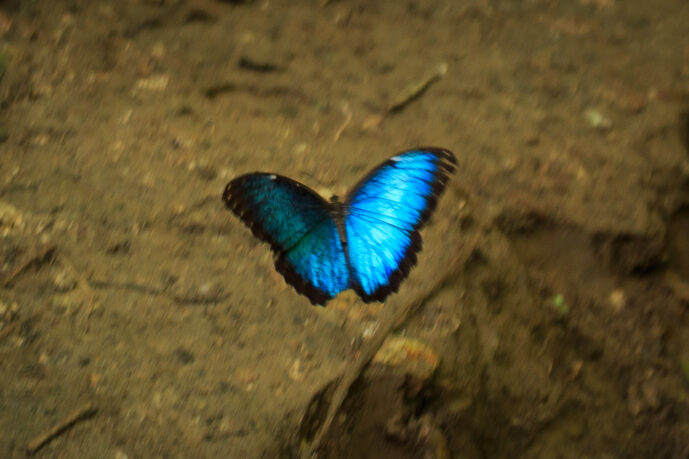
Quick Facts
- Scientific Name: Morpho peleides
- Family: Nymphalidae
- Known Nicknames: Common Morpho, Peleides Blue Morpho, The Emperor
- Average Length: 7.5–10 cm / 3–4 in
- Average Weight: 0.5–1 g / 0.018–0.035 oz
- Wingspan: 12.7–20 cm / 5–8 in
- Key Feature: Iridescent bright blue upper wing surfaces created by microscopic structural scales
- Primary Diet: Frugivore (fermenting fruit, tree sap, and decomposing organic matter)
- Range: Central and South America (Mexico through Colombia, Venezuela, and Paraguay)
- Habitat: Tropical Rainforest Understory and Canopy
- Social Structure: Solitary
- Nesting/Breeding: Underside of host plant leaves (primarily Leguminosae family)
- Conservation Status: Not Evaluated (NE)
- Population Trend: Stable
The Blue morpho (*Morpho peleides*) is one of the most mesmerizing insects found in the tropical rainforests of Central and South America, renowned for its massive wingspan and electric, iridescent blue color. Interestingly, this vivid hue is not caused by pigment but by structural coloration, where microscopic scales on the topside of the wings reflect light to create a shimmering, metallic effect. In stark contrast, the undersides are a dull, mottled brown adorned with large, decoy "eyespots," providing clever camouflage against predators when the butterfly is at rest. This dramatic difference creates a rhythmic "flashing" appearance during flight, making it exceptionally difficult for birds to track them through the sun-dappled canopy. Beyond their striking beauty, these butterflies possess a unique diet, utilizing a long proboscis to sip juices from fermenting fruit and tree sap rather than feeding on traditional flower nectar.
Habitats et répartition
This species is native to the Neotropical realm, with a geographical range that spans from Mexico through Central America and into northern South America, including countries such as Colombia, Venezuela, and parts of Paraguay. It is widely distributed across these regions, thriving in various lowland environments from sea level up to approximately 1,400 meters. It primarily inhabits the moist, humid conditions of tropical rainforests, although it can also be found in drier deciduous forests. Within these ecosystems, it is frequently observed in sun-drenched clearings, along the edges of the forest, and near bodies of water like rivers and streams. While it spends much of its time in the lower layers of the canopy, it often descends to the forest floor to feed or navigate through the understory.
Comportements & Reproduction
Primarily solitary and diurnal, these butterflies spend much of their time patrolling the forest understory and edges. Males are particularly territorial, establishing "flyways" along rivers or forest paths where they use the brilliant, iridescent flashing of their wings to communicate. This visual display serves a dual purpose: it warns rival males to stay away and attracts potential mates. Unlike many other lepidopterans, they do not feed on floral nectar, instead congregating around fermenting fruit or tree sap to consume nutrient-rich fluids. Reproduction begins with a high-speed aerial courtship initiated by the male. Once mated, the female deposits small, lime-green eggs on the underside of host plants, primarily within the Leguminosae family. A unique aspect of their reproductive strategy is the defensive nature of the larvae; the caterpillars are reddish-brown with bright patches and possess specialized glands that release a rancid odor to deter predators. They also exhibit occasional cannibalism if resources are scarce. The entire life cycle, from egg to the emergence of the adult from its camouflaged chrysalis, typically lasts around 115 days.
Alimentation
The Blue morpho butterfly undergoes a dramatic dietary transition from its larval stage to adulthood, beginning as a caterpillar that feeds voraciously on the leaves of plants within the pea family. Once it reaches its adult form, it ceases to eat solid food entirely, relying instead on a specialized proboscis to sip nutrient-rich liquids. Remarkably, this species rarely visits flowers for nectar, preferring instead the juices of fermenting fruits, oozing tree sap, and even the fluids from decomposing organic matter or moist fungi. An intriguing adaptation of the Blue morpho is the presence of chemoreceptors on its feet, which essentially allow the butterfly to taste its food upon landing. By walking over a potential food source, it can determine the presence of sugars and minerals before deciding to unfurl its proboscis and feed.
Couleurs
The *Morpho peleides* features brilliant, iridescent blue upper wings edged in black, a hue created by structural light reflection rather than pigment. In contrast, the undersides are a cryptic dull brown adorned with large, defensive eyespots, providing camouflage against tree bark and deterring predators when the wings are closed. This dramatic color shift creates a "flash" effect during flight that confuses pursuers.
Faits amusants
The Blue morpho’s brilliant color is actually an optical illusion; its wings contain no blue pigment but instead feature microscopic, diamond-shaped scales that reflect light to create a shimmering iridescent effect. To evade predators, these butterflies utilize a "flashing" flight pattern, rapidly alternating between their glowing blue tops and dull brown, eyespot-covered undersides to appear as if they are vanishing and reappearing. Interestingly, they rarely visit flowers and instead prefer to feed on the juices of fermenting fruit, decomposing animals, and wet mud. They navigate their environment by "tasting" with sensors on their legs and using their antennae to detect air currents and pheromones.