Blue-naped Chlorophonia
Chlorophonia cyanea
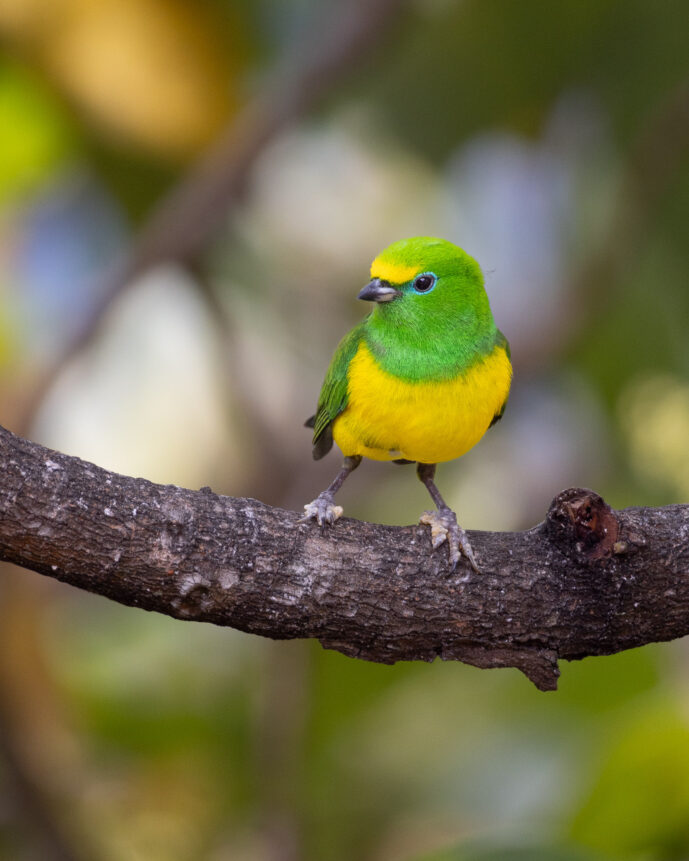
Quick Facts
- Scientific Name: Chlorophonia cyanea
- Family: Fringillidae
- Known Nicknames: Gaturamo-bandeira, Blue-naped Euphonia
- Average Length: 11–12 cm / 4.3–4.7 in
- Average Weight: 11–15 g / 0.39–0.53 oz
- Wingspan: 18–21 cm / 7.1–8.3 in
- Key Feature: Bright green plumage with a distinctive turquoise-blue nape, mantle, and eye-ring
- Régime alimentaire principal : Principalement frugivore
- Range: South America, including the Andes (Venezuela to Bolivia) and the Atlantic Forest (Brazil, Paraguay, Argentina)
- Habitat: Humid montane forests, canopy of tropical evergreen forests, and forest edges
- Social Structure: Pairs or small groups; frequently joins mixed-species foraging flocks
- Nesting/Breeding: Globular moss nests with side entrances built in epiphytes or tree forks
- Statut de conservation : Préoccupation mineure (LC)
- Population Trend: Decreasing
The Blue-naped Chlorophonia (*Chlorophonia cyanea*) is a small, jewel-toned songbird native to the humid forests of South America, renowned for its breathtakingly vivid plumage. This stocky, finch-like bird is instantly recognizable by the male’s brilliant lime-green body, which contrasts sharply with a radiant sky-blue nape and mantle and a sun-yellow belly. While the females are more subtly colored in olive tones, both sexes possess a charmingly plump silhouette and a short, squared tail. A specialized frugivore, this species is particularly famous for its reliance on mistletoe berries, which it deftly harvests while navigating the high canopy in small, social groups. With its rhythmic, whistling calls and its habit of moving like a vibrant flash of emerald and sapphire through the foliage, the Blue-naped Chlorophonia is a true masterpiece of tropical biodiversity.
Habitats et répartition
This species maintains a disjunct distribution across South America, primarily concentrated in three distinct regions: the Andes and coastal mountains from Venezuela and Colombia southward to Bolivia; the tepui highlands of southern Venezuela, Guyana, and northern Brazil; and the Atlantic Forest region spanning southeastern Brazil, eastern Paraguay, and northeastern Argentina. It is typically found at elevations ranging from 500 to 2,500 meters, though it may occur at sea level in the southern parts of its range. Its preferred habitats include humid montane forests, cloud forests, and dense secondary growth. While it primarily occupies the canopy and sub-canopy of primary forests, it frequently ventures into forest edges, clearings with scattered trees, and occasionally shaded plantations or mature gardens. Its presence in these environments is closely tied to the availability of mistletoe and various fruiting trees, which serve as its primary food sources.
Comportements & Reproduction
These birds are primarily social and are often observed in pairs or small, active groups, frequently joining mixed-species foraging flocks in the forest canopy. They are largely arboreal and move with agility through the foliage to feed on mistletoe berries and other small fruits. While generally peaceful, they maintain pair bonds through vocalizations and subtle physical displays, and they exhibit a specialized digestive system adapted for processing fleshy fruits while dispersing seeds. During the breeding season, they form monogamous pairs and construct distinctive dome-shaped nests with a side entrance, often camouflaging them within moss, epiphytes, or tree cavities. The female typically lays a clutch of two to three eggs. A notable reproductive strategy is the shared responsibility of chick-rearing; while the female performs most of the incubation, both parents participate in feeding the young a diet of regurgitated fruit pulp and occasional insects, ensuring the rapid development of the fledglings.
Alimentation
The Blue-naped Chlorophonia is primarily a frugivorous bird with a highly specialized diet that centers on small fruits and berries, particularly those from the mistletoe family. While it occasionally supplements its nutrition with insects and larvae, its digestive system is uniquely adapted to process the sticky berries of mistletoes, which it consumes in large quantities. An interesting aspect of its feeding behavior is its role as a key seed disperser; the bird processes the fruit pulp rapidly and excretes the seeds in a way that allows them to stick to tree branches, facilitating the growth of new mistletoe plants. Often found foraging in the high canopy, these birds frequently join mixed-species flocks to locate seasonal fruiting trees, such as figs, demonstrating a high level of efficiency in navigating the forest for energy-rich food sources.
Couleurs
The Blue-naped Chlorophonia features vibrant lime-green plumage that provides effective camouflage within sun-dappled tropical canopies. It is distinguished by a striking sky-blue nape, mantle, and rump, complemented by a turquoise eye-ring. While females are predominantly green with a subtle blue neck wash, males display a brilliant yellow belly, creating a high-contrast pattern used for species recognition amidst dense foliage.
Faits amusants
Despite their neon-bright plumage, these birds are surprisingly difficult to spot because their lime-green bodies blend perfectly with sun-dappled leaves. They are specialized mistletoe enthusiasts with a lightning-fast digestive system that processes berries in mere minutes; the sticky seeds pass through them unharmed and are "planted" onto new branches when the bird wipes its vent against the bark. These finch-like tanagers are also impressive acrobats, frequently hanging completely upside down to pluck fruit from the undersides of twigs. Their high-pitched, metallic whistles are so thin and piercing that they are often mistaken for the buzzing of local insects rather than the song of a bird.