Bothrops Asper
Bothrops asper
Quick Facts
- Scientific Name: Bothrops asper
- Family: Viperidae
- Known Nicknames: Fer-de-lance, Terciopelo, Barba Amarilla, Ultimate Pit Viper, Nauyaca
- Average Length: 120–180 cm / 47–71 in
- Average Weight: 1.5–6 kg / 3.3–13.2 lb
- Wingspan: N/A
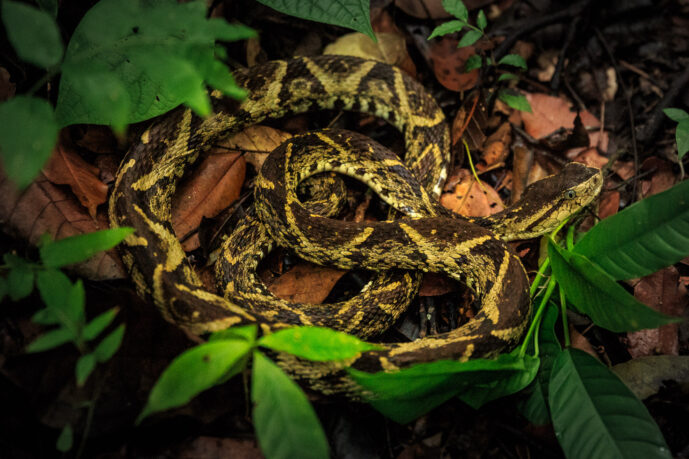
- Key Feature: Broad, triangular head and a pattern of dark-edged triangles or 'X' shapes along the flanks
- Primary Diet: Carnivore (Small mammals, birds, amphibians, and reptiles)
- Range: Southern Mexico through Central America to Northern South America (Colombia, Ecuador, Venezuela)
- Habitat: Lowland tropical rainforests, moist evergreen forests, and agricultural plantations
- Social Structure: Solitary
- Nesting/Breeding: Terrestrial (Ovoviviparous; gives birth to live young in leaf litter or dense vegetation)
- Statut de conservation : Préoccupation mineure (LC)
- Population Trend: Stable
The *Bothrops asper*, commonly known as the terciopelo or fer-de-lance, is a formidable pit viper native to the humid lowlands of Central and South America. Renowned as one of the most medically significant snakes in the Neotropics, it is easily identified by its broad, lance-shaped head and a distinctive dorsal pattern of dark triangles or "X" shapes set against a brown or olive-gray background. A key physical trait is its pale yellow chin, earning it the nickname "barba amarilla" in many regions. Beyond its striking appearance, the *Bothrops asper* possesses specialized loreal pits—heat-sensing organs located between the eyes and nostrils—that allow it to strike warm-blooded prey with lethal precision even in total darkness. As a highly adaptable generalist, it is both respected and feared for its impressive size, often exceeding two meters, and its notoriously defensive temperament.
Habitats et répartition
This species is widely distributed across the Neotropics, ranging from northeastern Mexico through Central America and into northwestern South America, including Colombia, Ecuador, and parts of Venezuela. It primarily occupies lowland regions, typically found from sea level up to elevations of approximately 1,200 to 1,500 meters. It thrives in a diverse array of environments, most notably tropical rainforests and evergreen forests, though it is also highly adaptable to seasonal dry forests. The species frequently inhabits disturbed landscapes, such as agricultural plantations, pastures, and areas near human dwellings, often showing a preference for moist microhabitats near rivers or streams.
Comportements & Reproduction
*Bothrops asper* is a primarily solitary and nocturnal predator that utilizes a sit-and-wait ambush strategy, relying on its cryptic coloration to blend into the forest floor. It lacks a formal social structure, with individuals generally avoiding one another except during the mating season. When threatened, it is known for its highly defensive and unpredictable nature, often striking repeatedly if it cannot escape. While mostly terrestrial, it is also a capable swimmer and climber, adapting its behavior to various environments within its range. The reproductive cycle is ovoviviparous, meaning females give birth to live young after an internal gestation period. Mating often coincides with the onset of the rainy season, and females have the unique ability to store sperm for extended periods, allowing them to time the birth of their offspring with peak prey availability. This species is exceptionally prolific, producing some of the largest litters among vipers, with a single female capable of birthing up to 80 or more neonates. These young are born fully independent and possess potent venom from birth, requiring no parental care for survival.
Alimentation
Bothrops asper is a highly versatile and opportunistic generalist predator with a diet that undergoes a significant ontogenetic shift as the snake matures. Juveniles primarily target ectothermic prey, such as small frogs, lizards, and even large insects, often employing a fascinating behavior known as caudal luring where they wiggle their brightly colored tail tips to mimic worms and attract unsuspecting meals. As they grow into adults, their dietary preference shifts toward endothermic prey, including a wide variety of small mammals like rodents and opossums, as well as birds and occasionally other snakes. Interestingly, these vipers are capable of consuming prey that weighs significantly more than themselves, and their potent venom not only immobilizes the target but also initiates the digestive process from the inside out by breaking down tissues before the meal is even swallowed. Furthermore, while they are primarily ambush hunters that wait patiently for prey to cross their path, they have been known to exhibit cannibalistic tendencies, particularly in environments where resources are scarce.
Couleurs
Bothrops asper features a base coloration of olive, gray, or brown, overlaid with a series of dark, pale-bordered lateral triangles or "X" markings that provide expert camouflage against forest leaf litter. A prominent dark stripe extends behind each eye, while juveniles often possess a distinct yellow tail tip used for caudal luring.
Faits amusants
Bothrops asper is a master of deception, utilizing a bright yellow tail tip as a juvenile to perform "caudal luring," where it wiggles its tail to mimic a worm and trick small frogs or lizards into range. Unlike many other snakes, these pit vipers are incredibly prolific breeders, capable of giving birth to record-breaking litters of up to 100 live young at once. They are also equipped with sophisticated heat-sensing pits located between their eyes and nostrils, allowing them to "see" the thermal signatures of warm-blooded prey even in total darkness. Additionally, when threatened, they frequently vibrate their tails against dry leaves to create a loud buzzing sound, a clever bluff that mimics the warning of a rattlesnake to ward off potential predators.