Jabiru Stork
Jabiru mycteria
Quick Facts
- Scientific Name: Jabiru mycteria
- Family: Ciconiidae
- Known Nicknames: Jabiru, Garzón Soldado, Tuyuyu
- Average Length: 120–140 cm / 47–55 in
- Average Weight: 4.3–9 kg / 9.5–20 lb
- Wingspan: 230–280 cm / 91–110 in
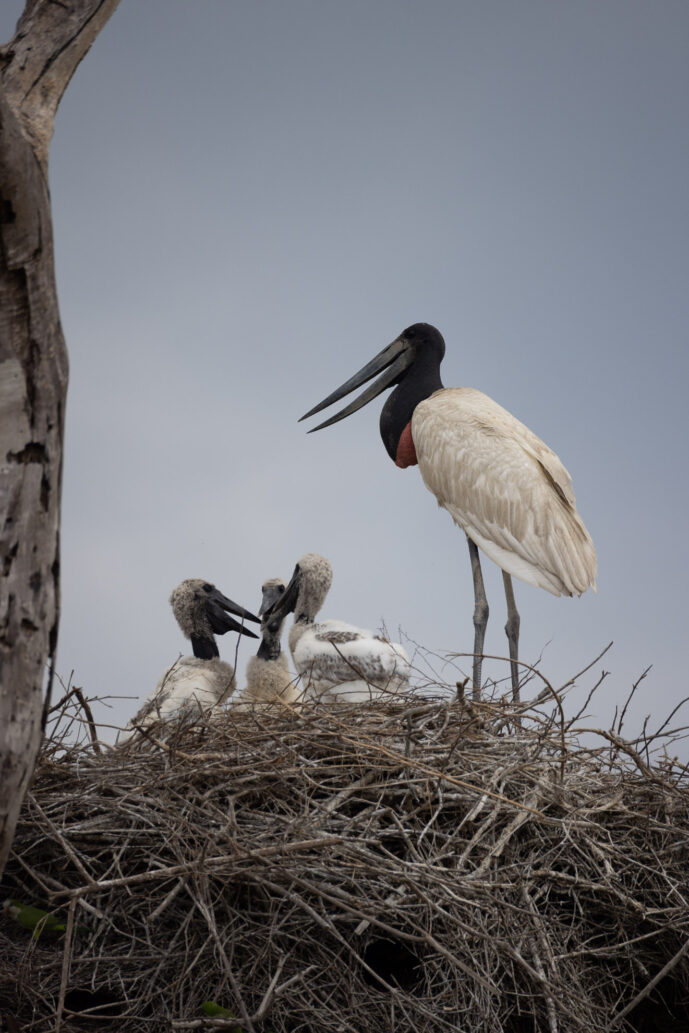
- Key Feature: Massive slightly upturned black bill and a naked black neck with a bright red stretchable gular pouch
- Primary Diet: Carnivore (Fish, mollusks, amphibians, reptiles, and small mammals)
- Range: Central and South America, from Southeastern Mexico to Northern Argentina
- Habitat: Freshwater marshes, wet savannas, and seasonally flooded wetlands
- Social Structure: Solitary or in pairs; occasionally forms loose groups for feeding
- Nesting/Breeding: Large platform nests made of sticks located high in tall trees
- Statut de conservation : Préoccupation mineure (LC)
- Population Trend: Stable
The Jabiru Stork (*Jabiru mycteria*) stands as the tallest flying bird in the Americas, a majestic sentinel of the wetlands characterized by its massive stature and striking monochromatic appearance. Reaching heights of five feet with a staggering nine-foot wingspan, this stork is instantly recognizable by its snow-white plumage, featherless black head, and a heavy, slightly upturned bill designed for precision hunting. Its most iconic feature is the vibrant red, inflatable throat pouch—or gular sac—at the base of its neck, which deepens in color during social displays or moments of territorial excitement. Named from a Tupi-Guarani term meaning "swollen neck," the Jabiru is both a powerful flier and a formidable predator, perfectly adapted for life in the expansive marshes and lagoons of Central and South America.
Comportements & Reproduction
These birds are primarily solitary or found in pairs, though they may congregate in large groups at shrinking pools to feed on concentrated fish populations. During the breeding season, they become highly territorial, using rhythmic bill-clattering—a sound produced by rapidly snapping their mandibles—to communicate and defend their space. This behavior also serves as an essential component of their courtship displays and pair-bonding rituals. Forming monogamous bonds that often persist across multiple seasons, they construct massive platform nests in the canopy of tall trees, frequently reusing and enlarging the same structure year after year. Breeding is timed to coincide with the dry season, ensuring that receding water levels provide an easy harvest of prey for their young. Both parents participate equally in incubating the eggs and provisioning the chicks, often carrying water in their bills to keep the nestlings cool and hydrated in the tropical heat.
Alimentation
The Jabiru stork is a generalist carnivore with a diverse diet primarily consisting of fish, mollusks, and amphibians, though it also opportunistically consumes reptiles like snakes and small caimans, as well as insects and small mammals. Utilizing its massive, slightly upturned bill, this stork employs a tactile hunting method known as bill-snapping, where it wades through shallow water and snaps its beak shut instantly upon sensing prey through touch rather than sight. An interesting aspect of its feeding behavior is how it capitalizes on the seasonal drying of wetlands, particularly in the Pantanal, where it gathers in large groups to feast on concentrated prey trapped in receding pools. Furthermore, while they are skilled hunters, Jabiru storks are known to be highly opportunistic, sometimes scavenging for carrion or stealing food from other wading birds to supplement their intake.
Couleurs
The Jabiru Stork features entirely white plumage contrasted by a featherless black head and upper neck. A signature bright red distensible pouch circles the base of its throat, while its massive bill and long legs are solid black. Juveniles exhibit muted grayish-brown feathers for camouflage before maturing into their stark adult coloration.