Collared Aracari
Pteroglossus torquatus
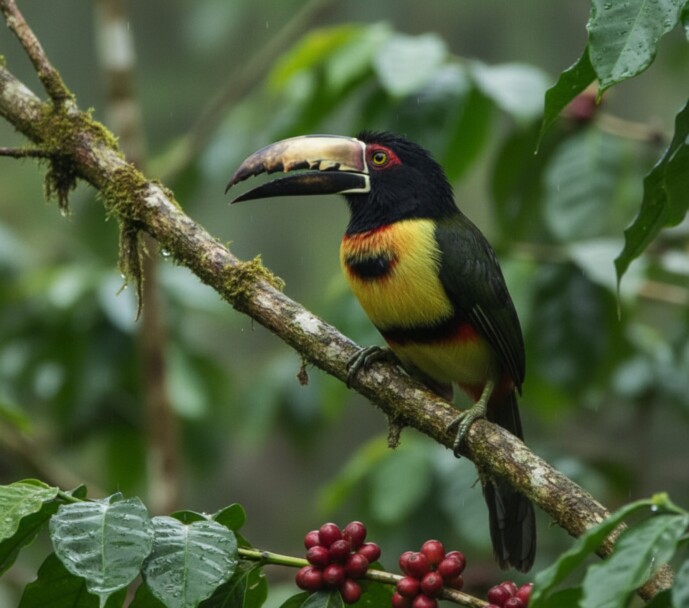
Quick Facts
- Scientific Name: Pteroglossus torquatus
- Family: Ramphastidae
- Known Nicknames: Banded Aracari, Ringed Aracari
- Average Length: 39–41 cm / 15.5–16 in
- Average Weight: 190–275 g / 6.7–9.7 oz
- Wingspan: 45–55 cm / 18–22 in
- Key Feature: Pale, saw-toothed upper mandible and a narrow reddish-brown collar on the hindneck
- Primary Diet: Primarily Frugivorous, also consumes insects, small lizards, and bird eggs
- Range: Southern Mexico through Central America to Northern Colombia and Northwestern Ecuador
- Habitat: Lowland tropical rainforests, gallery forests, and mature secondary growth
- Social Structure: Highly Social, typically traveling and roosting in groups of 6–15 individuals
- Nesting/Breeding: Tree hollows, frequently abandoned woodpecker holes
- Statut de conservation : Préoccupation mineure (LC)
- Population Trend: Decreasing
The Collared Aracari is a vibrant and charismatic member of the toucan family, instantly recognizable by its striking yellow underparts marked with a bold black chest spot and a horizontal reddish-black belly band. Its most distinctive physical feature is its large, saw-toothed beak, which possesses unique serrated edges used for plucking tropical fruits, complemented by a namesake cinnamon-colored collar encircling its dark nape. With piercing yellow eyes and glossy black plumage, this social bird is often found traveling in noisy family groups through the forest canopies of Central and South America. Perhaps its most fascinating behavior is its communal roosting habit, where up to half a dozen individuals will squeeze into a single tree cavity, neatly folding their long tails over their backs to conserve space in a remarkable display of avian cooperation.
Habitats et répartition
This species occupies a broad geographical range extending from southern Mexico through Central America into northwestern Colombia and western Ecuador. Within this territory, it is primarily found in tropical lowlands, typically occurring at elevations from sea level up to approximately 1,200 meters. It thrives in a variety of wooded environments, including humid evergreen forests, gallery forests, and advanced second-growth woodlands. While it prefers the canopy and mid-levels of the forest, it frequently ventures into forest edges, clearings with scattered trees, and even cacao or fruit plantations, demonstrating a degree of adaptability to modified landscapes.
Comportements & Reproduction
Highly social and gregarious, these birds typically live and forage in small family groups of six to fifteen individuals. They exhibit a unique communal roosting behavior where several adults sleep together in the same tree cavity, often folding their long tails over their backs to conserve space. While they generally form monogamous pairs, they employ a cooperative breeding strategy. This involves "helpers"—usually offspring from previous clutches or other non-breeding adults—who assist the primary parents in defending the nest and provisioning the chicks with a diet of fruit and insects. Nesting occurs high in the canopy within abandoned woodpecker holes or natural tree hollows. Both parents share the responsibilities of incubating the three to four white eggs and maintaining the nest's cleanliness. The presence of multiple caregivers significantly increases the survival rate of the fledglings, as the group provides constant vigilance against predators. This social cohesion is maintained year-round through mutual preening and shared foraging efforts, reinforcing the bonds within the group.
Alimentation
The Collared Aracari is primarily frugivorous, subsisting on a diverse array of fleshy fruits from forest trees such as palms and figs, which allows it to play a vital role as a seed disperser within its tropical ecosystem. While fruit makes up the bulk of its intake, this species is a highly opportunistic omnivore that supplements its diet with protein-rich insects, small lizards, and frogs. One of the most fascinating and perhaps ruthless aspects of its feeding behavior is its role as a significant nest predator; it frequently raids the nests of other birds to consume eggs and even live nestlings. To handle such a varied menu, the aracari utilizes its large, serrated bill to deftly pluck berries or grasp prey, often tossing the food into the air and catching it in its throat to swallow it whole.
Couleurs
The Collared Aracari features a black head and neck with a thin rufous collar, contrasting against dark olive-green upperparts and a vibrant red rump. Its pale yellow underparts are marked by a central black chest spot and a bold red-and-black horizontal band across the belly. The most striking feature is its massive ivory-yellow bill, which displays a black saw-tooth pattern along the cutting edge, while the yellow eyes are framed by patches of vivid red bare skin.
Faits amusants
These social birds are famous for their "communal slumber parties," where up to six adults will squeeze into a single tree cavity to sleep, neatly folding their long tails over their backs to save space. Their striking bills feature serrated, saw-like edges that allow them to deftly slice through tough fruit or even snatch eggs and small prey from other birds' nests. When they aren't foraging, they often engage in playful "bill-fencing," a behavior where two individuals clash their beaks together like miniature swordsmen to establish social hierarchy. Despite their tropical beauty, their vocalizations are surprisingly unmusical, consisting of high-pitched, anvil-like "pseek" sounds that resemble a squeaky toy.