Crested Oropendula
Psarocolius decumanus
Quick Facts
- Scientific Name: Psarocolius decumanus
- Family: Icteridae
- Known Nicknames: Crested Oropendola
- Average Length: Males: 46–48 cm / 18–19 in; Females: 33–38 cm / 13–15 in
- Average Weight: Males: 300 g / 11 oz; Females: 180 g / 6.3 oz
- Wingspan: 65–80 cm / 25–31 in
- Key Feature: Large, pale ivory-yellow bill and bright yellow outer tail feathers
- Primary Diet: Omnivore (Primarily Frugivore and Insectivore)
- Range: South America east of the Andes from Colombia to Northern Argentina; Panama, Trinidad and Tobago
- Habitat: Lowland tropical rainforest edges, clearings, and deciduous woodlands
- Social Structure: Highly Social; Colonial breeders with a polygynous mating system
- Nesting/Breeding: Pendulous, woven fiber nests (up to 125 cm long) hanging from tree branches
- Statut de conservation : Préoccupation mineure (LC)
- Population Trend: Stable
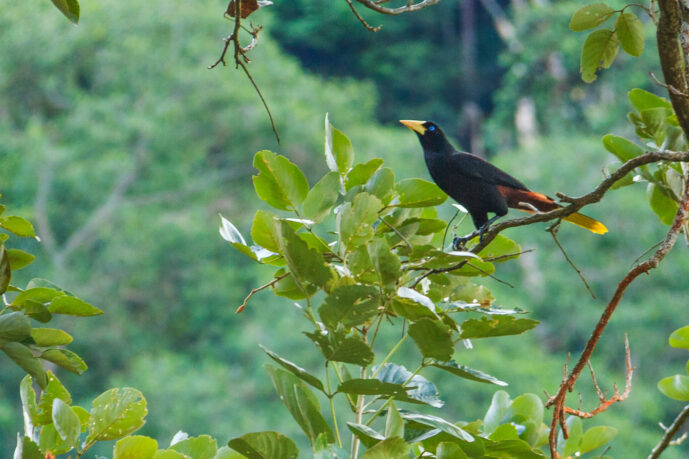
The Crested Oropendola (*Psarocolius decumanus*) is a striking Neotropical bird renowned for its architectural prowess and dramatic displays. Draped in sleek black plumage that contrasts sharply with a chestnut rump and vibrant yellow outer tail feathers, this large icterid is easily identified by its piercing blue eyes and a long, ivory-white bill. While males are significantly larger than females and possess a subtle, hair-like crest, their most captivating feature is their colonial nesting habit; they weave pendulous, basket-like nests that can hang over six feet long from the forest canopy. Equally famous for their complex vocalizations, males produce a bizarre series of liquid gurgles and crashing sounds while performing an acrobatic display, bowing forward until they are nearly upside down to defend their territory and attract mates.
Habitats et répartition
This species is widely distributed across South America east of the Andes, ranging from Panama and Colombia southward to northern Argentina, Uruguay, and southern Brazil. Its geographical presence also includes the Caribbean islands of Trinidad and Tobago. It primarily occupies lowland regions, generally remaining below elevations of 1,000 meters, though it may occasionally be found at higher altitudes in certain parts of its range. The preferred habitat consists of forest edges, clearings, and open woodlands rather than the interior of dense, primary rainforest. It is highly adaptable and frequently inhabits human-modified landscapes such as plantations, orchards, and suburban gardens, provided there are tall, sturdy trees available for its colonial nesting sites. This preference for edge habitats allows it to thrive in mosaic environments where forested areas transition into open or agricultural land.
Comportements & Reproduction
Highly social and polygynous, these birds live in colonies where a single dominant male typically defends a harem of several females. To attract mates, males perform dramatic displays, bowing forward until nearly upside down while flapping their wings and emitting a series of liquid, crashing vocalizations. While the dominant male performs most of the mating, subordinate males often remain on the periphery of the colony, waiting for opportunities to intercept females or challenge for status. Females are the primary builders, weaving impressive pendulous nests that can exceed one meter in length and hang from the outer branches of tall, isolated trees to deter arboreal predators. A unique reproductive strategy involves a complex relationship with the parasitic Giant Cowbird; in some colonies, the presence of cowbird chicks is tolerated because they protect the host's young by eating parasitic botfly larvae. This communal nesting strategy, often situated near wasp nests for added protection, maximizes the survival rate of the brood through collective vigilance and biological defense.
Alimentation
The Crested Oropendola maintains a versatile omnivorous diet that consists of a wide array of insects, small vertebrates, fruits, and nectar. These birds are frequently observed foraging in the forest canopy for large invertebrates like beetles and caterpillars, while also preying on small frogs and lizards when the opportunity arises. A significant portion of their nutritional intake comes from various tropical fruits and berries, making them vital contributors to seed dispersal within their habitats. Interestingly, they are also avid nectar drinkers, often visiting flowering trees where they use their sharp, powerful bills to reach deep into blossoms, a behavior that distinguishes them from many other large bird species in their range. Their foraging is typically a social activity, with small flocks working together to probe through foliage and bromeliads to uncover hidden food sources.
Couleurs
The Crested Oropendola features primarily iridescent black or dark chestnut plumage, which contrasts sharply with a massive, pale ivory bill and striking sky-blue irises. Its most diagnostic marking is the bright yellow outer tail feathers that flank a dark center, becoming highly visible during flight and elaborate mating displays. A thin, inconspicuous black crest adorns the crown, while the bird's dark overall coloration provides effective camouflage within the deep shadows of the tropical forest canopy.
Faits amusants
These birds are master architects, weaving hanging, pendulum-shaped nests that can reach over six feet in length to keep eggs safe from climbing predators. To attract mates, males perform a dramatic "bowing" display where they lean forward until they are nearly upside down, flapping their wings and emitting a bizarre, liquid gurgle that sounds like water crashing through a pipe. Beyond their striking sky-blue eyes, they are known for a distinct musky odor and a clever survival strategy: they often nest near aggressive wasp colonies, using the insects as a natural security system to ward off parasitic botflies.