Bruant à ailes dorées
Arremon schlegeli
Quick Facts
- Scientific Name: Arremon schlegeli
- Family: Passerellidae
- Known Nicknames: Schlegel's Sparrow
- Average Length: 14–15.5 cm / 5.5–6.1 in
- Average Weight: 23–27.5 g / 0.81–0.97 oz
- Wingspan: 20–23 cm / 7.9–9.1 in
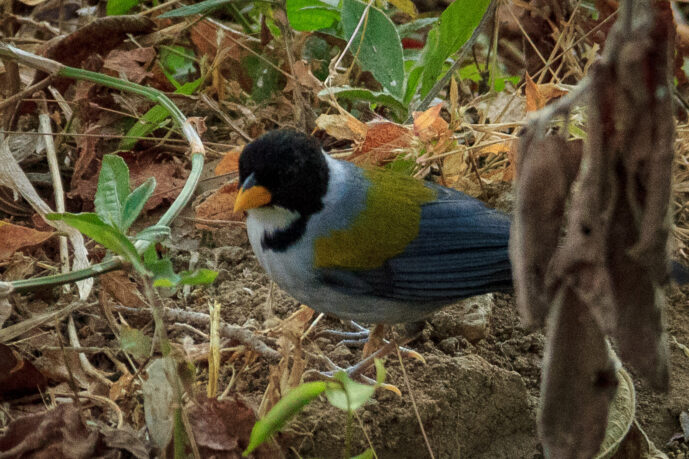
- Key Feature: Striking black head, bright yellow bill, and golden-yellow patches at the bend of the wings
- Primary Diet: Omnivore (Seeds, insects, and small fruits)
- Range: Northern South America (Caribbean coast of Colombia and Venezuela)
- Habitat: Tropical dry forest, deciduous woodland, and arid scrublands
- Social Structure: Solitary or in pairs
- Nesting/Breeding: Open cup nest built in low bushes or dense undergrowth
- Statut de conservation : Préoccupation mineure (LC)
- Population Trend: Stable
The Golden-winged Sparrow (*Arremon schlegeli*) is a visually striking songbird native to the tropical dry forests and scrublands of Colombia and Venezuela. Defined by its bold color palette, this species features a deep jet-black head that creates a dramatic mask against its brilliant white throat and bright yellow bill. Its namesake and most captivating feature is the vibrant splash of golden-yellow on its shoulders, which provides a stunning contrast to its otherwise olive-gray upperparts and pale underbelly. Primarily a ground-dwelling bird, it spends much of its time discreetly hopping through dense leaf litter in search of seeds and insects, making its flash of gold a prized sight for birdwatchers exploring the South American undergrowth.
Habitats et répartition
This species is restricted to northern South America, primarily inhabiting the Caribbean coastal regions of northern Colombia and northwestern Venezuela. Its range extends through the lowlands and into the foothills of the Sierra Nevada de Santa Marta and the Perijá Mountains, typically occurring at elevations from sea level up to approximately 1,200 meters.
Within these regions, it favors the dense undergrowth of deciduous and semi-deciduous forests, as well as arid scrublands and secondary growth. It is commonly found in the lower strata of forest edges, thickets, and shaded coffee plantations, where it stays close to the ground for foraging and protection.
Comportements & Reproduction
Primarily terrestrial and secretive, this species is often observed foraging within the leaf litter of dry forests and scrublands. It typically lives in monogamous pairs or small family units, maintaining year-round territories through melodic vocalizations. The social structure is defined by a strong pair bond, with individuals remaining in close proximity while searching for seeds and insects under dense vegetation.
Breeding usually coincides with the onset of the rainy season to maximize food availability for the offspring. The nest is a well-concealed, cup-shaped or slightly domed structure placed low in thickets or directly on the ground. Females typically lay a clutch of two to three eggs, and while incubation is primarily handled by the female, both parents are active in provisioning the fledglings. This reproductive strategy emphasizes camouflage and stealth to minimize the risk of predation within the forest understory.
Alimentation
The Golden-winged Sparrow is primarily an omnivore that finds the majority of its food by foraging through the leaf litter on the forest floor or within low-lying shrubbery. Its diet consists of a variety of small invertebrates, including beetles, ants, and other insects, which it supplements with a diverse selection of seeds and small fleshy fruits or berries. A fascinating aspect of its feeding strategy is the use of a rhythmic "double-scratch" technique, where it hops forward and then kicks both feet backward simultaneously to clear away debris and expose hidden prey. While it is often observed foraging alone or in pairs, this species is known to occasionally join mixed-species flocks, showcasing a specialized yet opportunistic approach to navigating the undergrowth of its tropical dry forest habitat.
Couleurs
The Golden-winged Sparrow is defined by a striking jet-black head, a bright orange-yellow bill, and a clean white throat. Its upperparts are slate-gray, most notably marked by brilliant golden-yellow patches on the bend of the wings, while the underparts are primarily white. This high-contrast plumage provides effective disruptive coloration within the shadows of dense tropical dry forests.
Faits amusants
Despite their name, the "golden" feature of these birds is actually a bright yellow patch hidden on the bend of the wing, often only visible during flight or specific displays. They are remarkably terrestrial, preferring to hop through dense undergrowth like forest rodents rather than fly, and they even build their elaborate, dome-shaped nests directly on or very near the ground. These nests feature a clever side entrance, camouflaging the home against the leaf litter and making it nearly invisible to passing predators. Consistently secretive, they are more often identified by their high-pitched, insect-like calls than by sight, as they spend much of their lives skulking through the shadows of dry tropical forests.