Grapevine Beetle
Pelidnota punctata
Quick Facts
- Scientific Name: Pelidnota punctata
- Family: Scarabaeidae
- Known Nicknames: Spotted June Beetle, Spotted Pelidnota
- Average Length: 2.5–3.0 cm / 1.0–1.2 in
- Average Weight: 1.0–2.0 g / 0.035–0.07 oz
- Wingspan: 5.0–6.5 cm / 2.0–2.6 in
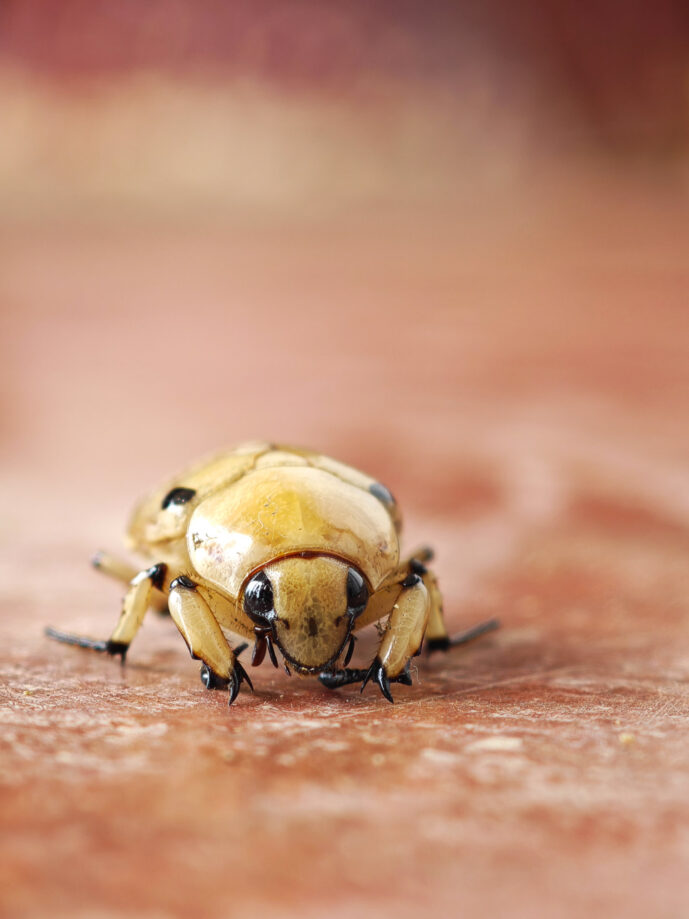
- Key Feature: Dull reddish-brown to yellowish-tan elytra featuring four distinct black spots on each side
- Primary Diet: Herbivore (Adults consume grape foliage and fruit; larvae consume decaying wood)
- Range: Eastern and Central North America, from Southern Ontario to Florida and west to Texas
- Habitat: Deciduous woodlands, thickets, and vineyards
- Social Structure: Solitary
- Nesting/Breeding: Decaying stumps and logs of deciduous trees
- Conservation Status: Not Evaluated (NE)
- Population Trend: Stable
The Grapevine Beetle (*Pelidnota punctata*) is a striking member of the scarab family, easily recognized by its robust, oval body that typically displays a warm, dull yellow or reddish-brown hue. Measuring about an inch in length, this beetle is most famous for the distinct arrangement of black dots adorning its frame: three spots line each wing cover, while two additional spots flank the sides of its thorax. A subtle yet captivating feature is the metallic, greenish-black sheen often found on its legs and underside, which contrasts beautifully with its clay-colored exterior. While adults are frequently spotted near vineyards or drawn to porch lights on summer nights, their life cycle begins in the shadows, where their larvae thrive within decaying logs and stumps, making these beetles both a fascinating find for gardeners and an essential part of the forest's natural decomposition process.
Habitats et répartition
This beetle is primarily distributed across eastern North America, ranging from southern Canada—specifically Ontario and Quebec—down to Florida and westward to the Great Plains. Its territory extends as far west as Texas, Nebraska, and South Dakota, generally remaining east of the Rocky Mountains. It thrives in various environments including deciduous forests, woodlands, thickets, and suburban gardens. Adults are commonly found in vineyards and areas populated by wild grapes or Virginia creeper, where they feed on foliage. In contrast, the larvae reside in moist, decaying wood, specifically within the rotting stumps and logs of deciduous trees, which provide the necessary nutrients for their development.
Comportements & Reproduction
These beetles are primarily nocturnal and are frequently observed flying toward artificial light sources during the summer months. While they are solitary insects, they may congregate in small groups on grapevine foliage or around fermenting fruit to feed. Their flight is characterized by a loud, distinctive buzzing sound, and they lack a complex social structure, interacting with others mainly for the purpose of mating. Reproduction begins in mid-to-late summer when females seek out moist, decaying wood, such as old stumps or fallen logs, to deposit their eggs. This choice of substrate provides a nutrient-rich environment for the developing larvae, or grubs, which spend approximately two years tunneling through and feeding on the rotting vegetation. This prolonged larval stage is a key reproductive strategy, allowing the insects to reach maturity within a protected and stable food source before emerging as adults.
Alimentation
The diet of the Grapevine Beetle, Pelidnota punctata, varies significantly between its life stages, with adults primarily feeding on the leaves and fruit of both wild and cultivated grapevines, as well as Virginia creeper. While they are known to skeletonize foliage, they are generally considered minor pests because they rarely cause substantial economic damage to vineyards. In a fascinating contrast to the herbivorous adults, the larvae are saproxylophagous, meaning they live in and consume the moist, decaying wood of rotting stumps and logs from deciduous trees such as oak, hickory, and maple. This specialized larval diet plays a crucial role in forest ecosystems by facilitating the decomposition of organic matter and recycling nutrients back into the soil. Interestingly, despite their specific name, these beetles are opportunistic feeders that can occasionally be found on other smooth-leaved plants, though they remain most famously associated with the viticulture from which they derive their common name.
Couleurs
The Grapevine Beetle features a smooth, dull reddish-brown to yellowish-tan exoskeleton marked by eight distinct black spots: three along the outer edge of each wing cover and two on the sides of the thorax. Their legs and undersides often display a dark, metallic greenish-black sheen, contrasting with the earthy dorsal tones that provide effective camouflage among dried leaves and vineyard foliage.
Faits amusants
These beetles are notoriously clumsy fliers that produce a loud, intimidating buzz, often startling people by crashing directly into porch lights or window screens at night. When threatened, they exhibit a quirky defense mechanism by tucking their legs in and playing dead to discourage predators. Although they are named for their love of grapevines, they are particularly fond of overripe, fermenting fruit and can occasionally become sluggish or "tipsy" from the natural alcohol content. Furthermore, the signature black spots on their yellowish wing covers are unique to each individual, varying in size and clarity much like a human fingerprint.