Great White Heron
Ardea herodias occidentalis
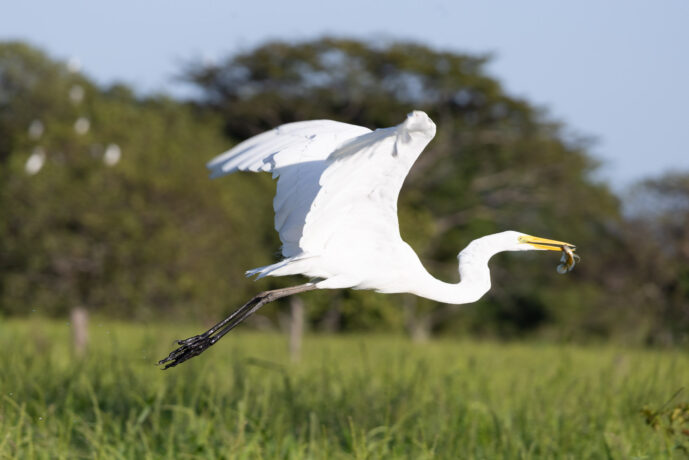
Quick Facts
- Scientific Name: Ardea herodias occidentalis
- Family: Ardeidae
- Known Nicknames: Great White Heron, White morph of the Great Blue Heron
- Average Length: 97–137 cm / 38–54 in
- Average Weight: 2.1–2.5 kg / 4.6–5.5 lb
- Wingspan: 167–201 cm / 66–79 in
- Key Feature: Pure white plumage with a heavy yellow bill and pale yellowish-green legs
- Primary Diet: Carnivore (Primarily Piscivore)
- Range: Southern Florida, the Florida Keys, the Caribbean, and coastal Yucatan Peninsula
- Habitat: Saltwater mangroves, tidal mudflats, and shallow coastal lagoons
- Social Structure: Solitary hunter, semi-colonial nester
- Nesting/Breeding: Mangrove trees or coastal shrubs
- Statut de conservation : Préoccupation mineure (LC)
- Population Trend: Stable
The Great White Heron (*Ardea herodias occidentalis*) is a majestic, snow-white subspecies of the Great Blue Heron, primarily found wading through the shallow saltwater flats of the Florida Keys and the Caribbean. As one of North America’s largest wading birds, it is frequently distinguished from the similar-looking Great Egret by its significantly heavier frame, sturdier yellow bill, and pale, yellowish-pink legs. This formidable predator is a master of patience, using its dagger-like beak to strike at fish and crustaceans with remarkable precision. Unique for its restricted coastal range and status as a distinct color morph, the Great White Heron stands as a rare and iconic sentinel of the tropical shoreline, blending the elegance of pristine plumage with the powerful, prehistoric stature of its blue-gray relatives.
Habitats et répartition
This subspecies is primarily restricted to coastal marine environments, favoring shallow saltwater habitats such as mangroves, tidal flats, and expansive seagrass beds. Unlike other variations of its species, it is almost exclusively found in brackish and saline ecosystems, where it forages for prey in the shallow surf and nests within the dense canopy of mangrove trees or on secluded islands. Its geographical range is highly localized, centered predominantly within the Florida Keys and Florida Bay, extending north along the southern tip of the Florida peninsula. Additional populations are found throughout parts of the Caribbean, including the Yucatán Peninsula, northern Cuba, and the Virgin Islands. This specialized distribution keeps it confined to subtropical coastal regions where warm, shallow waters are abundant.
Comportements & Reproduction
These large wading birds are primarily solitary when foraging, fiercely defending their feeding territories in shallow saltwater flats. However, they transition to a colonial social structure during the breeding season, congregating in rookeries often located in mangrove forests. Within these colonies, they maintain a monogamous pair bond for the duration of the nesting cycle. Courtship is highly ritualized, involving elaborate displays such as bill-snapping, neck-stretching, and the mutual presentation of sticks to initiate the construction of a bulky platform nest. Breeding can occur year-round in their tropical and subtropical ranges, a unique strategy that differs from the strictly seasonal patterns of more northern populations. Both parents share reproductive responsibilities, collaborating to incubate a clutch of two to four pale blue eggs for approximately one month. Following the hatch, the pair continues their cooperative effort by taking turns brooding and feeding the chicks through regurgitation until the young are capable of hunting independently in the surrounding seagrass beds.
Alimentation
The Great White Heron is an opportunistic carnivore whose diet primarily consists of small to medium-sized fish, but it also consumes crustaceans, amphibians, reptiles, and even small mammals or birds. Hunting primarily in shallow marine environments, this heron employs a "stand and wait" strategy or stalks slowly before using its powerful, spear-like bill to strike prey with incredible precision. One of the most fascinating aspects of its diet is its ability to swallow prey significantly wider than its own neck, often manipulating large fish to ensure they are swallowed head-first to prevent fins from catching in the throat. Additionally, these birds are known to be quite resourceful, occasionally engaging in kleptoparasitism by stealing food from other water birds or scavenging for discarded scraps near fishing docks, showcasing a dietary flexibility that allows them to thrive in diverse coastal ecosystems.
Couleurs
The Great White Heron is characterized by entirely snowy-white plumage, a heavy yellow bill, and pale greenish-yellow legs. Unlike the Great Egret, its legs are never black, providing a key identifying marker. This uniform white coloration acts as effective camouflage against bright tropical skies, making the heron less visible to fish and other aquatic prey when hunting from above.
Faits amusants
Despite being a color morph of the Great Blue Heron, this bird is a saltwater specialist that rarely ventures inland. It is the largest heron in North America and can be distinguished from the similar Great Egret by its pale yellow legs and significantly heavier, dagger-like bill. During courtship, these herons engage in "bill-clattering," a rhythmic snapping of their beaks that sounds like a wooden percussion instrument. They are also known for their clever hunting tactics, sometimes using their wings to create a "canopy" over the water to reduce glare and lure fish into the shade before striking with lightning speed.