Leafcutter ant
Atta cephalotes
Quick Facts
- Scientific Name: Atta cephalotes
- Family: Formicidae
- Known Nicknames: Parasol ants, Town ants, Fungus-growing ants
- Average Length: 2–30 mm / 0.08–1.2 in
- Average Weight: 0.01–0.5 g / 0.0003–0.017 oz
- Wingspan: 40–50 mm / 1.6–2.0 in (Alates only)
- Key Feature: Powerful serrated mandibles and three pairs of dorsal spines
- Primary Diet: Fungivore (Cultivates Leucoagaricus gongylophorus fungus)
- Range: Central and South America (Mexico to Northern Argentina)
- Habitat: Lowland tropical rainforest floor and subterranean nests
- Social Structure: Eusocial (Highly complex polymorphic colonies)
- Nesting/Breeding: Underground fungus garden chambers
- Conservation Status: Not Evaluated (NE)
- Population Trend: Stable
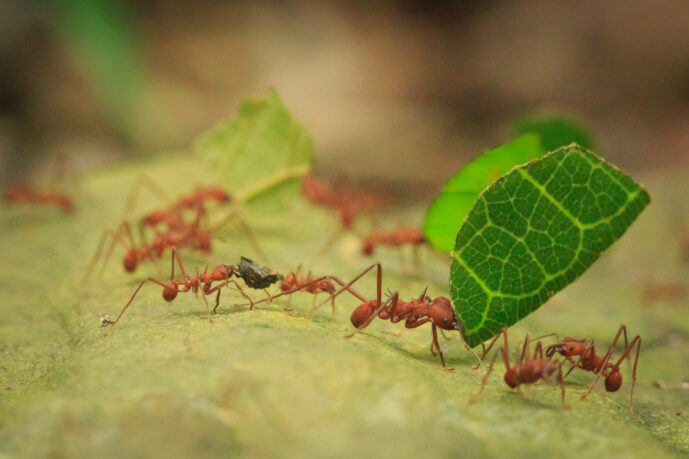
The leafcutter ant (*Atta cephalotes*) is a master of biological engineering and one of nature’s most sophisticated farmers, recognized by its reddish-brown hue, spiny exoskeleton, and powerful, serrated mandibles. These industrious insects are famous for their remarkable strength, capable of carrying leaf fragments weighing up to fifty times their own body mass back to massive, multi-chambered underground colonies. Unlike most herbivores, they do not consume the vegetation they harvest; instead, they use the masticated leaves to cultivate a specialized fungus garden, which serves as the primary food source for the entire colony. This complex social structure is defined by a highly specialized caste system, where individuals range from tiny gardeners to formidable soldiers, all working in a seamless, pheromone-guided harmony that makes them one of the most ecologically dominant species in the tropical rainforests of the Americas.
Habitats et répartition
This species is native to the Neotropical realm, spanning a broad geographical range that extends from southern Mexico through Central America and deep into South America, reaching as far south as Bolivia and Brazil. Within these regions, they are predominantly found in lowland areas, although they can occasionally be observed at higher elevations where environmental conditions remain favorable for their complex social structures. These ants primarily inhabit moist tropical rainforests and subtropical forests, where the dense canopy provides a continuous supply of fresh vegetation. They are highly adaptable and can also be found in disturbed habitats, secondary forests, and agricultural plantations. Their presence is marked by massive, subterranean nesting complexes that require well-drained soil and proximity to a diverse variety of host plants used to cultivate their essential fungal gardens.
Comportements & Reproduction
These insects exhibit a sophisticated eusocial structure divided into specialized castes based on physical size. Smaller individuals typically tend to the essential fungus gardens or care for the larvae, while larger workers forage for vegetation and the largest soldiers defend the massive subterranean nest. This complex society functions through an obligate mutualism where they harvest fresh leaves to serve as a substrate for cultivating a specific type of fungus, which remains the colony’s primary food source. Reproductive cycles center on synchronized nuptial flights where winged virgin queens and males emerge to mate. A single queen mates with multiple males to store enough sperm for her entire multi-decade lifespan before descending to the ground to shed her wings and excavate a new burrow. A critical reproductive strategy involves the queen carrying a small "starter" pellet of the original colony's fungus in a specialized pouch in her mouth. She uses this to seed a new garden in her founding chamber, ensuring the survival of the next generation through a continuous agricultural lineage.
Alimentation
Leafcutter ants of the species Atta cephalotes possess a remarkably sophisticated diet based on a mutualistic relationship with a specialized fungus, as they do not actually consume the plant matter they harvest. Instead, these industrious insects act as fungal farmers, transporting vast quantities of leaves, flowers, and stems into their underground chambers to serve as a nutrient-rich substrate for the cultivation of Leucoagaricus gongylophorus. The ants feed primarily on the nutrient-dense structures produced by this fungus, called gongylidia, which provide the essential proteins and carbohydrates required to sustain the colony and its larvae. An intriguing aspect of this dietary strategy is the ants' role as active gardeners; they meticulously clean the fungus, remove invasive molds, and even carry antibiotic-producing bacteria on their bodies to protect their food source from pathogens. This unique agricultural system allows Atta cephalotes to indirectly derive sustenance from a diverse range of vegetation that would otherwise be indigestible or toxic to them.
Couleurs
Atta cephalotes displays a uniform reddish-brown to dark chestnut coloration with a matte, non-reflective finish that provides effective camouflage against the forest floor. They lack distinct patterns or markings, instead featuring sharp thoracic spines and a monochromatic earthy tone that helps them blend into shadows and decaying leaf litter.
Faits amusants
Leafcutter ants are nature's original farmers, cultivating a specific fungus on the leaf fragments they harvest as their sole food source. To protect foragers from parasitic phorid flies, tiny "minim" ants often hitch a ride on the cut leaves to act as bodyguards. These insects possess incredible strength, capable of carrying loads up to fifty times their body weight, and they use specialized vibrations called stridulation to communicate the quality of a leaf to their nestmates. Beyond agriculture, they maintain dedicated waste management teams that handle hazardous refuse in specific disposal chambers to keep the rest of the colony sterile and disease-free.