Lehmann’s poison frog
Oophaga lehmanni
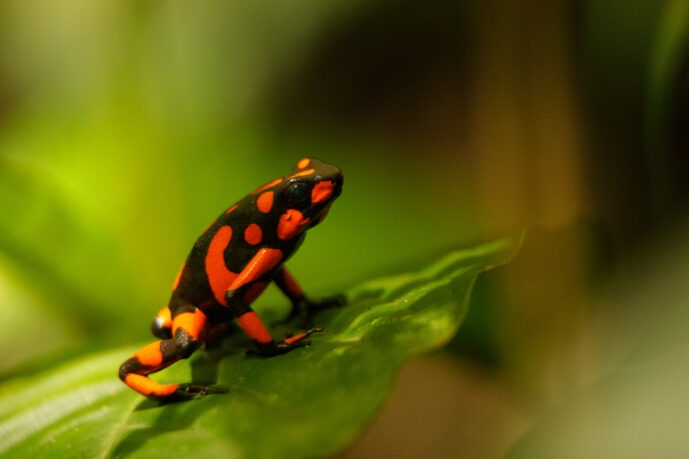
Quick Facts
- Scientific Name: Oophaga lehmanni
- Family: Dendrobatidae
- Known Nicknames: Lehmann's poison arrow frog, Red-banded poison frog
- Average Length: 3.1–3.6 cm / 1.2–1.4 in
- Average Weight: 2–5 g / 0.07–0.18 oz
- Wingspan: N/A
- Key Feature: Bold, brightly colored transverse bands of red, orange, or yellow against a dark black or brown background
- Primary Diet: Insectivore (primarily ants, mites, and small arthropods)
- Range: Highly restricted range in the Anchicayá Valley, Western Colombia
- Habitat: Tropical pre-montane and lowland rainforests
- Social Structure: Solitary and territorial
- Nesting/Breeding: Eggs laid in leaf litter; tadpoles transported to water-filled leaf axils of bromeliads
- Conservation Status: Critically Endangered (CR)
- Population Trend: Decreasing
Lehmann's poison frog (*Oophaga lehmanni*) is a critically endangered amphibian endemic to a small, misty region of the Colombian rainforest, renowned for its striking and highly variable appearance. This small frog typically showcases a smooth, jet-black body dramatically encircled by broad, vibrant bands of bright red, orange, or yellow, a brilliant display of aposematism used to warn predators of the potent toxins stored in its skin. Beyond its dazzling colors, the species is most celebrated for its remarkable parental care; as an "obligate egg-feeder," the female meticulously transports her tadpoles to individual water-filled plant axils and returns periodically to feed them unfertilized, nutrient-rich "trophic" eggs. This complex reproductive strategy and its vibrant aesthetic make it a biological marvel, though it remains under severe threat from habitat loss and the illegal pet trade.
Habitats et répartition
This species is endemic to a highly restricted geographical range in western Colombia, specifically within the Anchicayá River drainage in the Valle del Cauca department. It is found in a very small area on the western slopes of the Cordillera Occidental, typically occurring at elevations between 600 and 1,200 meters above sea level. Its primary habitat consists of humid tropical rainforests, particularly submontane and premontane environments characterized by high rainfall and humidity. Within these forests, the frog is largely terrestrial, often found among leaf litter on the forest floor, though it relies on arboreal bromeliads and water-filled plant axils for breeding and the development of its larvae.
Comportements & Reproduction
Primarily diurnal and terrestrial, these frogs exhibit a social structure defined by intense male territoriality. Males utilize persistent vocalizations to defend their specific forest floor patches and attract mates. Following a successful courtship, the female lays a small clutch of eggs in the leaf litter. Once hatched, the male transports the tadpoles on his back to separate water-filled plant axils, such as those in bromeliads, which serve as individual nurseries. The species is renowned for its specialized reproductive strategy known as obligate oophagy. Because the secluded water pools where tadpoles develop are nutrient-poor, the mother returns to each site to deposit unfertilized, trophic eggs. These eggs serve as the sole food source for the larvae until they complete metamorphosis. This high level of parental investment is essential for the survival of the offspring in their specific ecological niche.
Alimentation
Lehmann's poison frog primarily consumes a specialized diet consisting of small invertebrates such as ants, mites, termites, and tiny beetles found across the forest floor. An intriguing aspect of their nutrition is that their potent skin toxicity is directly derived from the various alkaloids present in the specific ants and mites they ingest, meaning that individuals raised in captivity on a standard diet of crickets and fruit flies lack these defensive toxins. Furthermore, the species exhibits a remarkable form of parental investment known as oophagy; after the eggs hatch, the female transports the tadpoles to water-filled leaf axils and returns periodically to deposit unfertilized eggs, which serve as the sole source of nourishment for her developing offspring.
Couleurs
Lehmann's poison frog displays a striking aposematic pattern consisting of broad, transverse bands in vibrant shades of red, orange, or yellow contrasted against a deep black or dark brown base. These high-visibility markings serve as a warning to predators of the frog's toxicity rather than providing camouflage. The smooth, encircling bands typically cover the entire body and limbs, creating a bold, unmistakable appearance that stands out within its tropical environment.
Faits amusants
Lehmann's poison frog is a master of "extreme parenting"; females transport their tadpoles to water-filled plants and return regularly to feed them unfertilized "trophic" eggs, which are the larvae's only source of food. This dietary dependency is so strict that the genus name *Oophaga* literally translates to "egg-eater." Beyond their nursery duties, these frogs are famous for their bold, aposematic patterns of red, orange, or yellow bands that signal their toxicity to predators, a chemical defense they acquire solely by consuming specific alkaloid-rich ants and mites. Despite their small size, males are fiercely territorial and will engage in upright wrestling matches to defend their preferred calling sites from rivals.