Long-tailed Sylph (Aglaiocercus kingii)
Aglaiocercus kingii
Quick Facts
- Scientific Name: Aglaiocercus kingii
- Family: Trochilidae
- Known Nicknames: Long-tailed Sylph, Blue-tailed Sylph
- Average Length: 9.7–19 cm / 3.8–7.5 in (including male tail)
- Average Weight: 4.7–6 g / 0.17–0.21 oz
- Wingspan: 10–12 cm / 4–4.7 in
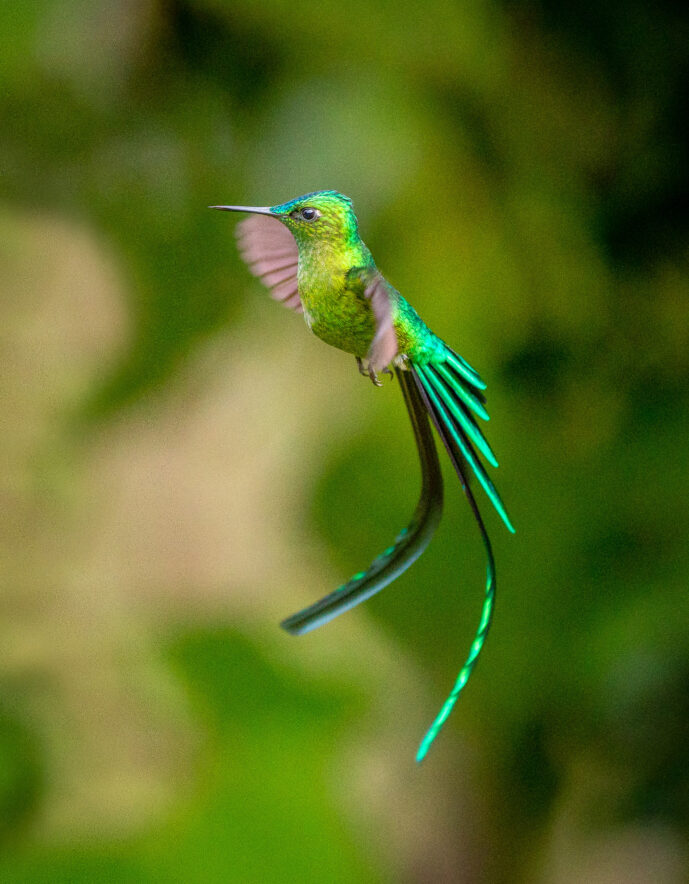
- Key Feature: Extremely long, iridescent, deeply forked blue-green tail in males
- Primary Diet: Primarily Nectarivore (nectar and small arthropods)
- Range: Andes of Venezuela, Colombia, Ecuador, Peru, and Bolivia
- Habitat: Humid montane forests and cloud forest edges
- Social Structure: Solitary and Territorial
- Nesting/Breeding: Mossy cup nests built in shrubs or low tree branches
- Statut de conservation : Préoccupation mineure (LC)
- Population Trend: Stable
The Long-tailed Sylph (*Aglaiocercus kingii*) is a breathtaking hummingbird native to the high-altitude cloud forests of the Andes, renowned for the male’s extraordinary, iridescent tail which can reach up to five inches in length—nearly double the size of its body. While females are more modestly attired with shorter tails and buff-colored underparts, the males sport shimmering emerald plumage and a brilliant blue or violet throat patch that glints in the mountain light. This spectacular tail, though an aerodynamic challenge, serves as a vital tool for courtship displays, trailing behind the bird like a metallic ribbon as it zips between nectar-rich flowers. Despite their delicate appearance, these birds are spirited and territorial, utilizing their needle-like bills and agile flight to navigate the dense undergrowth and defend their feeding grounds with remarkable precision.
Habitats et répartition
Found throughout the northern and central Andes, its range extends from Venezuela and Colombia southward through Ecuador and Peru to central Bolivia. Within this vast mountain chain, it typically occupies elevations between 1,400 and 3,000 meters, though specific altitudinal limits vary depending on the regional geography and the particular subspecies present. It primarily inhabits the canopy and edges of humid montane forests and cloud forests. While it favors dense, moisture-rich woodland, it is also frequently observed in secondary growth, bushy clearings, and suburban gardens where suitable flowering plants are available. These environments provide the necessary nectar sources and nesting sites required for its survival across its high-altitude range.
Comportements & Reproduction
These birds are primarily solitary and exhibit high levels of territorial aggression, especially when defending nectar-rich floral patches. Males utilize their exceptionally long, iridescent tail feathers in dramatic aerial displays to attract mates, a trait that serves as a significant indicator of fitness despite the aerodynamic handicap it imposes. The mating system is polygynous, with males seeking multiple partners and providing no parental care beyond the initial act of breeding. The female is solely responsible for the reproductive cycle after mating, from nest construction to rearing the young. She builds a camouflaged, cup-shaped nest using moss, lichen, and spider silk, typically hidden within dense vegetation or attached to hanging vines. After laying a clutch of usually two eggs, she performs all incubation and feeding duties alone, ensuring the survival of the offspring while the male continues to defend his territory and display for other potential mates.
Alimentation
The Long-tailed Sylph primarily sustains itself on a diet of nectar sourced from a variety of brightly colored, tubular flowers, including species from the families Ericaceae and Rubiaceae. While it typically hovers to feed, this hummingbird is also known for "nectar robbing," a behavior where it uses its bill to pierce the base of long-corolla flowers to access nectar that would otherwise be out of reach. To supplement its sugar intake with essential proteins, it actively hunts small insects and spiders, often capturing them mid-air through hawking or gleaning them from foliage. Interestingly, despite the cumbersome length of the male’s tail, which can reach up to five inches and potentially impact flight efficiency, these birds remain highly competitive foragers, often establishing and defending specific feeding territories or following established "trap-line" routes to ensure a consistent energy supply.
Couleurs
The male Long-tailed Sylph features iridescent emerald-green plumage and a spectacular, elongated tail that shimmers in shades of violet and sapphire blue. Females exhibit more muted tones, with green upperparts, buff-colored underparts, and a spotted throat. This vibrant green coloration serves as effective camouflage within Andean cloud forests, while the males' metallic sheen and dramatic tail feathers are specialized for courtship displays.
Faits amusants
The male’s iridescent tail is its most striking feature, often measuring over five inches long—more than double the length of its body. This cumbersome ornament actually makes the bird a less efficient flier than other hummingbirds, yet it serves as a high-stakes signal of genetic fitness to potential mates. Beyond their looks, these birds are surprisingly bold, frequently chasing away much larger species from their feeding territories with aggressive aerial displays. While most hummingbirds build open cup nests, the female Long-tailed Sylph constructs a bulky, enclosed dome made of moss and fibers, featuring a side entrance that helps regulate temperature in the cool, damp Andean cloud forests.