Magellanic Woodpecker
Campephilus magellanicus
Quick Facts
- Scientific Name: Campephilus magellanicus
- Family: Picidae
- Known Nicknames: Carpintero Negro, Magellanic Woodpecker
- Average Length: 36–45 cm / 14–18 in
- Average Weight: 276–363 g / 9.7–12.8 oz
- Wingspan: 66–80 cm / 26–31.5 in
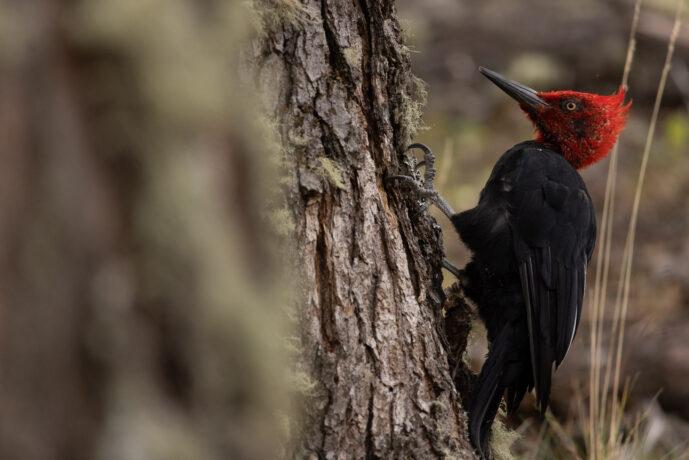
- Key Feature: Striking sexual dimorphism; males possess a fully crimson-red head and crest while females have a black head with a recurved crest
- Primary Diet: Insectivore (primarily wood-boring larvae and beetles)
- Range: Southern Chile and southwestern Argentina, extending to Tierra del Fuego
- Habitat: Mature and old-growth Nothofagus (Southern Beech) and Araucaria forests
- Social Structure: Monogamous pairs or small family groups of up to 4 or 5 individuals
- Nesting/Breeding: Self-excavated cavities in large, mature trees
- Statut de conservation : Préoccupation mineure (LC)
- Population Trend: Decreasing
The Magellanic Woodpecker (*Campephilus magellanicus*) is the undisputed giant of South American woodpeckers, a majestic specialist of the ancient sub-antarctic forests of Chile and Argentina. Renowned for its striking sexual dimorphism, the male displays a brilliant, fiery-red head and crest, while the female is identified by her elegant, forward-curling black crest and a small red patch near the base of her beak. Both sexes sport a glossy black plumage accented by white wing patches that flash brilliantly during flight. These birds are most famous for their powerful "double-knock" communication—a resonant, rhythmic drumming that echoes through the canopy—and their role as "ecosystem engineers," using their massive, chisel-like bills to excavate large cavities that provide essential nesting sites for a variety of other forest-dwelling species.
Habitats et répartition
This species is endemic to the southern regions of South America, specifically along the Andes of southern Chile and southwestern Argentina. Its range extends from the Valdivian temperate rainforests in the north down to the sub-Antarctic forests of Tierra del Fuego. Within this territory, it is primarily found in mature, old-growth forests dominated by Southern Beech (*Nothofagus*) and Monkey Puzzle trees (*Araucaria araucana*). It inhabits diverse elevations ranging from sea level up to approximately 2,000 meters at the timberline. The species is highly dependent on primary forests that provide large, decaying trees and snags, which are essential for both nesting and foraging for wood-boring larvae. Due to these specific requirements, its presence is closely tied to the availability of undisturbed woodland with significant vertical structure and dead wood.
Comportements & Reproduction
These birds are highly social and territorial, typically living in stable family groups composed of a monogamous breeding pair and their offspring from previous seasons. They communicate through a signature "double-knock" display, a powerful drumming sound used to mark their territory and coordinate with family members. Foraging is often a collective activity, with the group moving together through the forest canopy to search for wood-boring larvae in large, old-growth trees. During the breeding season, which typically spans from October to January, the pair excavates a large nesting cavity high above the ground, often in southern beech trees. They exhibit cooperative breeding strategies, where older siblings assist the parents in defending the nest and feeding the new chicks. While a clutch may contain up to four eggs, usually only one or two offspring survive to fledge, benefiting from an extended period of parental care and protection that can last for more than two years.
Alimentation
The Magellanic Woodpecker primarily sustains itself on wood-boring larvae, particularly those from the Cerambycidae and Lucanidae families, as well as adult beetles, spiders, and occasionally small vertebrates like lizards or bird eggs. This large avian predator is known for its powerful, percussive drilling, using its heavy bill to strip bark and excavate deep into decaying southern beech trees to extract prey with its long, specialized tongue. An interesting aspect of their foraging strategy is their role as keystone species; the large cavities they create while searching for food provide essential nesting and hiding spots for various other forest animals. Furthermore, these woodpeckers often forage in stable family groups where juveniles undergo a long period of parental dependency, learning the complex physical techniques required to locate and extract deeply embedded larvae from solid wood.
Couleurs
The Magellanic Woodpecker features a glossy black body with prominent white patches on its wings. Males are distinguished by a striking, entirely crimson-red head and crest, whereas females are predominantly black with a small red area at the base of the bill and a unique forward-curled crest. Their pale, ivory-colored bills contrast with their dark plumage, which provides effective camouflage amidst the deep shadows and bark of southern beech forests.
Faits amusants
The Magellanic Woodpecker is famous for its iconic "double-tap" drum, a signature two-stroke rhythmic knock that echoes through the Patagonian forests. As South America’s largest woodpecker, it possesses a reinforced skull and a specialized hyoid bone that wraps around its brain to act as a natural shock absorber during high-impact drilling. These birds are unusually social, with juveniles often remaining with their parents for up to two years to master the complex art of extracting wood-boring larvae. Beyond their drumming, they communicate with a loud, nasal call that remarkably resembles the sound of a squeaky toy, adding a whimsical soundtrack to their ancient woodland habitats.