Motmot hurleur
Momotus subrufescens
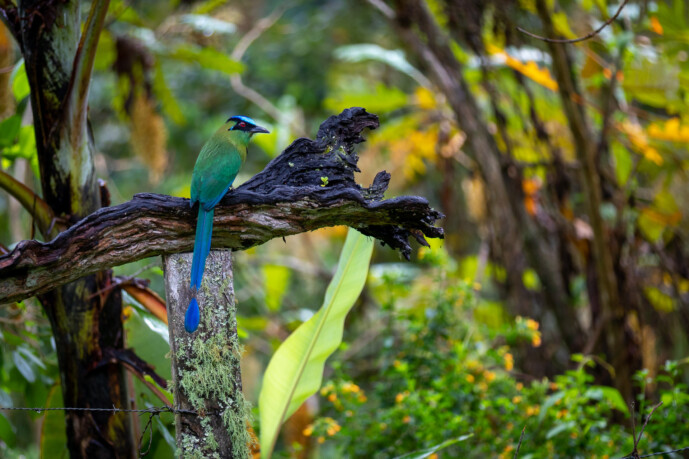
Quick Facts
- Scientific Name: Momotus subrufescens
- Family: Momotidae
- Known Nicknames: Blue-crowned Motmot (formerly), Barranquero
- Average Length: 38–43 cm / 15–17 in
- Average Weight: 100–150 g / 3.5–5.3 oz
- Wingspan: 45–55 cm / 18–22 in
- Key Feature: Long tail with distinct racket-shaped tips and a turquoise-blue crown ring
- Primary Diet: Omnivore (Insects, small vertebrates, and fruit)
- Range: Central Panama through Northern Colombia and Venezuela to Northwest Peru
- Habitat: Tropical lowland evergreen forest, deciduous forest, and arid scrubland
- Social Structure: Solitary or in pairs
- Nesting/Breeding: Burrows excavated in vertical earthen banks
- Statut de conservation : Préoccupation mineure (LC)
- Population Trend: Decreasing
The Whooping Motmot (*Momotus subrufrescens*) is a captivating bird of the Neotropical dry forests, instantly recognizable by its vibrant plumage and iconic "racket-tipped" tail. This medium-sized avian features a brilliant lime-green back, a warm rufous belly, and a striking black facial mask framed by a shimmering turquoise-blue crown. Its most extraordinary feature is its long central tail feathers, which the bird preens to remove the barbs, leaving two elegant feathered paddles at the ends that it rhythmically swings like a pendulum when it detects a predator. True to its name, this motmot is also famous for its low, resonant "whoop-whoop" call, a hauntingly beautiful sound that echoes through the canopy as the bird sits motionless, waiting to swoop down on insects or small lizards with its serrated beak.
Habitats et répartition
This species is distributed across eastern Panama, northern Colombia, and northern Venezuela, extending southward into the Amazon basin of Peru and Brazil. Its range primarily encompasses lowland regions where it occupies a variety of woodland environments across Central and South America.
It inhabits tropical and subtropical dry forests, humid lowland forests, and semi-open woodland habitats. These birds are frequently found in secondary growth forests and forest edges rather than dense, undisturbed primary rainforest. A critical feature of their habitat is the presence of earthen banks or slopes, which they utilize for excavating their long nesting burrows.
Comportements & Reproduction
These birds typically live in pairs or small family units and are known for their distinctive pendulum-like tail wagging, a behavior used to signal awareness to potential predators. They are primarily sit-and-wait predators that hunt from perches in the forest understory. Socially, they maintain territories and use a resonant "whoop-whoop" call to communicate and defend their space, often vocalizing most frequently during the early morning or late afternoon.
During the breeding season, they form monogamous bonds and engage in a collaborative nesting process where both the male and female excavate a long, winding tunnel into a vertical earthen bank. These burrows can reach lengths of several meters, terminating in a secure nesting chamber where the female lays three to four white eggs. Both parents share the responsibilities of incubation and provisioning the chicks, ensuring the survival of the brood within the safety of their subterranean nursery.
Alimentation
The Whooping Motmot is a versatile omnivore that sustains itself on a diverse array of prey, including large insects like beetles and cicadas, as well as small vertebrates such as lizards, frogs, and occasionally small snakes. Utilizing a sit-and-wait hunting strategy, it perches quietly before launching a sudden sally to snatch food from the air, foliage, or the ground. One of the most fascinating aspects of its dietary behavior is the practice of "beating" its prey; the bird will strike large insects or vertebrates repeatedly against a branch to kill them, break their bones, or remove wings before swallowing them whole. To complement this protein-rich diet, it also consumes significant quantities of fruit, particularly palm fruits and berries, which makes it an important seed disperser within its tropical ecosystem.
Couleurs
The Whooping Motmot features a vibrant green back and wings contrasting with a rich rufous underbelly and breast. Its head is defined by a black facial mask bordered by brilliant turquoise and a black crown encircled by a blue diadem. Most distinctive are its red eyes and long, blue-green tail ending in "racket" tips, while its overall olive-green upperparts provide effective camouflage within the tropical canopy.
Faits amusants
The Whooping Motmot is best known for its distinctive "racket" tail, a look achieved by the bird preening away weak barbs along the feather shafts until only the tips remain. This tail serves as a sophisticated communication tool; when a predator is near, the motmot performs a "wag-display," swinging its tail back and forth like a pendulum to signal that the intruder has been spotted, often discouraging an ambush. These birds are also industrious excavators that dig nesting tunnels up to several feet long into earthen banks. When hunting, they exhibit a grizzly efficiency by repeatedly slamming large insects or small lizards against a branch to break their bones and soften them before swallowing the meal whole.