South American Coati
Nasua Nasua
Quick Facts
- Scientific Name: Nasua
- Family: Procyonidae
- Known Nicknames: Coati, Coatimundi, Hog-nosed Raccoon, Snookum
- Average Length: 73–136 cm / 29–54 in
- Average Weight: 2–8 kg / 4.4–17.6 lb
- Wingspan: N/A
- Key Feature: Elongated, flexible snout and a long, ringed tail typically held erect
- Primary Diet: Omnivore (primarily fruit and invertebrates)
- Range: Southwestern United States through Central America to Northern Argentina
- Habitat: Tropical rainforests, dry forests, and mountain woodlands
- Social Structure: Social (females/juveniles in bands); adult males are solitary
- Nesting/Breeding: Tree-top nests
- Statut de conservation : Préoccupation mineure (LC)
- Population Trend: Decreasing
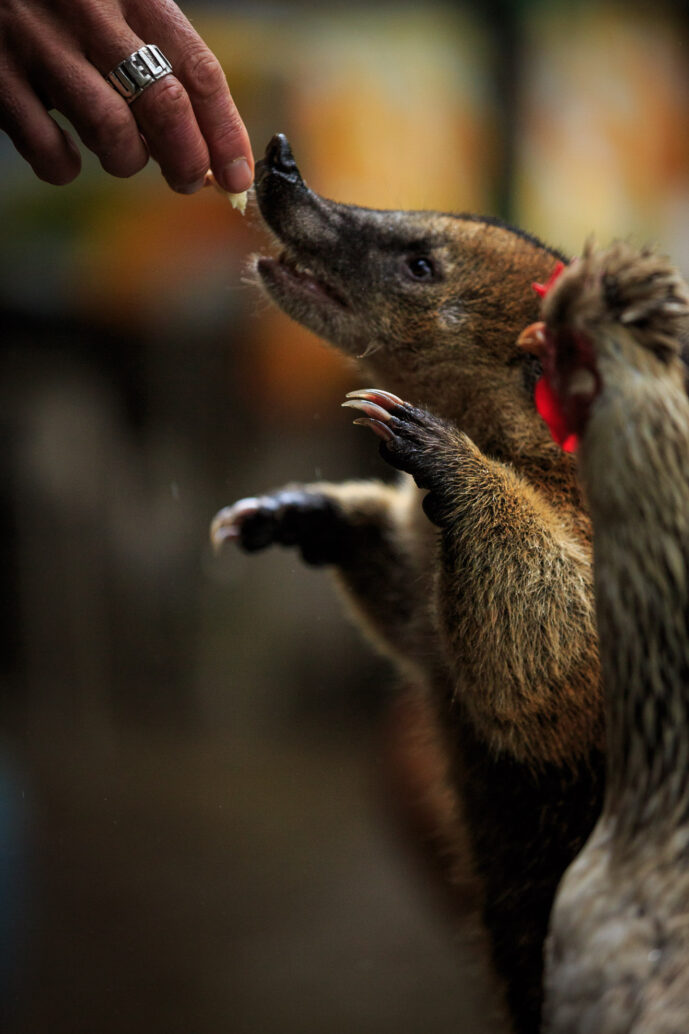
The South American coati (*Nasua nasua*) is a charismatic and highly adaptable member of the raccoon family, easily identified by its elongated, flexible snout and remarkably long, bushy tail ringed with dark bands. Clad in dense fur ranging from reddish-brown to gray, these social mammals are distinguished by their diurnal lifestyle and impressive arboreal agility, aided by powerful claws and double-jointed ankles that allow them to descend trees head-first. Their most striking feature is their sensitive, "proboscis-like" nose, which they use with surgical precision to root through leaf litter for insects and fruit, while their habitually upright tail acts as a vital visual signal to keep their social groups, known as bands, together in the dense undergrowth of their native tropical forests.
Habitats et répartition
This species is widely distributed throughout South America, spanning from Colombia and Venezuela in the north down to Uruguay and northern Argentina. Its range covers the vast majority of the continent east of the Andes, including extensive territories in Brazil, Peru, Bolivia, and Paraguay. It occupies a diverse array of environments, ranging from dense tropical rainforests and deciduous woodlands to gallery forests and xeric scrublands. Highly adaptable, it is found at various elevations from sea level up to approximately 2,500 meters, typically favoring areas with significant canopy cover but also frequently inhabiting forest edges and occasionally open grasslands.
Comportements & Reproduction
Social organization is characterized by a distinct split between the sexes, as females and juveniles form stable bands of up to thirty individuals while adult males are primarily solitary. During the annual breeding season, a solitary male integrates into a female group by using submissive posturing to avoid aggression from the collective. This polygynous arrangement allows the male to mate with multiple females within the band before he is eventually expelled by the group to resume his solitary lifestyle. Reproductive strategies involve a significant period of maternal isolation; pregnant females leave their social group to build nests high in the forest canopy. After a gestation of roughly 77 days, they give birth to litters of two to seven young. These altricial kits remain in the safety of the arboreal nest for several weeks to avoid ground-based predators. Once the offspring are approximately six weeks old, the mother leads them down to rejoin the original band, where the young benefit from the protection and social learning provided by the larger group.
Alimentation
The genus Nasua, commonly known as coatis, consists of highly versatile omnivores that maintain a diverse diet primarily composed of fruits and invertebrates. They spend a significant portion of their active hours foraging on the forest floor, utilizing their long, sensitive, and incredibly flexible snouts to root through leaf litter and soil for insects, spiders, and land crabs. Beyond these staples, coatis are opportunistic predators that consume small vertebrates such as lizards, rodents, and birds, as well as eggs when they are available. An interesting dietary behavior is the distinct social dynamic of their foraging; while females and juveniles hunt in large, coordinated bands that help flush out prey, adult males are typically solitary hunters. Their physical adaptations are perfectly suited for this varied diet, as they possess powerful claws for digging out subterranean food and unique ankles that can rotate 180 degrees, allowing them to descend trees headfirst to reach arboreal fruits and nests with ease.
Couleurs
The South American coati (*Nasua nasua*) features a coat ranging from reddish-brown to gray or yellowish, with a pale cream or white underside. Its most distinct markings are the dark brown or black rings encircling its long tail and white spots around the eyes, snout, and throat. These earthy hues provide effective camouflage within forest environments, while the high-contrast tail rings serve as visual signals for group cohesion in dense foliage.
Faits amusants
Coatis possess incredibly flexible snouts that can rotate up to 60 degrees to poke into narrow crevices, and they are among the few mammals capable of climbing down trees headfirst thanks to double-jointed ankles that rotate 180 degrees. Their long, ringed tails serve as both balancing poles and signaling flags to keep their social groups, known as bands, together in dense undergrowth. While females and juveniles are highly communal, adult males are strictly solitary, a behavioral quirk that once led naturalists to mistakenly classify them as an entirely different species.