Orange-chinned Parakeet
Brotogeris jugularis
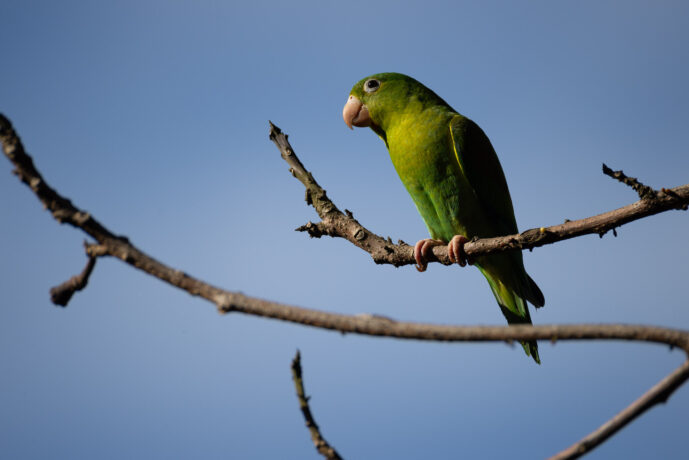
Quick Facts
- Scientific Name: Brotogeris jugularis
- Family: Psittacidae
- Known Nicknames: Tovi Parakeet, Bee Bee Parrot
- Average Length: 17.5–18 cm / 6.9–7.1 in
- Average Weight: 55–65 g / 1.9–2.3 oz
- Wingspan: 30–35 cm / 11.8–13.8 in
- Key Feature: Small orange patch on the chin and bronze-brown shoulder patches
- Primary Diet: Primarily Frugivore and Granivore
- Range: Southern Mexico through Central America to Northern Colombia and Venezuela
- Habitat: Lowland tropical forests, deciduous woodlands, and urban parks
- Social Structure: Highly Social, typically found in pairs or large noisy flocks
- Nesting/Breeding: Tree hollows or excavated arboreal termite mounds
- Statut de conservation : Préoccupation mineure (LC)
- Population Trend: Stable
The Orange-chinned Parakeet (*Brotogeris jugularis*), often affectionately called the "Tovi Parakeet," is a small, vibrant parrot native to the tropical lowlands stretching from southern Mexico to northern South America. Measuring roughly seven inches in length, this bird is primarily adorned in a brilliant lime-green plumage, which is beautifully contrasted by bronze-brown shoulder patches and subtle blue highlights on its wing feathers. Its most striking and namesake feature is the small, triangular patch of bright orange feathers located just beneath its lower mandible, a detail that pops against its pale, hooked beak. Highly social and energetic, these parakeets are known for their boisterous personalities and high-pitched chatter, often seen traveling in devoted pairs or large, synchronized flocks as they forage for a versatile diet of seeds, fruits, and even nectar.
Habitats et répartition
This species is native to the Pacific slope of the Americas, ranging from southern Mexico (Chiapas) through Central America to northern Colombia and northwestern Venezuela. It is primarily found in tropical lowlands and foothills, typically occurring at elevations below 1,000 meters, though it may occasionally be spotted at slightly higher altitudes in certain regions.
It thrives in a variety of semi-open environments, including deciduous forests, gallery woodlands, savannas, and scrublands. Highly adaptable to human-modified landscapes, it is frequently seen in coffee and fruit plantations, cattle pastures with scattered trees, and urban parks or residential gardens. While it utilizes forest edges, it generally avoids the interior of dense, unbroken rainforests.
Comportements & Reproduction
Highly gregarious and vocal, these birds typically travel in noisy pairs or small family groups that may congregate into communal roosts of several hundred individuals. They maintain strong, long-term monogamous pair bonds characterized by frequent mutual preening and synchronized movements. Their social structure is centered around these pairs, which remain together even within larger flocks while foraging for fruit, seeds, and nectar throughout the canopy.
Reproduction often involves a specialized nesting strategy where pairs excavate holes in active arboreal termite mounds, though they also utilize natural tree cavities or abandoned woodpecker holes. The female typically lays a clutch of four to six eggs, which she incubates for approximately three weeks. Both parents share the responsibility of feeding the altricial chicks through regurgitation, maintaining a dedicated parental bond until the young fledge at about five to six weeks of age.
Alimentation
The Orange-chinned Parakeet maintains a diverse diet primarily consisting of seeds, fruits, flowers, and nectar, often foraging in the canopy in noisy, social groups. They are particularly fond of the fruits of the balsa tree and various species of figs, but they also consume insects and larvae to supplement their protein intake during the breeding season. An interesting aspect of their feeding behavior is their role as occasional pollinators; as they probe flowers for nectar, pollen frequently adheres to their facial feathers, facilitating cross-pollination between trees. Additionally, these parakeets have been observed engaging in geophagy, where they consume mineral-rich soil or clay to help neutralize secondary compounds and toxins found in the unripe fruits and seeds they consume.
Couleurs
The Orange-chinned Parakeet is primarily bright green, providing effective camouflage within tropical foliage. Its most defining feature is a small, vibrant orange triangular patch directly beneath the beak. The bird also displays distinctive yellowish-bronze patches on its wing shoulders and blue-tinged primary feathers, while the undersides of the wings reveal a flash of yellow during flight.
Faits amusants
Despite their diminutive size, Orange-chinned Parakeets are notoriously feisty and will aggressively chase away much larger birds, including hawks and macaws, from their favorite feeding spots. They have a peculiar nesting preference for active arboreal termite mounds, where they excavate tunnels to lay eggs, benefiting from the consistent warmth the insect colony provides. To maintain social bonds within their boisterous flocks, they engage in synchronized mutual preening and use their distinct orange chin patch as a visual signal during social interactions. Additionally, they often employ a "sentinel" system, where one bird remains on high alert to screech a warning at the slightest sign of danger while the rest of the group feeds.