Rainbow Whiptail
Cnemidophorus lemniscatus
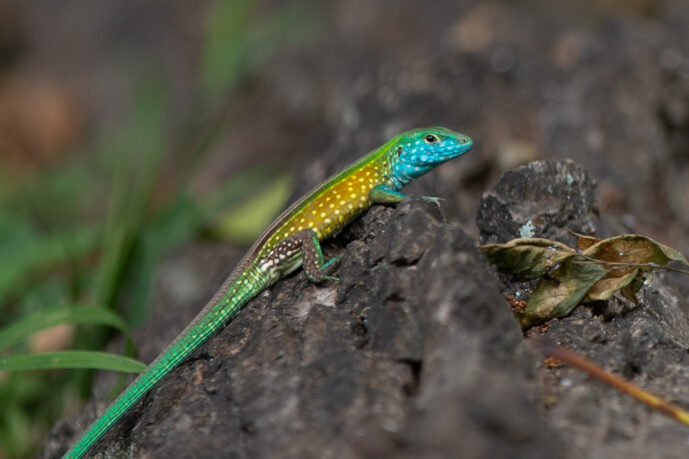
Quick Facts
- Scientific Name: Cnemidophorus lemniscatus
- Family: Teiidae
- Known Nicknames: Rainbow Whiptail Lizard, Four-lined Whiptail
- Average Length: 20–30 cm / 8–12 in
- Average Weight: 15–30 g / 0.5–1.1 oz
- Wingspan: N/A
- Key Feature: Vibrant turquoise or bright blue tail and hind limbs in adult males, with eight to nine longitudinal yellow or cream-colored stripes
- Primary Diet: Insectivore
- Range: Central America and northern South America, including Panama, Colombia, Venezuela, and the Guianas; also introduced to Florida, USA
- Habitat: Open, sunny lowland areas, sandy coastal regions, savannas, and disturbed habitats with loose soil
- Social Structure: Solitary and Diurnal
- Nesting/Breeding: Subterranean burrows excavated in sandy or loose soil
- Statut de conservation : Préoccupation mineure (LC)
- Population Trend: Stable
The Rainbow Whiptail (*Cnemidophorus lemniscatus*) is a striking lizard celebrated for its brilliant, multi-colored appearance and remarkable biological adaptability. Adult males are particularly eye-catching, showcasing a vivid mosaic of neon blues, greens, and yellows along their slender bodies, often accented by bright yellow longitudinal stripes and a long, electric-blue tail. These agile reptiles are high-energy foragers, constantly flicking their tongues to sense prey while moving with incredible speed across the tropical landscapes of Central and South America. Perhaps their most extraordinary feature is their reproductive flexibility; in several regions, certain populations are entirely female and reproduce through parthenogenesis, a process where mothers produce identical clones of themselves without the need for mating. This combination of iridescent beauty and unique evolutionary strategy makes the Rainbow Whiptail one of the most fascinating lizards in the neotropics.
Habitats et répartition
This species is native to Central and South America, spanning a range from Guatemala and Belize southward through Colombia, Venezuela, and the Guianas into northern Brazil. It is also found across various Caribbean islands, such as Trinidad, Tobago, and the ABC islands. Beyond its native territory, it has been introduced to the United States, specifically Florida, where it has established populations in several southern counties. The lizard prefers open, arid to semi-arid environments that provide ample sunlight for basking. Its typical habitats include tropical savannas, grasslands, coastal dunes, and the edges of dry forests. Highly adaptable to human presence, it is frequently encountered in disturbed areas like roadsides, agricultural clearings, and suburban gardens, where loose or sandy soil allows for easy burrowing and foraging.
Comportements & Reproduction
These lizards are primarily diurnal and highly active, characterized by their rapid, jerky movements while foraging for insects in open, sunny habitats. While they are generally solitary, they often congregate in high densities where resources are abundant. Males exhibit territorial behavior, using aggressive displays and physical combat to defend their home ranges and gain access to potential mates during the breeding season. Reproduction is notably diverse, as the species includes both bisexual populations that reproduce sexually and unisexual populations that reproduce through parthenogenesis. In sexual populations, males engage in vigorous courtship rituals involving head-bobbing and chasing before mating. In contrast, certain populations consist entirely of females that produce clones of themselves without fertilization. Regardless of the reproductive mode, they are oviparous, typically laying small clutches of eggs in sandy soil or under debris to incubate.
Alimentation
The Rainbow Whiptail is primarily an insectivorous lizard that maintains a high-energy lifestyle through active foraging. Its diet consists of a diverse array of small invertebrates, including ants, beetles, grasshoppers, spiders, and termites, which it locates by flicking its tongue to detect chemical cues in the environment. Interestingly, these lizards are classified as "widely foraging" predators, meaning they spend a significant portion of their active hours moving through leaf litter and loose soil to unearth hidden prey rather than waiting in ambush. While their intake is dominated by insects, they are opportunistic feeders and may occasionally supplement their nutrition with small amounts of plant matter or even smaller lizards. This constant search for food is driven by a high metabolic rate, requiring them to consume a large volume of prey relative to their body size to sustain their rapid movements and vibrant coloration.
Couleurs
The Rainbow Whiptail features a dark green or brown base accented by seven to nine prominent longitudinal yellow stripes running from the head to the tail. Males exhibit striking sexual dichromatism, displaying vibrant turquoise or electric blue on their heads, flanks, and limbs, while females and juveniles remain more muted. These stripes function as disruptive coloration, breaking up the lizard's silhouette against grassy backgrounds to provide effective camouflage and visual confusion while moving at high speeds.
Faits amusants
These lizards are famous for their ability to reproduce through parthenogenesis, a process where certain populations consist entirely of females that clone themselves without the need for males. Beyond their striking turquoise and neon-green displays, they are high-energy foragers that use a distinct "stop-and-go" jerky gait to confuse potential threats. If a predator manages to catch up, the Rainbow Whiptail can instantly discard its long, twitching tail to create a distraction while it sprints to safety at remarkable speeds. They are also known to be dedicated "sun-worshippers," maintaining high body temperatures that would be lethal to many other reptile species just to keep their metabolism running at peak performance.