Red howler monkey
Alouatta seniculus
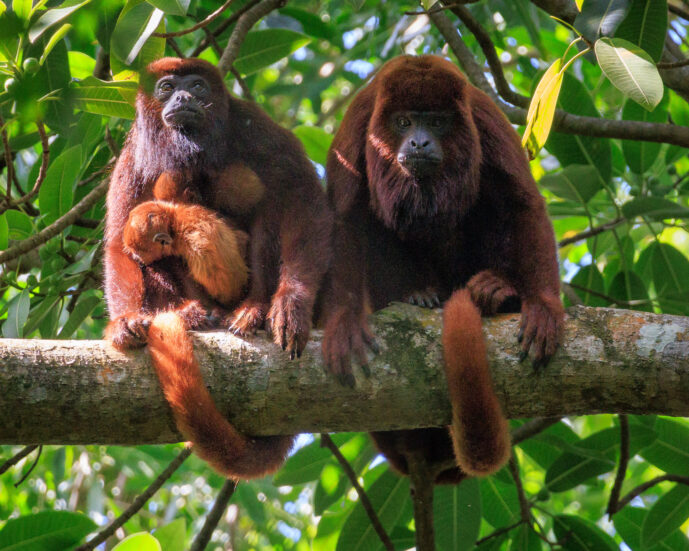
Quick Facts
- Scientific Name: Alouatta seniculus
- Family: Atelidae
- Known Nicknames: Venezuelan red howler, Colombian red howler
- Average Length: 46–72 cm (18–28 in) body; 49–75 cm (19–30 in) tail
- Average Weight: 4.1–9 kg (9–20 lb)
- Wingspan: N/A
- Key Feature: Enlarged hyoid bone facilitating exceptionally loud vocalizations and a thick reddish-brown coat
- Primary Diet: Folivore and Frugivore (primarily leaves, fruits, and flowers)
- Range: Northwestern South America, including Colombia, Venezuela, Ecuador, Peru, and parts of Brazil
- Habitat: Lowland and montane tropical rainforests, gallery forests, and mangroves
- Social Structure: Social (groups of 3 to 10 individuals, typically polygynous)
- Nesting/Breeding: Arboreal canopy
- Statut de conservation : Préoccupation mineure (LC)
- Population Trend: Decreasing
The Red howler monkey (*Alouatta seniculus*) is a striking primate native to the lush rainforests of South America, most famous for its vibrant, deep reddish-orange fur and its thunderous vocalizations. As one of the loudest land animals on Earth, it possesses a specialized, enlarged hyoid bone in its throat that acts as a resonator, allowing its haunting roars to travel up to three miles through the dense canopy to defend territory. Beyond its impressive voice, this monkey is characterized by a powerful prehensile tail—often described as a fifth limb—which features a hairless, sensitive tactile pad on the underside for gripping branches with precision while it forages for leaves and fruit. With its thick beard and slow-moving, deliberate pace, the Red howler monkey is a majestic and essential figure in the neotropical ecosystem, embodying the wild, resonant spirit of the Amazonian wilderness.
Habitats et répartition
This species is widely distributed across northern South America, spanning countries such as Colombia, Venezuela, Ecuador, Peru, and northern Brazil. Its range encompasses vast areas of the Amazon and Orinoco basins, extending from the eastern foothills of the Andes to the Atlantic coast. It is found in a variety of elevations, typically ranging from sea level up to 1,200 meters, though populations have been recorded at higher altitudes in certain mountainous regions.
It primarily inhabits dense tropical rainforests, but it is remarkably adaptable to diverse environments including gallery forests, deciduous dry forests, and swampy mangroves. As a strictly arboreal animal, it spends nearly its entire life in the forest canopy, favoring the middle and upper layers where food is abundant. This adaptability also allows it to persist in fragmented or secondary forests, provided there is sufficient connectivity and a consistent supply of foliage and fruit.
Comportements & Reproduction
Living in small, hierarchical groups typically consisting of one to three adult males and several females, these primates maintain their territory through resonant vocalizations that can travel for miles. Their social structure is defined by a dominant alpha male who oversees the group's movements and defense against rivals. Both males and females often emigrate from their natal groups upon reaching maturity to join or establish new troops, a strategy that minimizes inbreeding. Daily life is largely spent resting and foraging for leaves, with their loud howling serving as a primary means of avoiding physical conflict with neighboring groups by signaling occupancy.
Mating is predominantly polygynous, with the alpha male securing the majority of breeding opportunities. Females generally give birth to a single infant after a gestation period of approximately 190 days. A notable and aggressive reproductive strategy occurs during group takeovers; an incoming dominant male may commit infanticide to eliminate the offspring of his predecessor. This behavior triggers the females to return to estrus more quickly, allowing the new male to sire his own young sooner. Mothers provide intensive care for their infants, who remain physically dependent for several months before gradually integrating into the social hierarchy.
Alimentation
The Red howler monkey is primarily a folivore, maintaining a diet that consists largely of leaves, though it also supplements its intake with fruits, flowers, and occasionally bark or mineral-rich soil. Because leaves are difficult to digest and relatively low in energy, these primates have evolved a specialized, multi-compartmented stomach that hosts symbiotic bacteria to ferment plant cellulose, a physiological trait similar to that of ruminants. A fascinating aspect of their feeding strategy is their high level of selectivity; they predominantly seek out young leaves and buds, which are easier to digest and contain higher protein levels compared to tough, toxin-laden mature foliage. To manage the low caloric yield of their food, Red howler monkeys have a remarkably slow metabolic rate and spend over half of their day resting to conserve energy and facilitate the intensive fermentation process required to extract nutrients from their fibrous meals.
Couleurs
The Red howler monkey is characterized by its thick, vibrant coat ranging from deep coppery-red to golden-maroon, which often darkens toward the tail and limbs. It features a distinctively hairless black face and a prominent, heavy beard of long reddish fur around the throat. This intense rufous coloration provides natural camouflage, allowing the monkey to blend into the shifting shadows and sun-drenched foliage of the tropical forest canopy.
Faits amusants
Red howler monkeys possess a specialized, enlarged hyoid bone in their throats that acts as a resonance chamber, allowing their guttural roars to travel up to three miles through dense jungle. Unlike many of their New World relatives, they have evolved trichromatic vision, which helps them pinpoint the most nutritious young leaves and ripe fruit from a distance. To manage their low-energy leaf-based diet, these primates spend about 80% of their day resting, often anchored by a powerful prehensile tail that features a unique hairless "tactile pad" on the underside for a sensitive, non-slip grip.