Rhinella horribilis
Rhinella horribilis
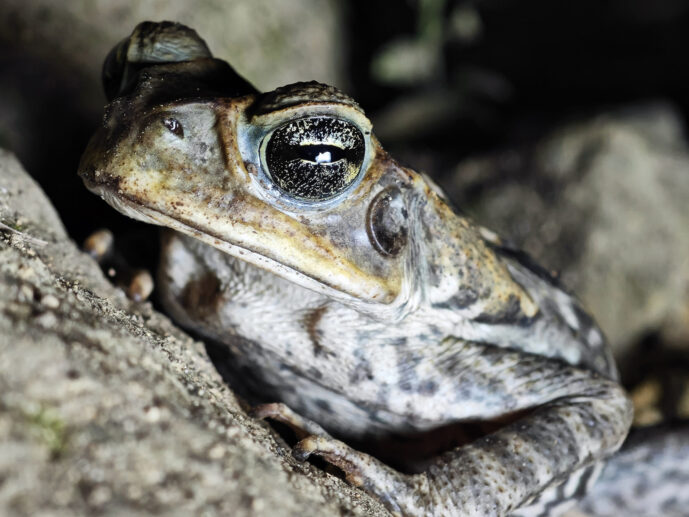
Quick Facts
- Scientific Name: Rhinella horribilis
- Family: Bufonidae
- Known Nicknames: Mesoamerican Cane Toad, Central American Cane Toad, Giant Toad
- Average Length: 10–20 cm / 4–8 in
- Average Weight: 0.45–1.5 kg / 1.0–3.3 lb
- Wingspan: N/A
- Key Feature: Large triangular parotoid glands and prominent cranial ridges
- Primary Diet: Generalist Carnivore (Insects, small vertebrates, and carrion)
- Range: Southern Texas through Mexico and Central America to Northwest South America
- Habitat: Lowland tropical forests, open grasslands, and disturbed anthropogenic environments
- Social Structure: Solitary
- Nesting/Breeding: Lentic water bodies such as ponds, ditches, and slow-moving streams
- Statut de conservation : Préoccupation mineure (LC)
- Population Trend: Stable
The *Rhinella horribilis*, commonly known as the Mesoamerican Cane Toad, is a formidable amphibian distinguished by its massive, robust build and heavily ossified skull featuring prominent bony ridges. Native to regions stretching from southern Texas to northwestern South America, this species is easily recognized by its dry, deeply warty skin—often mottled in earthy tones of brown, olive, and grey—and its exceptionally large, triangular parotoid glands located just behind the eyes. These specialized glands are its most famous feature, secreting a potent, milky cocktail of bufotoxins that serves as a highly effective chemical defense against predators. As one of the largest toads in existence, *Rhinella horribilis* is a resilient and opportunistic nocturnal hunter, capable of thriving in diverse environments ranging from dense tropical rainforests to disturbed suburban landscapes.
Habitats et répartition
This species is distributed from the lower Rio Grande Valley in Texas throughout Mexico and Central America, extending into northwestern South America west of the Andes in Colombia, Ecuador, and Peru. It occupies a wide range of elevations, from coastal lowlands up to approximately 1,500 meters, effectively spanning various climatic zones across the Neotropics. It inhabits a diverse array of environments, including tropical moist and dry forests, shrublands, and open savannas. Known for its extreme adaptability, it thrives in human-modified landscapes such as agricultural fields, suburban gardens, and urban areas. While primarily terrestrial, it requires proximity to permanent or semi-permanent water sources, such as ponds, slow-moving streams, or drainage ditches, for breeding and larval development.
Comportements & Reproduction
Primarily nocturnal and solitary, these toads congregate in large numbers around water sources during the breeding season. Males attract females using a characteristic low-pitched, rhythmic trill, often competing for space at the water's edge. Once a female is selected, mating occurs through axillary amplexus, where the male firmly grasps the female from behind until she is ready to deposit her eggs. The species employs a reproductive strategy focused on extreme fecundity, with females capable of laying tens of thousands of eggs in long, gelatinous strings within shallow, still water. A unique and formidable defense mechanism is the inherent toxicity of their offspring; both eggs and tadpoles contain potent bufotoxins that are lethal to many potential predators. This chemical protection, paired with rapid larval growth, allows the population to thrive and quickly colonize diverse environments.
Alimentation
Rhinella horribilis, commonly known as the Mesoamerican Cane Toad, is a highly opportunistic and generalist predator with a diet primarily consisting of a wide variety of invertebrates, such as beetles, ants, grasshoppers, and spiders. However, its voracious appetite extends to small vertebrates, including other frogs, lizards, small snakes, and even rodents, making it a formidable hunter within its ecosystem. A particularly fascinating aspect of its feeding behavior is its willingness to consume non-living matter; unlike many other amphibians that rely strictly on movement to trigger a strike, this species has been observed eating carrion, fallen fruit, and even household pet food left outdoors. This dietary flexibility, combined with a highly efficient tongue-flicking mechanism, allows the toad to thrive in diverse environments ranging from natural forests to human-altered landscapes where it capitalizes on abundant food sources.
Couleurs
Rhinella horribilis typically displays a cryptic coloration of dull browns, olive-grays, or yellowish-tans, often mottled with darker blotches to mimic leaf litter and soil. Its heavily textured, warty skin may feature reddish-brown accents, while the ventral surface is usually cream-colored with dark speckling. The large, prominent parotoid glands blend seamlessly with the head's coloration, enhancing its overall earthy camouflage.
Faits amusants
Despite its intimidating name, *Rhinella horribilis* acts as a biological "vacuum cleaner," greedily consuming almost anything that fits in its mouth, including small snakes, rodents, and even discarded pet food or charcoal. To protect themselves, these toads are equipped with large parotoid glands that secrete a potent milky toxin, essentially making them walking chemical shields against predators. Their mating call is equally distinctive, consisting of a low-pitched, mechanical trill that sounds more like a distant motorboat or a purring engine than a typical frog croak. Remarkably hardy, they are also among the few amphibians capable of tolerating brackish water, allowing them to colonize coastal areas that would be lethal to most of their relatives.