Royan Terns
Thalasseus maximus
Quick Facts
- Scientific Name: Thalasseus maximus
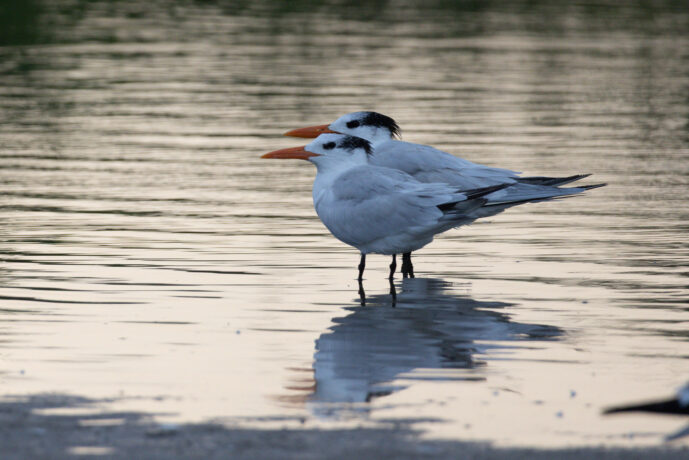
The Royal Tern (*Thalasseus maximus*) is a striking and social seabird easily identified by its impressive size and vibrant, carrot-orange bill. This coastal dweller features a sleek, pale gray mantle and white underparts, but its most distinctive trait is the shaggy black crest that sweeps back from its head like a windblown crown. During the breeding season, this cap is solid black, while in the winter, it recedes to a "balding" appearance with a white forehead. Renowned for their aerial agility, these terns are masterful plunge-divers, hovering high above the surf before dropping like a stone to snatch small fish from the waves. Beyond their physical prowess, Royal Terns are known for their highly communal nature, often nesting in dense colonies where they raise their young in large "creches," a unique nursery system that provides protection and social structure within the bustling coastal environment.
Habitats et répartition
These birds primarily inhabit coastal marine environments, including sandy beaches, barrier islands, estuaries, and salt marshes. They are rarely observed far from the ocean, as they rely on shallow coastal waters for foraging. For breeding, they select open, sandy areas or shell banks with minimal vegetation, often on isolated islands that offer protection from terrestrial predators. The geographical range extends across the Atlantic and Pacific coasts of the Americas, as well as the Atlantic coast of West Africa. In the Americas, they are found from the mid-Atlantic United States and California southward through the Caribbean to Argentina and Peru. The African populations occupy the coastal regions from Mauritania to Angola, where they remain strictly tied to the shoreline throughout the year.
Comportements & Reproduction
Highly social and gregarious, these birds nest in dense colonies that can number in the thousands, providing safety through collective vigilance. Mating begins with elaborate courtship displays, including synchronized aerial glides and ground-based rituals where the male offers small fish to the female as a "nuptial gift." Once a pair bond is formed, they create a simple scrape in the sand to house a single egg, which both parents take turns incubating for approximately four weeks. A defining feature of their reproductive strategy is the formation of crèches. Just a few days after hatching, the chicks leave their individual nest sites to gather in a large communal group. This social structure allows the young to remain protected from predators while the parents are away foraging at sea. Remarkably, despite the presence of hundreds of nearly identical chicks within a crèche, parents are able to locate and feed their specific offspring by recognizing their unique vocal signatures.
Alimentation
Royal Terns are primarily piscivorous, focusing their diet on a variety of small, schooling fish such as anchovies, sardines, menhaden, and croakers, though they also consume crustaceans like shrimp and small crabs. These agile hunters employ a dramatic plunge-diving technique, where they hover briefly above the water before diving headfirst to snatch prey just below the surface. An interesting aspect of their feeding behavior is their tendency toward kleptoparasitism, frequently harassing other seabirds, such as Brown Pelicans, to steal their catch. Furthermore, Royal Terns typically swallow their prey whole and head-first to ensure the fins do not catch in their throat, and they are known to forage almost exclusively in saltwater environments like coastal lagoons and estuaries.
Couleurs
Royal Terns feature pale gray upperparts and white underparts, providing effective countershading camouflage against the sky and sea. They are characterized by a large, bright orange-red bill, black legs, and a distinctive black cap with a shaggy crest that recedes to a white-streaked forehead during the non-breeding season.
Faits amusants
Royal Terns are masters of social coordination, organizing their young into massive "crèches" where parents remarkably identify their own chicks by unique vocalizations among thousands of identical-looking birds. These seabirds are also notorious thieves, frequently practicing kleptoparasitism by harassing brown pelicans until they drop their fish. To manage their high-salt diet, they utilize specialized glands above their eyes to "sneeze" out excess salt crystals. For a final quirky defense, they are known to dive-bomb intruders with targeted defecation to protect their colonies, a tactic as effective as it is unpleasant.