Saffron-crowned Tanager
Tangara xanthocephala
Quick Facts
- Scientific Name: Tangara xanthocephala
- Family: Thraupidae
- Known Nicknames: Tangara coronigualda
- Average Length: 13 cm / 5.1 in
- Average Weight: 15–23 g / 0.5–0.8 oz
- Wingspan: 18–22 cm / 7.1–8.7 in
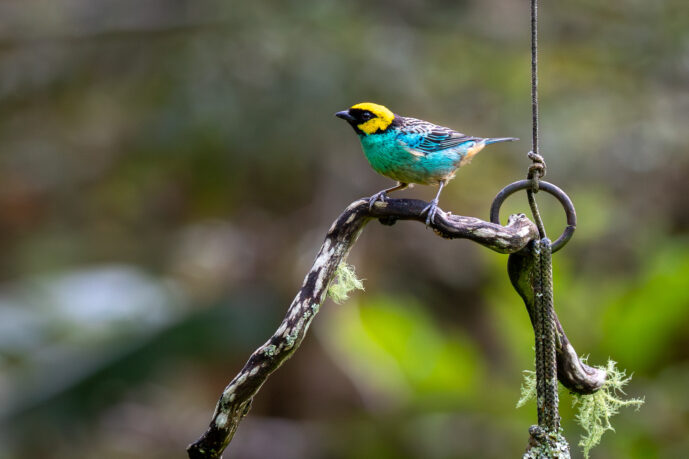
- Key Feature: Vibrant saffron-yellow crown and nape contrasting with a black facial mask
- Primary Diet: Omnivore (Primarily Frugivore and Insectivore)
- Range: Andes Mountains of South America (Venezuela, Colombia, Ecuador, Peru, and Bolivia)
- Habitat: Subtropical or tropical moist montane forests and forest edges
- Social Structure: Social; found in pairs or small groups and frequently joins mixed-species foraging flocks
- Nesting/Breeding: Open-cup nest constructed in trees or shrubs
- Statut de conservation : Préoccupation mineure (LC)
- Population Trend: Stable
The Saffron-crowned Tanager (*Tangara xanthocephala*) is a small, brilliantly colored songbird that brings a burst of radiance to the humid montane forests of the Andes. True to its name, this bird is most distinguished by its luminous, golden-yellow head, which contrasts sharply with a velvety black mask surrounding its eyes and throat. Its body is a stunning mosaic of opalescent sea-green and turquoise-blue feathers, accented by bold black streaking across its back and wings. Often seen flitting through the canopy in lively, mixed-species flocks, this tanager is as social as it is beautiful, darting with agile grace to forage for small fruits and insects. Its glowing plumage and energetic personality make it one of the most captivating jewels of the South American cloud forests.
Habitats et répartition
This species primarily inhabits humid montane forests and cloud forests along the slopes of the Andes, where it is frequently found in the canopy, forest edges, and lush second-growth woodlands. It favors areas of high humidity and dense vegetation, often occurring at elevations between 1,000 and 2,500 meters. Its geographical range extends across the Andean highlands of South America, encompassing northern Venezuela, Colombia, Ecuador, Peru, and central Bolivia. Within this broad distribution, it is restricted to the subtropical and lower temperate zones, where it navigates the mountain slopes in search of fruit and insects.
Comportements & Reproduction
Typically found in pairs or small family units, these birds are highly social and frequently join mixed-species foraging flocks within the canopy of humid montane forests. They exhibit a restless and active foraging style, hopping quickly through moss-covered branches to glean insects and fruit. This gregarious behavior allows them to benefit from the collective vigilance of a larger group while maintaining strong pair bonds through constant proximity and vocal communication. During the breeding season, they form monogamous pairs and construct compact, cup-shaped nests hidden within dense foliage or epiphytes. These nests are primarily built by the female using moss and fine rootlets to provide camouflage against predators. A typical clutch consists of two eggs, and while the female handles the majority of the incubation, both parents are deeply involved in provisioning the nestlings. This biparental care is essential for the survival of the young in their competitive high-altitude habitats.
Alimentation
The Saffron-crowned Tanager maintains an omnivorous diet that primarily consists of a variety of small fruits, berries, and a wide array of insects and spiders. Foraging actively within the high canopy of montane forests, these birds are frequently seen in mixed-species flocks where they employ agile, almost acrobatic techniques to secure their meals. An interesting aspect of their feeding behavior is their versatility; they often glean arthropods from the undersides of leaves or mossy branches while hanging upside down, and they are also known to perform short aerial sallies to catch flying insects mid-air. While they rely heavily on the sugary energy of fruits like those from the Melastomataceae family, their constant movement and consumption of whole berries make them vital seed dispersers within their Andean ecosystem.
Couleurs
The Saffron-crowned Tanager is defined by its brilliant golden-yellow crown and nape, framed by a sharp black facial mask and throat. Its back displays a scaly texture of black feathers edged in opaline green or turquoise, while the wings and tail are black with vibrant blue margins. The underparts are a pale, shimmering blue-green, creating a high-contrast palette that aids in blending with the dappled sunlight and mossy foliage of its Andean cloud forest habitat.
Faits amusants
These birds are the ultimate socialites of the Andes, frequently acting as core members and leaders of mixed-species foraging flocks. They are renowned for their "acrobatic" feeding style, often hanging completely upside down from thin twigs to pluck berries or glean insects from the undersides of leaves. Despite their brilliant, high-contrast yellow heads, they are masters of concealment when it matters most; they expertly camouflage their cup-shaped nests deep within thick clumps of moss and epiphytes, making them nearly invisible to predators in the misty cloud forest canopy.