Squirrel Cuckoo
Piaya cayana
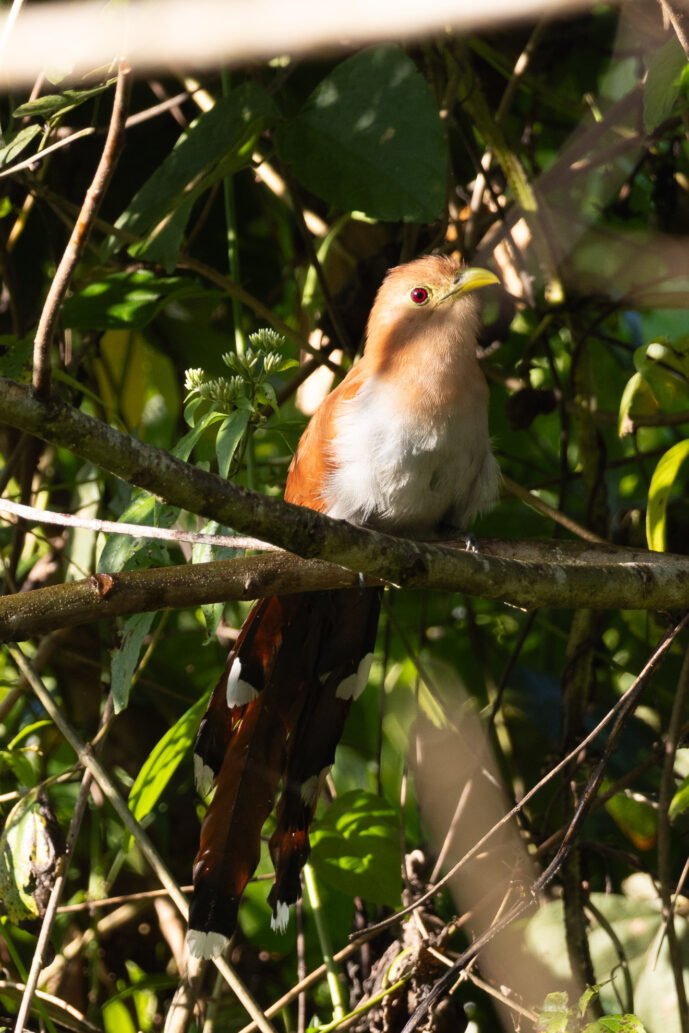
Quick Facts
- Scientific Name: Piaya cayana
- Family: Cuculidae
- Known Nicknames: Alma-de-gato, Cuco ardilla, Chestnut Cuckoo
- Average Length: 40.5–50 cm / 16–20 in
- Average Weight: 95–120 g / 3.4–4.2 oz
- Wingspan: 45–55 cm / 18–22 in
- Key Feature: Extremely long, graduated tail with white-tipped black feathers and bright chestnut upperparts
- Primary Diet: Insectivore (primarily large insects, caterpillars, and cicadas)
- Range: Northwestern Mexico to Northern Argentina and Uruguay
- Habitat: Canopy and edges of humid forests, woodlands, and second growth
- Social Structure: Solitary or in pairs; occasionally joins mixed-species flocks
- Nesting/Breeding: Shallow cup nest of twigs and leaves hidden in dense foliage
- Statut de conservation : Préoccupation mineure (LC)
- Population Trend: Decreasing
The Squirrel Cuckoo (*Piaya cayana*) is a striking Neotropical bird named for its uncanny, squirrel-like habit of scurrying nimbly through the forest canopy rather than relying solely on flight. Measuring up to 18 inches in length, it is easily identified by its exceptionally long, graduated tail, which features bold black-and-white banding on the underside that creates a dramatic display during movement. Its plumage is a rich, warm chestnut on the upperparts, contrasting beautifully with a pale gray underbelly, a vibrant lime-yellow bill, and a distinct red ring around the eye. Unlike many other cuckoo species, the Squirrel Cuckoo is not a brood parasite; it builds its own nests and is a dedicated hunter, gracefully "leaping" between branches to snatch up insects and small lizards, making it a charismatic and acrobatic fixture of Central and South American woodlands.
Habitats et répartition
This species occupies an extensive range stretching from northwestern and northeastern Mexico, through Central America, and deep into South America as far south as northern Argentina, Uruguay, and southern Brazil. It is found across a wide variety of elevations, from coastal lowlands up to approximately 2,500 meters in the Andean foothills. Within this broad range, it inhabits a diverse array of wooded environments, including primary tropical rainforests, deciduous woodlands, gallery forests, and mangroves. It is particularly common in forest edges and semi-open areas with dense secondary growth. While it primarily stays within the canopy and mid-story foliage to forage, it occasionally ventures into coffee plantations and suburban gardens with sufficient tree cover.
Comportements & Reproduction
Primarily arboreal and remarkably agile, this species moves through the canopy with a fluid, leaping motion that mimics the scurrying of a rodent. While generally solitary or found in monogamous pairs, individuals occasionally join mixed-species foraging flocks to hunt for insects and small vertebrates. They are highly territorial and use a variety of explosive, rhythmic calls to communicate with mates and signal their presence to rivals within their home ranges. Unlike many other members of the cuckoo family, this species is not a brood parasite and instead constructs its own shallow, cup-shaped nest out of leaves and twigs hidden in dense foliage. Mating is preceded by courtship rituals where the male offers nuptial gifts, such as large caterpillars, to the female to strengthen the pair bond. Both parents share the responsibilities of incubating the two white eggs and providing food for the rapidly developing chicks until they are ready to fledge.
Alimentation
The Squirrel Cuckoo maintains a primarily insectivorous diet, expertly hunting large arthropods such as cicadas, grasshoppers, crickets, and spiders within the forest canopy. One of the most intriguing aspects of its feeding behavior is its predilection for large, hairy, or stinging caterpillars; the bird often vigorously beats these larvae against branches to neutralize their defensive hairs or toxins before consumption. While it occasionally supplements its meals with small vertebrates like lizards and frogs or small fruits and berries, it is particularly noted for its opportunistic foraging strategies. Specifically, the Squirrel Cuckoo is frequently observed following army ant columns, not to eat the ants themselves, but to capture the various insects and small creatures that are flushed out of hiding by the advancing swarm.
Couleurs
The Squirrel Cuckoo features vibrant cinnamon-brown upperparts and a long, graduated tail marked by bold white tips on a dark underside. Its underparts are pale gray, accented by a yellowish-green bill and a striking red orbital ring around the eye. This rufous plumage provides effective camouflage within the sun-dappled canopy, allowing the bird to blend seamlessly with reddish-brown branches and dense foliage.
Faits amusants
True to its name, the Squirrel Cuckoo is known for its remarkably squirrel-like agility, often choosing to run and leap through dense canopy branches rather than flying. It possesses a specialized digestive adaptation that allows it to feast on large, stinging, hairy caterpillars that most other birds avoid, often thrashing the larvae against branches to remove irritating hairs before swallowing. Unlike many of its famous cousins, this species is not a brood parasite; it builds its own cup-shaped nests and diligently raises its own young. Additionally, it is a clever opportunist that frequently follows army ant swarms to snatch up insects fleeing from the advancing predators.