Toco Toucan
Ramphastos toco
Quick Facts
- Scientific Name: Ramphastos toco
- Family: Ramphastidae
- Known Nicknames: Common Toucan, Giant Toucan
- Average Length: 55–65 cm / 22–26 in
- Average Weight: 0.5–0.88 kg / 1.1–1.9 lb
- Wingspan: 100–120 cm / 39–47 in
- Key Feature: Massive orange-yellow bill with a distinctive black spot at the tip
- Primary Diet: Primarily Frugivorous (also consumes insects, eggs, and small reptiles)
- Range: Central and Eastern South America (Brazil, Bolivia, Paraguay, Argentina)
- Habitat: Semi-open habitats including woodlands, savannas, and forest edges
- Social Structure: Small flocks or pairs
- Nesting/Breeding: Tree cavities
- Statut de conservation : Préoccupation mineure (LC)
- Population Trend: Decreasing
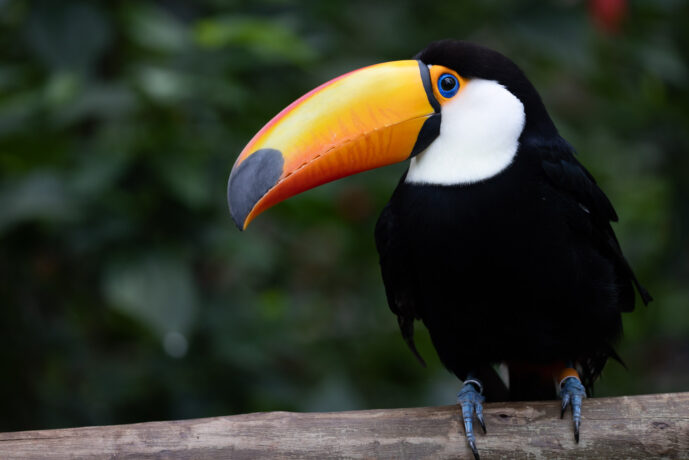
The Toco Toucan (*Ramphastos toco*) is the largest and most iconic member of the toucan family, instantly recognizable by its colossal, neon-orange beak that can account for nearly one-third of its total body length. While this massive bill appears heavy, it is actually a lightweight marvel of biological engineering made of keratin-covered bone struts, serving both as a precision tool for reaching distant fruit and as a sophisticated thermal radiator to regulate body temperature. Its striking appearance features a sleek black plumage contrasted by a brilliant white throat and vibrant blue skin surrounding the eyes. Unlike many of its relatives that prefer deep rainforests, the Toco Toucan thrives in the more open woodlands and savannas of South America, where it uses its specialized zygodactyl feet—two toes facing forward and two backward—to hop with surprising agility through the canopy.
Habitats et répartition
This species is native to central and eastern South America, maintaining a broad range that encompasses central and eastern Brazil, eastern Bolivia, Paraguay, and northern Argentina. Unlike many other members of its family, it is generally absent from the dense interior of the Amazon rainforest, instead favoring the more open landscapes of the Cerrado and Pantanal regions. Its preferred habitats include semi-open areas such as tropical savannas, light woodlands, forest edges, and palm groves. It is highly adaptable and frequently occupies human-modified environments, including fruit plantations, cattle ranches, and suburban parks, provided there are sufficient scattered trees for nesting and foraging.
Comportements & Reproduction
These birds typically live in pairs or small family groups, engaging in social behaviors such as mutual preening and "bill-fencing," where individuals tap their large beaks together or toss fruit to one another to strengthen bonds. During the breeding season, they exhibit monogamous mating habits, with courtship rituals centered around the male offering fruit to the female. While they are highly visible during the day, they are also known to be territorial around their chosen nesting sites, defending them from potential competitors. Nesting occurs in hollow tree cavities, often utilizing abandoned woodpecker holes or occasionally termite mounds. Both parents share the responsibilities of incubating the clutch of two to four eggs and feeding the altricial young. A unique reproductive adaptation is the development of specialized heel pads on the chicks; these protective structures cushion the nestlings against the rough floor of the cavity, remaining until they are ready to fledge at approximately six to eight weeks of age.
Alimentation
The Toco Toucan is primarily a frugivorous species, consuming a vast array of tropical fruits such as figs, oranges, and guavas, but it is also an opportunistic feeder that supplements its intake with insects, small lizards, frogs, and the eggs or nestlings of other birds. Its iconic, oversized bill serves as a specialized tool that allows the bird to reach fruit on branches too thin to support its weight and is used with remarkable dexterity to peel skins or toss food items into the air to be swallowed whole. Interestingly, because they digest the pulp of the fruit and regurgitate the large seeds intact, Toco Toucans play a vital ecological role as seed dispersers, helping to maintain the biodiversity and regeneration of their native habitats.
Couleurs
The Toco Toucan features a predominantly black body contrasted by a brilliant white throat and chest. Its most striking attribute is a massive, vibrant orange-yellow bill tipped with a large black spot and a black base. Distinctive blue skin encircles the eyes within a patch of bright orange, while the undertail coverts are a vivid red. This bold, high-contrast patterning serves as social signaling and provides disruptive camouflage among the sun-dappled foliage of the forest canopy.
Faits amusants
The Toco Toucan possesses a massive bill that serves as a sophisticated biological radiator, regulating body temperature by adjusting blood flow to the surface. Despite its size, the beak is surprisingly light due to a hollow, honeycomb-like structure of keratin. When it is time to sleep, these birds exhibit a quirky behavior by tucking their long beaks under their wings and folding their tails forward to transform into a compact, feathery ball. Additionally, their tongues are long, flat, and fringed with bristles, resembling a feather, which helps them taste and manipulate fruit before they toss it back into their throats with a distinctive flick.