King Vulture
Sarcoramphus papa
Quick Facts
- Scientific Name: Sarcoramphus papa
- Family: Cathartidae
- Known Nicknames: Rey de los zopilotes, King of the vultures
- Average Length: 67–81 cm / 26–32 in
- Average Weight: 2.7–4.5 kg / 6–10 lb
- Wingspan: 120–200 cm / 47–79 in
- Key Feature: Vibrantly colored, featherless head and neck with a fleshy orange caruncle on the cere
- Primary Diet: Scavenger (Carrion)
- Range: Southern Mexico to Northern Argentina
- Habitat: Lowland Tropical Rainforests and Savannas
- Social Structure: Solitary or in small family groups
- Nesting/Breeding: Tree hollows, stumps, or ground in dense vegetation
- Statut de conservation : Préoccupation mineure (LC)
- Population Trend: Decreasing
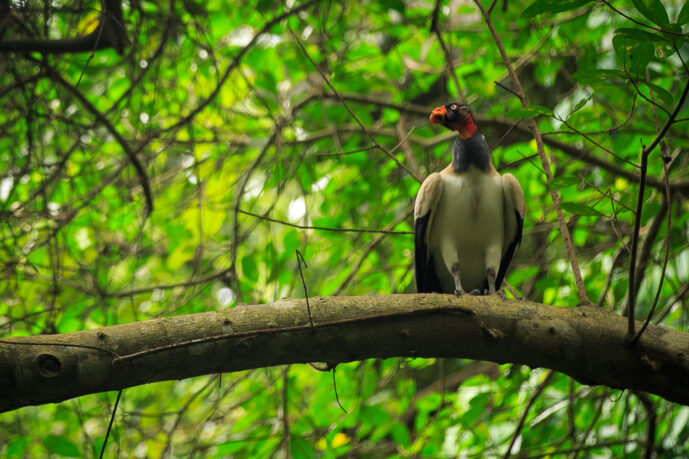
The King Vulture (*Sarcoramphus papa*) is a strikingly regal scavenger that stands out as one of the most colorful birds of prey in the tropical forests of Central and South America. While most vultures possess somber plumage, the King Vulture boasts a creamy white body contrasted by dark grey flight feathers and a thick, velvety neck ruff. Its most arresting feature is its featherless head and neck, which display a vivid kaleidoscope of orange, yellow, red, and purple skin, topped with a distinctive, fleshy orange caruncle above its powerful hooked beak. True to its name, this large raptor dominates the scavenging hierarchy; its superior size and immense beak strength allow it to tear through tough hides that smaller vultures cannot, granting it "royal" priority at every carcass it discovers.
Habitats et répartition
The geographical range of this species extends from southern Mexico through Central America and across South America to northern Argentina and Uruguay. It is primarily a resident of lowland tropical forests, typically staying below elevations of 1,200 meters, though it is occasionally spotted in higher regions up to 2,500 meters. In addition to dense primary rainforests, it inhabits various open and semi-open landscapes, including savannas, grasslands, and marshes, provided there is nearby forest cover for nesting and roosting. It tends to avoid heavily degraded habitats, preferring relatively undisturbed environments where it can soar above the canopy to search for carrion.
Comportements & Reproduction
These birds are primarily solitary or live in small family groups, rarely forming large flocks except when congregating at a carcass. As dominant scavengers, they use their powerful beaks to tear through tough hides that smaller species cannot penetrate, often dictating the feeding order through sheer size and aggression. They spend much of their day soaring on thermal updrafts to locate carrion using keen eyesight, frequently following smaller vultures that possess a better sense of smell to lead them to food. Reproduction is characterized by monogamous pairings and elaborate courtship displays that involve mutual preening and synchronized movements on the ground. They do not construct traditional nests; instead, a single white egg is laid in the hollow of a rotting stump, a tree cavity, or a secluded cliff crevice. Both parents share the duties of incubation and cooperate in feeding the chick via regurgitation. This high level of parental investment is necessary for the survival of their slow-developing young, which may remain dependent on the adults for several months.
Alimentation
The King Vulture is a specialized scavenger that feeds almost exclusively on carrion, ranging from deceased fish and reptiles to large mammals like cattle, deer, and tapirs. Unlike many other New World vultures that rely on a highly developed sense of smell to locate food, the King Vulture primarily uses its acute eyesight to spot carcasses or follows smaller vultures, such as Turkey Vultures, to a meal. It occupies a dominant position in the scavenging hierarchy due to its large size and exceptionally powerful, hooked beak, which is strong enough to tear through the thick, tough hides of large animals that other scavengers cannot penetrate. By being the first to "open" a carcass, it provides access for smaller birds to feed, performing a vital ecological service by efficiently disposing of organic waste and helping to limit the spread of diseases within its tropical habitat.
Couleurs
The King Vulture features a striking contrast between its creamy-white body and jet-black flight feathers and tail. Its unfeathered head and neck display a vibrant mosaic of red, orange, yellow, and purple skin, topped with a distinctive orange fleshy caruncle on the beak. Piercing white eyes are encircled by prominent red rings. This predominantly white plumage serves as high-altitude camouflage, making the bird less visible against the bright sky when viewed from below.
Faits amusants
The King Vulture is a master of scavenge-site politics, using its massive size and powerful beak to dominate carcasses and tear through tough hides that smaller vultures cannot penetrate. Despite their regal appearance, they lack a syrinx, meaning they are incapable of singing and can only produce low croaks or hisses. To stay cool in tropical heat, they practice urohidrosis, a process where they intentionally defecate on their own legs to lower their body temperature through evaporation. While many of its relatives rely on a keen sense of smell, the King Vulture primarily uses its exceptionally sharp eyesight to spot meals or follow other birds to a find. These birds also held deep spiritual significance in ancient Mayan culture, where they were depicted as divine messengers that carried communications between humans and the gods.