White-fronted capuchin
Cebus albifrons
Quick Facts
- Scientific Name: Cebus albifrons
- Family: Cebidae
- Known Nicknames: Humboldt's white-fronted capuchin, White-faced capuchin
- Average Length: 75–93 cm / 30–36 in (including tail)
- Average Weight: 1.7–3.4 kg / 3.7–7.5 lb
- Wingspan: N/A
- Key Feature: Light-colored or white forehead and face contrasting with a dark brown cap on the crown
- Primary Diet: Omnivore (Primarily Frugivore and Insectivore)
- Range: Northern South America, including the Amazon Basin of Brazil, Colombia, Peru, Ecuador, and Venezuela
- Habitat: Lowland tropical rainforest, flooded forests (igapó and várzea), and montane forests
- Social Structure: Highly Social (Groups of 15–35 individuals)
- Nesting/Breeding: Tree canopy (young are carried on the mother's back)
- Statut de conservation : Préoccupation mineure (LC)
- Population Trend: Decreasing
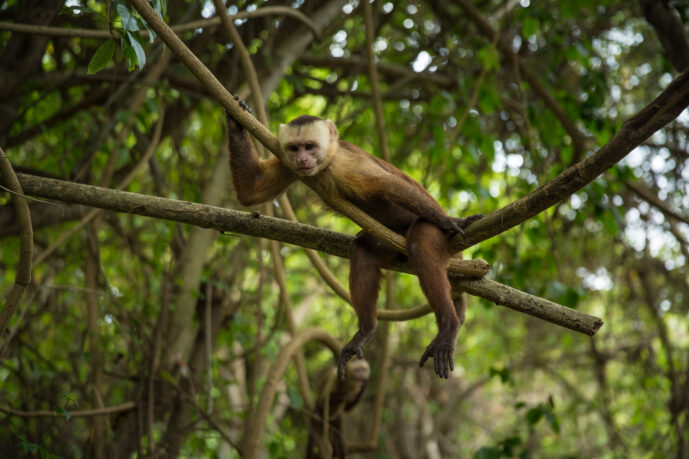
The White-fronted capuchin (*Cebus albifrons*) is a remarkably intelligent and agile primate native to the lush rainforests of the Amazon basin. Easily identified by its slender build and the striking contrast between its light tan or brown body and its creamy white face, throat, and shoulders, this monkey also sports a distinctive dark "cap" of fur atop its head. Beyond its elegant appearance, the species is celebrated for its high brain-to-body mass ratio, which translates into complex social behaviors and the sophisticated use of tools for foraging. Navigating the high canopy with the help of a versatile prehensile tail that acts as a fifth limb, these vocal and energetic primates live in organized social troops, playing a vital ecological role as seed dispersers throughout their tropical habitat.
Habitats et répartition
Distributed throughout northwestern South America, this species occupies a vast range that includes the Amazon Basin and the eastern slopes of the Andes. Its territory encompasses parts of Colombia, Venezuela, Brazil, Peru, Ecuador, and Bolivia, extending as far as the island of Trinidad.
It thrives in a diverse array of environments, ranging from primary tropical rainforests and secondary growth to seasonally flooded forests known as várzea and igapó. Additionally, it is found in gallery forests, mangroves, and deciduous woodlands, typically favoring the lower and middle canopy levels for its daily activities.
Comportements & Reproduction
These primates organize into complex multi-male and multi-female groups, typically consisting of 15 to 35 individuals. Their social structure is matrilineal, meaning females remain in their birth groups for life while males disperse to find new troops upon reaching maturity. A linear dominance hierarchy regulates social interactions, with grooming serving as a vital tool for maintaining bonds and reducing tension. They are highly intelligent and display cooperative behaviors, particularly when foraging or defending their shared territory from neighboring groups.
Reproduction is characterized by a polygamous mating system where females often initiate courtship through specific vocalizations and proceptive displays. Following a gestation period of about five months, a single offspring is born, receiving intensive care not only from the mother but also from other group members. This practice of alloparenting is a key reproductive strategy, as it allows the mother more time to forage while ensuring the infant remains protected. Breeding can occur year-round, though births often peak during periods of high fruit abundance to ensure the survival of the young.
Alimentation
The white-fronted capuchin is a highly versatile omnivore whose diet primarily consists of succulent fruits, which make up the majority of its caloric intake, supplemented significantly by animal matter such as insects, spiders, and small vertebrates like lizards or nesting birds. These primates are renowned for their extractive foraging techniques, often spending a considerable portion of their day peeling bark, snapping twigs, or manipulating dense foliage to uncover hidden larvae and invertebrates. An intriguing aspect of their feeding behavior is their remarkable adaptability to seasonal changes; during periods of fruit scarcity, they transition to consuming palm nuts, nectar, and even the soft pith of various plants to survive. Furthermore, they play a crucial role in their ecosystem as effective seed dispersers, as they often travel long distances after consuming fruit and deposit seeds in new locations, which significantly aids in tropical forest regeneration.
Couleurs
The White-fronted capuchin features a light brown or grayish-tan torso contrasted by a signature pale cream or white forehead and face. A dark brown patch or "cap" marks the crown, while the limbs and underside often display lighter, yellowish tones. These earthy, neutral shades serve as effective camouflage, blending the monkey into the dappled light and shadows of the tropical forest canopy.
Faits amusants
White-fronted capuchins are highly resourceful primates known for "anointing" their fur by rubbing it with crushed millipedes or citrus fruits to act as a natural insect repellent. They are among the few non-human species to use tools, frequently employing heavy stones as hammers to crack open hard-shelled nuts. Their prehensile tail is exceptionally dexterous, functioning as a fifth limb that allows them to hang securely while using both hands for complex tasks. Perhaps most bizarre is their "eye-poking" social ritual, where individuals poke their fingers into a companion's eye sockets or nostrils as a peculiar way to test trust and reinforce social bonds within the troop.