Wild Turkey
Meleagris gallopavo
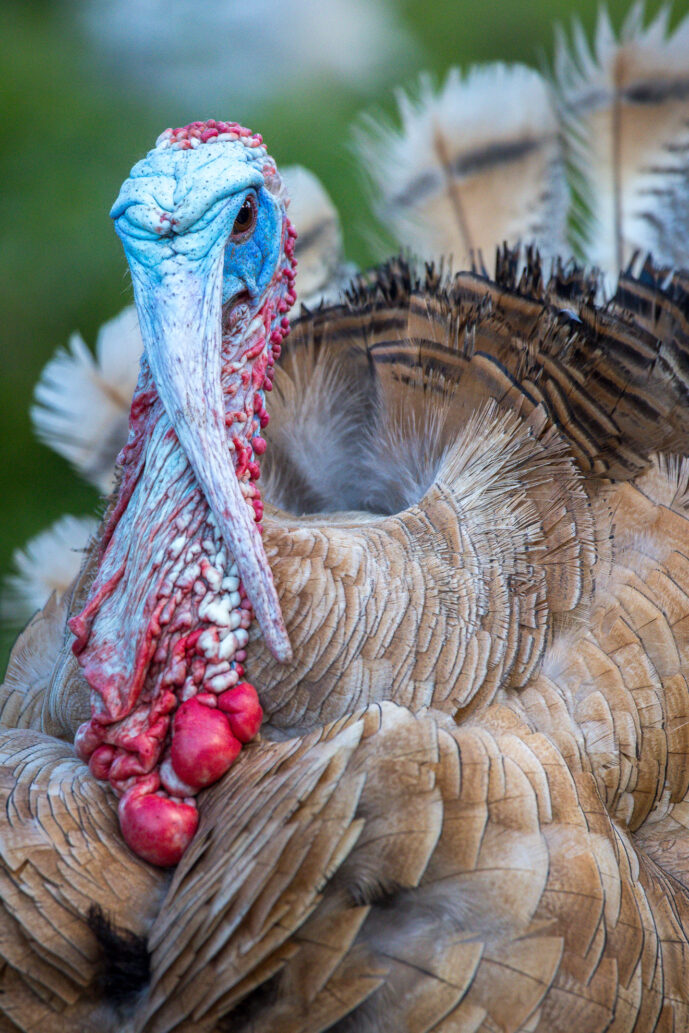
Quick Facts
- Scientific Name: Meleagris gallopavo
- Family: Phasianidae
- Known Nicknames: Tom, Gobbler, Hen, Jake, Bearded Bird
- Average Length: 76–125 cm / 30–49 in
- Average Weight: 2.5–11 kg / 5.5–24 lb
- Wingspan: 125–144 cm / 49–57 in
- Key Feature: Iridescent bronze plumage, fan-shaped tail, and fleshy facial caruncles including the snood and wattle
- Primary Diet: Omnivore (seeds, nuts, berries, insects, and small reptiles)
- Range: North America, ranging from Southern Canada through the United States to Central Mexico
- Habitat: Open woodlands, mature hardwood forests with clearings, and agricultural fields
- Social Structure: Gregarious (highly social, living in flocks often segregated by sex)
- Nesting/Breeding: Ground nests (shallow depressions lined with leaves and grass in dense cover)
- Statut de conservation : Préoccupation mineure (LC)
- Population Trend: Increasing
The Wild Turkey (*Meleagris gallopavo*) is a majestic and surprisingly agile bird native to North America, distinguished by its large, pear-shaped body and iridescent plumage that shimmers with metallic shades of bronze, copper, and green. Its most striking features are found on its featherless head and neck, which can shift in color between red, blue, and white depending on the bird's emotional state, alongside unique fleshy appendages known as the snood and wattle. Mature males, or toms, are famous for their magnificent fan-shaped tails and the coarse, hair-like "beard" that protrudes from their chests. While often perceived as slow-moving ground-dwellers, these intelligent birds are capable of powerful short-distance flight to roost in trees and can reach impressive running speeds of up to 25 miles per hour, making them a dynamic and resilient symbol of the American wilderness.
Habitats et répartition
This species is native to North America, with a vast geographical range extending from southern Canada through the continental United States and into northern Mexico. Following successful conservation and reintroduction efforts, populations are now established in nearly every U.S. state. They occupy a diverse array of landscapes, ranging from the arid scrublands of the Southwest to the lush eastern deciduous forests and even suburban fringes. Their preferred habitat typically consists of mature hardwood or mixed conifer-hardwood forests interspersed with open areas like fields, pastures, and orchards. These environments provide a necessary balance of resources: large trees offer secure nocturnal roosting sites, while open clearings are essential for foraging, mating displays, and brood rearing. Access to water and a steady supply of mast-producing trees, such as oaks and hickories, are critical factors in their habitat selection.
Comportements & Reproduction
Highly social and organized by a strict pecking order, these birds live in flocks that typically segregate by sex outside of the breeding season. During the spring mating period, males engage in elaborate polygynous courtship displays to attract a harem of females. This behavior, known as "strutting," involves the male fanning his tail feathers, dragging his wings against the ground, and puffing out his plumage while the fleshy skin on his head and neck changes between vibrant shades of red, white, and blue. In a unique reproductive strategy, subordinate males may cooperate with their dominant brothers during these displays; while only the dominant male mates, this teamwork increases the likelihood of their shared genetic lineage being passed on. After mating, the female selects a well-concealed ground site to scratch out a shallow nest, where she lays a clutch of approximately 10 to 14 eggs. She incubates the eggs alone for nearly a month, during which time she remains highly secretive to avoid detection by predators. The young are precocial, meaning they are born with downy feathers and the ability to forage for food alongside their mother within 24 hours of hatching. To enhance survival rates, several hens and their offspring often coalesce into large nursery flocks, providing more eyes to watch for threats during the critical early weeks of the chicks' development.
Alimentation
The wild turkey is a highly opportunistic omnivore whose diet shifts significantly based on seasonal availability and habitat. They primarily forage on the ground, scratching through leaf litter to find hard mast such as acorns, beech nuts, and hickory nuts, which serve as crucial fat sources during the winter months. Their plant-based consumption also includes a variety of seeds, berries, grasses, tubers, and agricultural grains. To supplement their protein intake, especially during the breeding season, turkeys consume a wide array of insects, spiders, and snails, and they are even known to hunt small vertebrates like lizards, frogs, and snakes. An interesting physiological adaptation is their use of a gizzard—a muscular part of the stomach—where they store swallowed grit and small stones to help grind up tough nuts and fibrous vegetation. Additionally, turkeys possess a specialized throat pouch called a crop, which allows them to quickly gather and store a large volume of food to be digested later in the safety of dense cover.
Couleurs
Wild turkeys display dark, iridescent plumage with metallic bronze, copper, and green highlights that provide camouflage in dappled forest light. Their wings and fan-shaped tails are marked with distinct white or buff bars, while males feature a bare, fleshy head that shifts between vibrant red, white, and blue depending on their mood. Females possess duller, brown-toned feathers for nesting concealment, utilizing these mottled patterns to blend seamlessly into the woodland leaf litter.
Faits amusants
Despite their bulky appearance, these birds can reach flight speeds of 55 miles per hour and sprint on land at nearly 25 miles per hour. They possess a unique anatomical feature called a snood—a fleshy appendage on the forehead—which changes color and length based on their mood or health. Remarkably, a turkey’s sex can be determined by the shape of its droppings; males produce J-shaped waste, while females leave behind spiral-shaped coils. To stay safe from nocturnal predators, they fly into the canopies of trees to roost at night. Additionally, their vision is three times sharper than a human's and covers a 270-degree field, allowing them to spot movement from great distances.