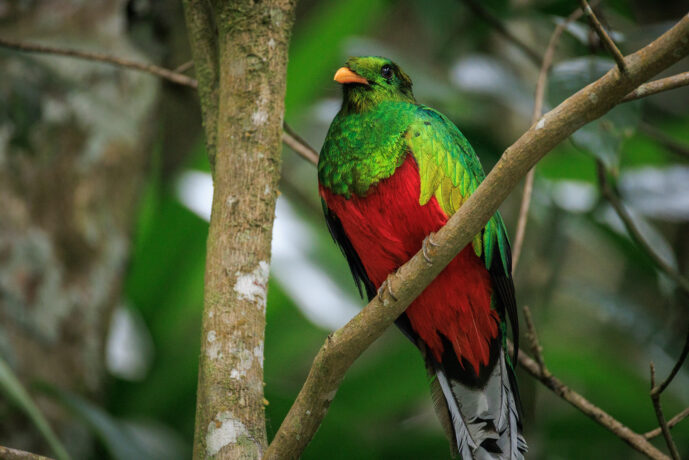
Golden-headed Quetzal (male)
Pharomachrus auriceps
Quick Facts
- Scientific Name: Pharomachrus auriceps
- Spanish Name: Quetzal cabecidorado
- Family: Trogonidae
- Known Nicknames: Golden-headed Trogon
- Average Length: 33–36 cm / 13–14 in
- Average Weight: 154–182 g / 5.4–6.4 oz
- Wingspan: 30–36 cm / 12–14 in
- Key Feature: Iridescent green plumage with a distinct golden-bronze head and vibrant red lower breast and belly
- Primary Diet: Primarily Frugivorous (specializing in Lauraceae fruits), occasionally Insectivorous
- Range: Eastern Panama and the Andes of Colombia, Venezuela, Ecuador, Peru, and Bolivia
- Habitat: Humid montane forests and cloud forests
- Social Structure: Solitary or paired
- Nesting/Breeding: Tree cavities, often abandoned woodpecker holes
- Statut de conservation : Préoccupation mineure (LC)
- Population Trend: Decreasing
The Golden-headed Quetzal (*Pharomachrus auriceps*) is a breathtaking inhabitant of the high-altitude cloud forests of South America, renowned for its dazzling, iridescent emerald plumage and a vibrant crimson belly. Living up to its name, the male displays a magnificent golden-bronze crown that shimmers against the misty canopy, while its elongated tail feathers add an air of regal elegance to its silhouette. Beyond its striking aesthetics, this bird possesses specialized large eyes for navigating the dim forest light and a wide bill perfectly adapted for consuming its favorite meal: wild avocados. As a vital seed disperser, the Golden-headed Quetzal is not only a visual masterpiece of nature but also a cornerstone of its delicate ecosystem, captivating observers with its haunting, flute-like calls and secretive, mystical presence.
Faits amusants
The Golden-headed Quetzal acts as a vital forest gardener by swallowing wild avocados whole and later regurgitating the large pits, effectively replanting its own habitat across the cloud forest. To navigate the perpetual gloom of the canopy, it possesses oversized eyes that provide exceptional low-light vision, allowing it to spot fruit and small insects in deep shadow. Despite its vibrant plumage, this bird is a master of "still-hunting," remaining perfectly motionless for long periods to avoid detection by predators. During courtship, males perform a dramatic "sky-dance," spiraling high above the trees before plunging downward to showcase their shimmering, ribbon-like tail feathers.
Habitats et répartition
Its geographical range extends from eastern Panama through the Andes of Colombia and Venezuela, continuing south through Ecuador and Peru into northern Bolivia. Within these territories, it is primarily found in humid montane forests and cloud forests, typically at elevations ranging from 1,200 to 3,100 meters. These habitats are characterized by high moisture levels and dense vegetation, where the species favors the canopy and sub-canopy layers. It relies on the presence of decaying tree trunks for nesting and resides in areas with a steady supply of fruiting trees, particularly those in the laurel family, which are essential for its diet.
Comportements & Reproduction
These birds are primarily solitary or found in monogamous pairs, maintaining a quiet and somewhat sedentary presence within the canopy of humid montane forests. They are highly territorial during the breeding season, with males using melodic, fluting calls and occasional aerial displays to define their boundaries and attract mates. While generally non-social outside of the breeding period, they may briefly congregate at abundant fruiting trees, though they remain largely independent in their foraging habits. Mating involves a collaborative effort to excavate a nest cavity in decaying tree trunks or to repurpose abandoned woodpecker holes. The female typically lays two pale blue eggs, which both parents take turns incubating; the male usually covers the daylight hours while the female remains on the nest overnight. Once the chicks hatch, both adults participate in brooding and feeding, initially providing a diet of insects before transitioning to small fruits and lipids. This biparental care and shared nest maintenance are essential strategies for ensuring the survival of their young in the competitive cloud forest environment.
Alimentation
The Golden-headed Quetzal is primarily a frugivore with a specialized preference for the fruits of the laurel family, particularly wild avocados known as aguacatillos. While fruit makes up the majority of its sustenance, this bird is also opportunistic, supplementing its diet with protein-rich sources such as insects, beetles, small frogs, and lizards, especially during the breeding season to provide essential nutrients for its young. An intriguing aspect of its feeding behavior is that it typically plucks fruit mid-air while hovering briefly before returning to a nearby branch to feed. Because it swallows fruits whole and possesses a specialized digestive system that strips the pulp, the quetzal plays a vital ecological role by regurgitating the large seeds intact, thereby acting as a primary seed disperser for many montane forest tree species.
Couleurs
The Golden-headed Quetzal features iridescent emerald-green upperparts and breast, which provide effective camouflage against mossy cloud forest foliage. Males are distinguished by a vibrant golden-bronze head, a brilliant scarlet belly, and a bright yellow bill, while their wings and tail are primarily black. This metallic plumage creates a shimmering effect that shifts between green and turquoise, helping the bird vanish into the dappled canopy light.