Amazon Kingfisher
Chloroceryle amazona
Quick Facts
- Scientific Name: Chloroceryle amazona
- Spanish Name: Martín pescador amazónico
- Family: Alcedinidae
- Known Nicknames: Amazon Green Kingfisher
- Average Length: 29–30 cm / 11.4–11.8 in
- Average Weight: 110–140 g / 3.9–4.9 oz
- Wingspan: 45–50 cm / 17.7–19.7 in
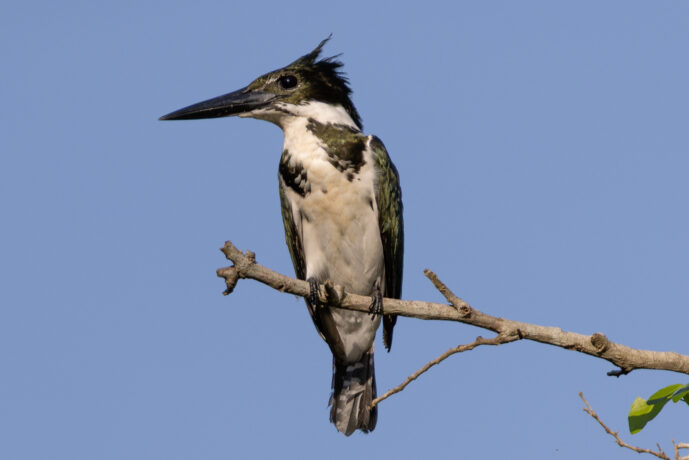
- Key Feature: Dark oily-green upperparts with a prominent white collar and a large, heavy dagger-like bill; males possess a broad chestnut breast band.
- Primary Diet: Piscivore (primarily fish, supplemented by crustaceans and aquatic insects)
- Range: Southern Mexico south through Central America to Northern Argentina and Uruguay
- Habitat: Lowland tropical rivers, slow-moving streams, lakes, and mangrove swamps
- Social Structure: Solitary or Paired
- Nesting/Breeding: Horizontal burrows excavated in vertical riverbanks or sandy cliffs
- Statut de conservation : Préoccupation mineure (LC)
- Population Trend: Decreasing
The Amazon Kingfisher (*Chloroceryle amazona*) is a robust and striking sentinel of Neotropical waterways, easily recognized by its deep oily-green upperparts and a prominent, shaggy crest that gives it a regal silhouette. This medium-sized kingfisher displays distinct sexual dimorphism: while both sexes possess a crisp white collar and underparts, the male is distinguished by a bold chestnut breast band, whereas the female features subtle green patches on the sides of her chest. A key field mark that separates it from its relatives is the lack of white spotting on its dark wings, giving it a sleek, uniform appearance. A master of patience and precision, the Amazon Kingfisher perches motionlessly on branches overhanging rivers and lakes before executing a high-speed vertical dive to snatch fish with its heavy, dagger-like bill, often announcing its success with a loud, metallic rattling call.
Faits amusants
As the largest of the "green" kingfishers, this bird is a master of engineering, excavating horizontal nesting tunnels up to five feet deep into riverbanks. To ensure a smooth meal, it employs a brutal but effective "tenderizing" technique, vigorously bashing captured fish against a branch to break their bones and scales before swallowing them head-first. When perched, they are known for a distinctive "nervous" habit of constantly bobbing their heads and flicking their tails, a behavior thought to help them better triangulate the distance to their underwater prey before launching a high-speed precision dive.
Habitats et répartition
This species is widely distributed across the lowlands of the American tropics, with a range extending from southern Mexico through Central America and into South America as far south as central Argentina and Uruguay. It is primarily a resident bird throughout its range, occupying elevations from sea level up to approximately 1,200 meters, though it is most common in lower tropical zones.
Its preferred habitats are almost exclusively freshwater environments, including large, slow-moving rivers, lakes, and forested streams. It favors areas with dense overhanging vegetation or submerged branches that provide stable perching sites for hunting. While it is most frequent in interior freshwater systems, it can occasionally be found in brackish lagoons and mangroves along coastal regions.
Comportements & Reproduction
This species is primarily territorial and solitary, though it forms monogamous pairs during the breeding season. It spends much of its time perched on branches overhanging slow-moving water, from which it dives to capture fish with its powerful bill. Its social structure centers on these seasonal pairings, with both individuals defending a specific stretch of riverbank from rivals. When threatened or defending territory, they engage in vocal displays, emitting harsh, clicking calls while bobbing their heads and tails to signal dominance.
To reproduce, both parents cooperate to excavate a horizontal tunnel into a vertical sandy or muddy riverbank, with burrows sometimes reaching lengths of over 1.5 meters. This tunnel ends in a nesting chamber where the female typically lays three to four white eggs. Both the male and female share incubation duties and later collaborate to feed the altricial chicks a steady diet of small fish. This subterranean nesting strategy provides a secure environment, shielding the developing young from most terrestrial and aerial predators until they are ready to fledge.
Alimentation
The Amazon Kingfisher is a specialized carnivore that primarily feeds on a variety of small fish, supplemented occasionally by crustaceans and aquatic insects. To secure its meal, this bird typically perches on a branch overhanging a river or lake, scanning the water before performing a swift, vertical plunge-dive to seize its prey with its powerful bill. An interesting aspect of its feeding behavior is how it handles its catch; once back on its perch, the kingfisher frequently beats the fish against the wood to stun or kill it and soften the bones. It then maneuvers the fish to swallow it headfirst, a strategic move that prevents the prey's fins or scales from catching in its throat during ingestion.
Couleurs
The Amazon Kingfisher features deep metallic green upperparts and a prominent white collar, complemented by a shaggy crest and white underparts. Males are distinguished by a broad chestnut breast band, while females possess green patches on the sides of the chest. This dark green dorsal coloration provides effective camouflage against dense riverbank foliage, while the pale underside helps blend with the bright sky when viewed by prey from below.