Amazon River Dolphin
Inia geoffrensis
Quick Facts
- Scientific Name: Inia geoffrensis
- Spanish Name: Delfín rosado
- Family: Iniidae
- Known Nicknames: Boto, Pink River Dolphin, Boto Cor-de-rosa, Boutu
- Average Length: 1.5–2.5 m / 4.9–8.2 ft
- Average Weight: 100–185 kg / 220–408 lb
- Wingspan: N/A
- Key Feature: Distinctive pink skin coloration and unfused neck vertebrae allowing 90-degree head rotation
- Primary Diet: Carnivore (primarily Piscivore, also includes crustaceans and small turtles)
- Range: Amazon and Orinoco River basins across South America
- Habitat: Freshwater river systems, lakes, and seasonally flooded forests
- Social Structure: Primarily Solitary or in small mother-calf pairs; loose aggregations at feeding sites
- Nesting/Breeding: Flooded forests during high-water seasons
- Conservation Status: Endangered (EN)
- Population Trend: Decreasing
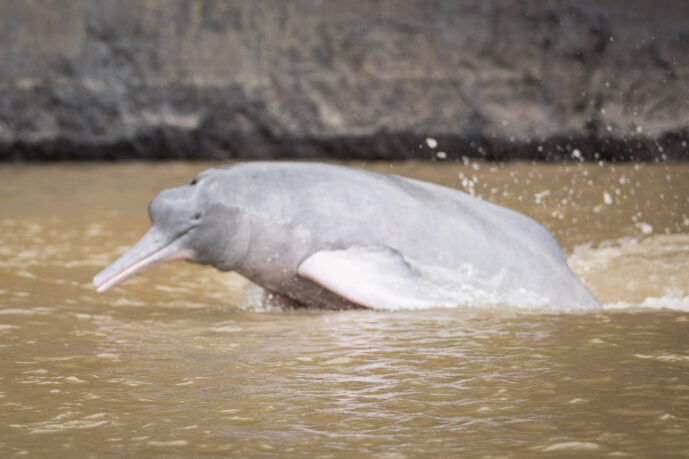
The Amazon River Dolphin, also known as the "Boto," is a remarkable freshwater cetacean famous for its striking bubblegum-pink coloration and extraordinary physical flexibility. Unlike its oceanic relatives, this dolphin possesses unfused neck vertebrae, allowing it to turn its head 90 degrees to navigate the complex, flooded forests and tangled roots of the Amazon and Orinoco basins. Its appearance is truly distinctive, featuring a long, tube-like snout lined with sensory bristles, a prominent bulbous forehead called a melon, and a low ridge instead of a traditional dorsal fin. These highly intelligent mammals are master navigators of murky waters, utilizing sophisticated echolocation and broad, paddle-like flippers to hunt with precision, making them one of the most specialized and culturally iconic species of the South American river systems.
Faits amusants
These dolphins are famous for their vibrant pink hue, which intensifies when they are excited or active, much like a human blush. Unlike most dolphins, they possess unfused neck vertebrae that allow them to turn their heads 90 degrees, a crucial adaptation for navigating through the submerged roots of flooded forests. They also exhibit a unique social behavior where males carry sticks, stones, or clumps of vegetation in their mouths to impress potential mates. To hunt in murky waters, they utilize stiff sensory hairs on their snouts and specialized molar-like teeth capable of crushing hard-shelled prey like turtles and crabs.
Habitats et répartition
This species is widely distributed across the Amazon and Orinoco River basins, spanning much of northern South America including Brazil, Bolivia, Colombia, Ecuador, Peru, and Venezuela. It is strictly a freshwater inhabitant, restricted to the extensive river systems and their numerous tributaries. Its range is often defined by seasonal water levels and natural geological barriers, such as rapids and waterfalls, which can isolate different populations within the vast drainage basins. Within these regions, it occupies a diverse array of aquatic environments, ranging from deep river channels and confluences to tranquil lakes. During the rainy season, it frequently moves into flooded forests and grasslands, utilizing its flexible anatomy to navigate through dense, submerged vegetation. It thrives in various water types, including sediment-heavy "white waters," acidic "black waters," and clear water streams typical of the tropical rainforest ecosystem.
Comportements & Reproduction
These dolphins are primarily solitary or found in small, loose-knit groups, often consisting of a mother and her offspring. Their social structure is less rigid than that of marine dolphins, though they display remarkable agility in flooded forests due to their unfused neck vertebrae, which allow them to move their heads independently. During the mating season, males engage in a unique courtship display where they carry objects such as branches, weeds, or balls of clay in their mouths to attract females, a behavior that also serves as a display of strength and competitive fitness among rivals. Reproduction is synchronized with the river's seasonal cycles, with mating typically occurring during the dry season and births taking place as water levels rise. This timing ensures that calves are born into nutrient-rich flooded forests, providing them with protection and abundant food sources. Females give birth to a single calf after a gestation period of roughly eleven months, maintaining a close bond and providing maternal care for several years to teach the young how to navigate and hunt in the complex river environment.
Alimentation
The Amazon River Dolphin maintains an incredibly diverse diet that includes over 50 different species of fish, such as piranhas, croakers, and tetras, as well as crustaceans like river crabs and even small turtles. As opportunistic feeders, they possess a unique anatomical feature known as heterodont dentition; unlike most cetaceans, they have different types of teeth, including molar-like back teeth that allow them to crush the hard shells of their prey. During the high-water season, these dolphins exhibit a fascinating hunting strategy by swimming deep into flooded forests to capture fish among the submerged trees, utilizing their extreme physical flexibility. Their hunting efficiency is further enhanced by highly developed echolocation, which enables them to pinpoint prey in the turbid, low-visibility waters of the Amazon and Orinoco river systems.
Couleurs
The Amazon River Dolphin is characterized by its unique transition from a uniform gray in juveniles to a distinctive pink hue in adults, which can range from mottled blotches to a vibrant bubblegum color. This coloration is influenced by blood flow near the skin, water temperature, and accumulated scar tissue, with males often appearing more vividly pink than females. Lacking complex camouflage patterns, their solid or speckled skin tones blend effectively into the sediment-heavy, murky waters of the Amazon basin.