Anhinga
Anhinga anhinga
Quick Facts
- Scientific Name: Anhinga anhinga
- Spanish Name: Pato aguja
- Family: Anhingidae
- Known Nicknames: Snakebird, Water Turkey, Darter, American Anhinga
- Average Length: 75–95 cm / 30–37 in
- Average Weight: 1.0–1.4 kg / 2.2–3.1 lb
- Wingspan: 109 cm / 43 in
- Key Feature: Slender, S-shaped neck and sharp, pointed bill; plumage lacks oil glands causing feathers to become waterlogged
- Primary Diet: Primarily Piscivore
- Range: Southeastern United States through Central America to Northern Argentina
- Habitat: Shallow freshwater environments such as cypress swamps, marshes, and lakes
- Social Structure: Solitary when foraging; colonial when nesting
- Nesting/Breeding: Stick nests in trees or bushes over water
- Statut de conservation : Préoccupation mineure (LC)
- Population Trend: Increasing
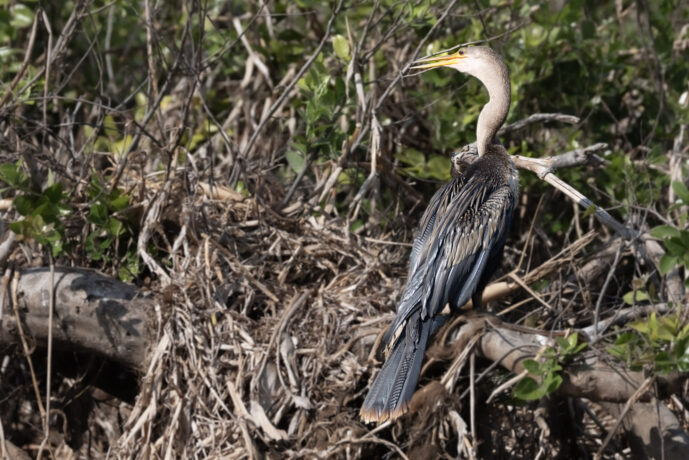
The Anhinga (*Anhinga anhinga*), frequently referred to as the "snakebird," is a captivating water bird characterized by its slender, S-shaped neck, fan-like tail, and a sharp, dagger-like bill used for spearing fish. Predominantly found in the freshwater marshes of the Americas, males boast shimmering black plumage with silver-white wing patches, while females and juveniles are distinguished by their buff-colored necks and breasts. A truly unique feature of the Anhinga is its lack of waterproof oil glands; this allows its feathers to become fully saturated, reducing buoyancy so it can dive deeply and swim stealthily underwater. Consequently, it is a common sight to see this bird perched on a sunlit branch with its large wings outspread in a dramatic pose, drying its heavy plumage and regulating its body temperature after a hunt.
Faits amusants
Often nicknamed the "snakebird," this avian hunter swims with its body completely submerged, leaving only its long, undulating neck visible above the surface. Because it lacks the waterproof oils common to most water birds, its feathers become fully saturated, an adaptation that reduces buoyancy and allows for stealthy underwater stalking. After skewering prey with its needle-sharp beak, the bird must emerge to toss its catch into the air and swallow it head-first to avoid prickly fins. Once finished, it spends hours in a characteristic "spread-eagle" pose, drying its heavy, waterlogged wings in the sun to regain the ability to fly.
Habitats et répartition
This species primarily inhabits shallow, quiet freshwater and brackish environments, such as cypress swamps, marshes, lakes, and slow-moving rivers. It is frequently found in areas with dense vegetation and abundant perching sites, like low-hanging branches or fallen logs, which are essential for drying its water-absorbent feathers after diving. While it prefers inland wetlands, it can occasionally be seen in coastal lagoons and mangrove forests. Its geographical range extends across the warmer regions of the Americas, stretching from the southeastern United States—particularly from North Carolina through the Gulf Coast and Florida—down through Mexico and Central America. In South America, it is widely distributed east of the Andes, reaching as far south as northern Argentina and Uruguay. While mostly a year-round resident in tropical areas, populations in the northernmost parts of its range may migrate south during colder months.
Comportements & Reproduction
These birds are primarily solitary hunters, often seen swimming with their bodies submerged and only their long, slender necks visible above the surface. Because their feathers are not fully waterproof—an adaptation that reduces buoyancy for more efficient diving—they must spend long periods perched with their wings outspread to dry and thermoregulate in the sun. Despite their solitary foraging habits, they are gregarious during the breeding season, often nesting in mixed-species colonies alongside herons and egrets for added protection against predators. Reproduction involves seasonal monogamy and elaborate courtship rituals. Males initiate the process by claiming a nesting site and performing displays that include soaring, wing-waving, and presenting sticks to potential mates. Once paired, both adults cooperate in constructing a platform nest and share incubation duties for the clutch of eggs. A notable reproductive strategy is the intensive biparental care; both parents feed the altricial chicks by regurgitation, continuing to support them until the young are capable of diving and drying their own plumage independently.
Alimentation
The Anhinga is primarily a piscivore, specializing in stalking and capturing a variety of small to medium-sized freshwater and estuarine fish, such as sunfish, mullet, and catfish. Beyond fish, its opportunistic diet extends to aquatic insects, crustaceans like crayfish and shrimp, and even the occasional small reptile or amphibian. What makes its hunting strategy particularly fascinating is its specialized neck anatomy, which features a hinge-like mechanism that allows the bird to strike forward with lightning speed, effectively spearing prey with its sharp, serrated bill. Because it lacks waterproof feathers, the Anhinga can stay submerged for extended periods to hunt stealthily; once a fish is impaled, the bird surfaces, skillfully tosses the prey into the air, and catches it to swallow it headfirst, ensuring the scales and fins do not lodge in its throat.
Couleurs
Adult male Anhingas display glossy black plumage with striking silvery-white streaks and spots on their upper wings and back, while females and juveniles feature a contrasting pale tan head, neck, and breast. They possess long, yellow-orange bills and dark, fan-shaped tails often tipped with white or buff. During the breeding season, they develop vibrant emerald green skin around their eyes, and their dark coloration provides effective camouflage when perched in the shadows of dense wetland vegetation.