Band-tailed Guan
Penelope argyrotis
Quick Facts
- Scientific Name: Penelope argyrotis
- Spanish Name: Pava camata
- Family: Cracidae
- Known Nicknames: Pava de monte, Pava de cola bandeada
- Average Length: 50–65 cm / 20–26 in
- Average Weight: 800–1,200 g / 1.7–2.6 lb
- Wingspan: 75–85 cm / 30–33 in
- Key Feature: White-tipped tail feathers forming a distinct band and a reddish throat dewlap
- Régime alimentaire principal : Principalement frugivore
- Range: Northern South America (Colombia and Venezuela)
- Habitat: Subtropical or tropical moist montane forests
- Social Structure: Solitary, pairs, or small family groups
- Nesting/Breeding: Shallow platform nests in trees
- Statut de conservation : Préoccupation mineure (LC)
- Population Trend: Decreasing
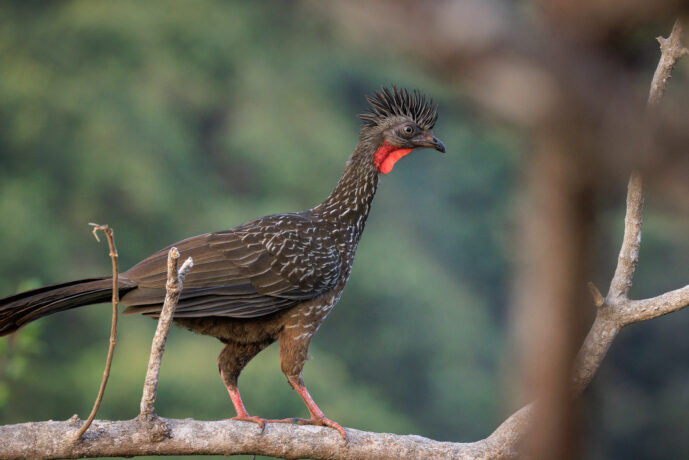
The Band-tailed Guan (*Penelope argyrotis*) is a striking, arboreal bird native to the lush montane forests of Colombia and Venezuela, known for its elegant profile and raucous presence in the canopy. This chicken-like member of the Cracidae family features a rich, chocolate-brown plumage that is beautifully accented by delicate silvery-white streaking across its neck and breast, giving it a distinctive "frosted" appearance. Its most defining characteristic, and the source of its name, is the prominent buff-colored band at the tip of its long, dark tail, which is particularly visible during its heavy, flapping flight. Adding a splash of color to its earthy tones is a bright red, fleshy dewlap hanging from its throat, which contrasts vividly against its dark head. Often heard before it is seen, the Band-tailed Guan plays a vital role in its ecosystem as a seed disperser, navigating the high branches with surprising agility while letting out loud, resonant calls that echo through the misty highlands.
Faits amusants
The Band-tailed Guan is famous for its "wing-drumming" display, where it produces a loud, mechanical rattling sound by rapidly vibrating its primary feathers during short, ritualized flights. It sports a striking, fleshy red dewlap on its throat that it can distend during social interactions to signal to rivals or mates. Despite their relatively large size, these birds are remarkably agile "branch-runners," often choosing to sprint and leap through the high canopy rather than flying. They also act as essential forest gardeners, as their specialized digestive systems allow them to disperse the seeds of large montane fruits across the Andean cloud forests.
Habitats et répartition
The geographical range of this species is restricted to northern South America, specifically the mountain ranges of northern Colombia and northern and western Venezuela. It is found in the Santa Marta Mountains, the Serranía del Perijá, and across the Coastal Cordillera. These populations are generally distributed across elevations ranging from 500 to 2,500 meters above sea level. Its primary habitats consist of humid montane forests and cloud forests, where it frequents both the dense canopy and the forest edges. While it favors primary forest, it also demonstrates a degree of tolerance for disturbed environments, often appearing in secondary growth and shade-grown coffee plantations that offer sufficient cover and food resources.
Comportements & Reproduction
Primarily arboreal and social, these birds are typically encountered in pairs or small family groups as they forage through the mid-to-upper canopy of montane forests. They are relatively shy and spend much of their time hidden within dense foliage, moving with agility among branches. During the breeding season, males perform distinctive courtship displays that include "wing-drumming," a mechanical sound produced by rapidly vibrating their wings during short, ritualized flights. These displays are often accompanied by loud, raucous vocalizations used to establish territories and attract mates. Reproduction is generally monogamous, with nesting periods timed to coincide with the increased food availability of the rainy season. Females construct a shallow, well-concealed platform nest made of twigs and leaves, situated several meters above the ground in thick vegetation or vine tangles. A typical clutch consists of two white eggs, which are incubated by the female. Both parents participate in the care of the precocial chicks, which are capable of moving through the trees shortly after hatching, staying close to the adults for protection and guidance.
Alimentation
The Band-tailed Guan is primarily a frugivore, subsisting on a diverse array of fruits and berries harvested from the canopy of its montane forest habitat. While its diet is heavily centered on fleshy fruits, it also supplements its nutritional intake with seeds and occasionally small invertebrates or insects. An interesting aspect of its feeding ecology is its significant role as a seed disperser; by consuming fruits whole and later depositing the seeds across the forest floor, it actively contributes to the regeneration of its ecosystem. These birds are typically observed foraging in the middle and upper strata of the trees, where they move with surprising agility to pluck ripe produce, though they will occasionally descend to the ground to forage for fallen fruit or grit to aid in digestion.
Couleurs
The Band-tailed Guan features a predominantly olive-brown body with distinct silvery-white streaking on its head and neck. Its breast displays a scaly pattern created by white feather edges, while its most defining feature is a broad, pale cinnamon or buff band at the tip of its dark tail. This cryptic plumage provides effective camouflage within montane forest canopies, complemented by a vibrant red throat dewlap and reddish legs.