Bicoloured Wren
Campylorhynchus griseus
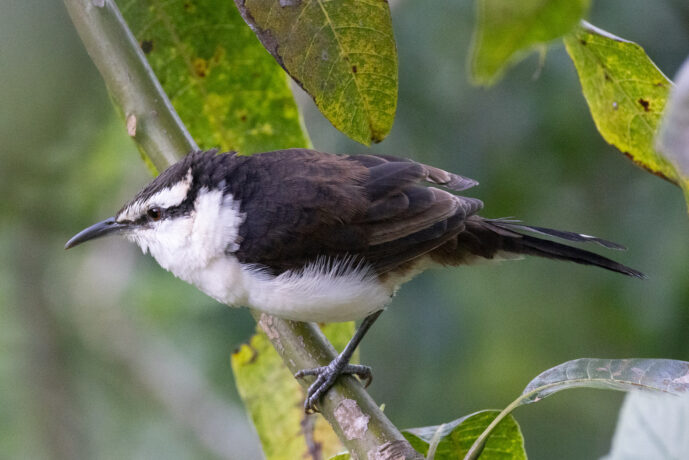
Quick Facts
- Scientific Name: Campylorhynchus griseus
- Spanish Name: Cucarachero bicolor
- Family: Troglodytidae
- Known Nicknames: Bicolored Wren
- Average Length: 21–22 cm / 8.3–8.7 in
- Average Weight: 37–46.5 g / 1.3–1.6 oz
- Wingspan: 30–35 cm / 12–14 in
- Key Feature: Large size for a wren with starkly contrasting brownish-gray upperparts and clean white underparts
- Primary Diet: Primarily Insectivore
- Range: Northern South America, including Colombia, Venezuela, Guyana, and northern Brazil
- Habitat: Arid scrub, savanna, open woodland, and suburban gardens
- Social Structure: Highly Social, Cooperative Breeder
- Nesting/Breeding: Large, domed stick nests in trees, shrubs, or cacti
- Statut de conservation : Préoccupation mineure (LC)
- Population Trend: Stable
The Bicoloured Wren (*Campylorhynchus griseus*) is a striking and charismatic songbird native to the dry woodlands and savannas of northern South America. As one of the largest members of the wren family, it is easily identified by its bold, high-contrast plumage, featuring a dark brownish-black cap and back that offsets its brilliant white underparts and prominent white eyebrow stripe. Beyond its elegant appearance and long, slightly curved bill, this species is renowned for its complex social behavior; they are cooperative breeders that live in tight-knit family groups, frequently engaging in loud, synchronized duets or raucous group choruses to defend their territory. These "architects of the bird world" are also famous for constructing massive, globular nests that serve as both nurseries and communal dormitories, making them as much a fixture of the landscape for their engineering as for their boisterous personalities.
Faits amusants
These birds are famous for building "dormitory" nests, which are bulky, domed structures used exclusively for communal sleeping rather than raising young. As cooperative breeders, grown offspring frequently remain with their parents to help forage and protect the next brood, creating tight-knit and highly vocal family units. They are remarkably bold and will aggressively mob much larger predators, such as hawks or snakes, using synchronized, harsh calls to drive threats away. Furthermore, while primarily insectivores, they are opportunistic enough to occasionally hunt and consume small vertebrates like lizards.
Habitats et répartition
This species is primarily distributed across northern South America, with its range extending through Colombia, Venezuela, and northern Brazil, as well as parts of Guyana. It is a common resident in the Llanos region and along the Caribbean coast, typically inhabiting lowlands and foothills up to elevations of approximately 1,600 meters.
It favors a variety of open and semi-open environments, particularly arid to semi-arid scrublands, dry deciduous forests, and riparian thickets. These wrens are well-adapted to human-altered landscapes and are frequently seen in suburban gardens, parks, and agricultural clearings, where they utilize dense vegetation and thorny bushes for nesting and foraging.
Comportements & Reproduction
This species exhibits a complex social structure characterized by cooperative breeding, where a dominant monogamous pair is supported by a group of non-breeding helpers, typically offspring from previous seasons. These helpers play a crucial role in territory defense and the provisioning of food for the new nestlings, which significantly increases the survival rate of the brood. The group maintains a year-round territory through loud, synchronized duets and communal displays, often engaging in aggressive mobbing of potential predators to protect their shared space.
Nesting occurs within large, conspicuous domed structures constructed from grass and fibers, featuring a side entrance. These nests serve a dual purpose, functioning as both the site for egg incubation and as communal dormitories where the entire group roosts at night. While only the dominant female typically incubates the clutch of three to five eggs, the entire social unit participates in the care and protection of the young until they reach independence. Some individuals may remain with their natal group as helpers for several years before attempting to establish their own breeding territory.
Alimentation
The Bicoloured Wren is primarily an insectivore, maintaining a diet rich in various invertebrates such as beetles, ants, caterpillars, grasshoppers, and spiders. While its main sustenance comes from animal matter, this species is also known to consume small fruits and berries, and it occasionally opportunistically preys on tiny vertebrates like lizards. A fascinating aspect of their dietary habits is their cooperative foraging behavior, where family groups move through the environment together, vigorously searching for food in leaf litter, tree bark, and within bromeliads. Furthermore, these wrens are notably bold and will sometimes forage near human habitations, taking advantage of insects drawn to artificial lights or even scavenging for small food scraps.
Couleurs
The Bicoloured Wren is defined by a sharp contrast between its dark brownish-black upperparts and brilliant white underparts. It features a prominent white supercilium above a dark eye stripe, along with intricate dark barring on its wings and tail. This bold, two-toned plumage acts as disruptive camouflage, allowing the bird to blend into the dappled shadows of its arid, scrubby habitat.