Black-capped donacobius
Donacobius atricapilla
Quick Facts
- Scientific Name: Donacobius atricapilla
- Spanish Name: Cucarachero de laguna
- Family: Donacobiidae
- Known Nicknames: Donacobius, Black-capped Mockingthrush, Swamp Warbler
- Average Length: 21.5–23 cm / 8.5–9 in
- Average Weight: 30–42 g / 1.1–1.5 oz
- Wingspan: 25–30 cm / 10–12 in
- Key Feature: Glossy black cap, bright yellow eyes, and inflatable orange-yellow neck sacs used during vocal displays
- Primary Diet: Insectivore
- Range: Panama and South America east of the Andes to Northern Argentina
- Habitat: Tropical wetlands, marshes, swamps, and lake margins with tall emergent vegetation
- Social Structure: Highly Social (monogamous pairs and cooperative breeding family groups)
- Nesting/Breeding: Open cup nest attached to reeds or grasses over water
- Statut de conservation : Préoccupation mineure (LC)
- Population Trend: Stable
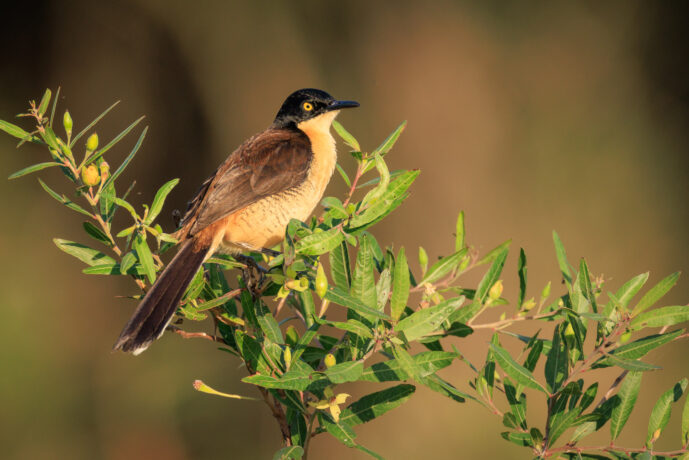
The Black-capped donacobius (*Donacobius atricapilla*) is a charismatic and vocal resident of South American wetlands, notable for being the sole member of its own unique taxonomic family. This striking bird is easily identified by its namesake velvet-black cap, piercing orange-yellow eyes, and a long, white-tipped tail that it frequently fans and wags in a rhythmic display. Its plumage features a rich chocolate-brown back contrasting with creamy-buff underparts, but its most fascinating physical trait is the pair of inflatable yellow skin sacs on the sides of its neck, which are puffed out during its loud, synchronized "antiphonal" duets. Highly social and territorial, mated pairs often stand side-by-side atop marsh vegetation, performing complex, boisterous songs in perfect unison to defend their swampy domain, making them one of the most animated and recognizable personalities of the Neotropical riverside.
Faits amusants
These birds are renowned for their elaborate, synchronized duets where breeding pairs stand side-by-side, rhythmically wagging their tails and bobbing their bodies in a coordinated "dance." So unique that they are the sole members of their own family, Donacobiidae, they possess striking inflatable patches of bare, bright orange-yellow skin on the sides of their necks that puff out during vocal displays. Beyond their theatrical singing, they are highly social cooperative breeders, with grown offspring often remaining in the family territory to help their parents protect the nest and raise the next generation of chicks.
Habitats et répartition
This species is widely distributed across tropical South America, primarily east of the Andes. Its range extends from Colombia, Venezuela, and the Guianas southward through the Amazon Basin into eastern Bolivia, Paraguay, and northern Argentina. It is also found throughout much of Brazil, particularly in the Pantanal and along major river systems. It exclusively inhabits lowland wetlands and areas adjacent to standing or slow-moving water. Its preferred environments include freshwater marshes, swamps, lakeside reed beds, and tall riparian grasses. It is frequently seen perched prominently on vegetation overhanging water, as it relies heavily on these dense, semi-aquatic thickets for both foraging and nesting.
Comportements & Reproduction
These birds are highly social and territorial, typically living in family groups that consist of a monogamous breeding pair and their adult offspring. This cooperative breeding system is a defining feature of their social structure, as older siblings remain in the parental territory to help protect and feed new chicks. They are famous for their elaborate, synchronized vocal displays; pairs engage in loud, rhythmic duets while performing physical movements like tail-wagging and inflating conspicuous yellow throat sacs to reinforce their pair bond and defend their territory. Reproduction generally coincides with the wet season, during which the pair constructs an open cup nest hidden among marsh vegetation. While the female is the primary incubator, the entire family group participates in guarding the nest and provisioning the young. This communal approach to chick-rearing significantly enhances the survival chances of the brood. Their unique blend of complex communication and collective parental care allows them to thrive in competitive wetland ecosystems.
Alimentation
The Black-capped donacobius is primarily insectivorous, sustaining itself on a diverse array of invertebrates including ants, beetles, caterpillars, and spiders found within its marshy habitat. These birds are active foragers that typically hunt in pairs or family groups, meticulously gleaning prey from the stems and leaves of dense aquatic vegetation and reeds. An interesting aspect of their dietary behavior is their high level of synchronization; family members often maintain vocal contact while foraging to coordinate their movements through thick riverside thickets. Additionally, they are known to venture onto floating vegetation to capture insects that are inaccessible to many other avian species, demonstrating a specialized hunting agility tailored to their wetland environment.
Couleurs
The Black-capped donacobius is characterized by a prominent black cap and mask set against vivid yellow or orange eyes. Its upperparts are dark chocolate brown, contrasting with creamy-buff underparts that often feature fine dark barring on the flanks. Notable markings include large white tips on the outer feathers of its long, dark tail and bright yellow-orange inflatable throat sacs used during vocal displays.