Black-chested Jay
Cyanocorax affinis
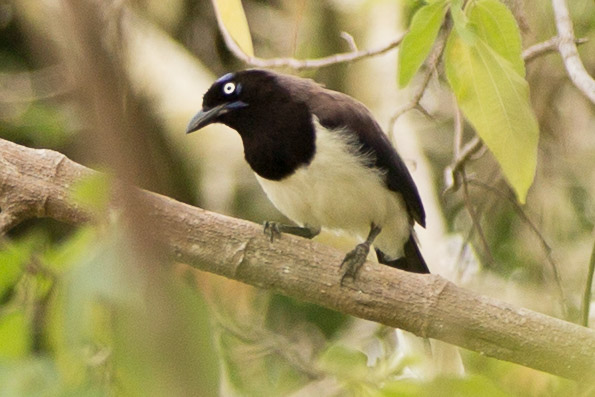
Quick Facts
- Scientific Name: Cyanocorax affinis
- Spanish Name: Carriquí pechinegro
- Family: Corvidae
- Known Nicknames: Black-chested Jay
- Average Length: 33–36 cm / 13–14 in
- Average Weight: 194–232 g / 6.8–8.2 oz
- Wingspan: 50–55 cm / 20–22 in
- Key Feature: Distinctive black hood and chest contrasting with creamy-white underparts and bright yellow irises
- Primary Diet: Omnivore (Insects, fruits, seeds, and small vertebrates)
- Range: Southeastern Costa Rica and Panama to Northern Colombia and Northwestern Venezuela
- Habitat: Tropical lowland forests, humid woodland edges, and mature secondary growth
- Social Structure: Social (Found in pairs or small family groups of up to 8 individuals)
- Nesting/Breeding: Bulky cup nests made of twigs, typically placed in trees or tall shrubs
- Statut de conservation : Préoccupation mineure (LC)
- Population Trend: Stable
The Black-chested Jay (*Cyanocorax affinis*) is a striking and charismatic member of the corvid family found throughout the humid forests and woodlands of Central and South America. This medium-sized bird is easily identified by its namesake velvety black head, throat, and chest, which creates a dramatic visual contrast against its creamy-white underparts and vibrant violet-blue wings and tail. Perhaps its most captivating features are the small, luminous pale blue spots located above and below its piercing yellow eyes, giving the bird an inquisitive and sharp expression. Highly social and remarkably intelligent, these jays are known for their complex vocalizations and bold personalities, often traveling in lively groups through the canopy where their bold plumage and boisterous calls make them a standout sight for any observer.
Faits amusants
These birds are master mimics, frequently imitating the piercing cries of predatory hawks to startle other species and clear the way for their own feeding. Highly social and cooperative, they live in tight-knit family groups where older siblings act as "nannies," helping the parents raise and protect the newest chicks. Their most striking physical feature is their piercing, pale yellow or white irises that contrast sharply against their velvet-black facial feathers, giving them an intense, watchful expression. They also serve as the forest's unofficial alarm system, using a complex repertoire of raucous, metallic calls to alert the entire neighborhood to the presence of snakes or other intruders.
Habitats et répartition
This species is primarily distributed from southeastern Costa Rica and Panama through northern and western Colombia, extending into northwestern Venezuela. It is most commonly found in lowland and foothill regions, typically occupying elevations from sea level up to approximately 1,600 meters, though it may occasionally be seen at higher altitudes.
Its preferred habitats include humid and deciduous forests, dense secondary growth, and woodland edges. It is also known to frequent more open environments such as scrublands, coffee plantations, and suburban gardens, showing a degree of tolerance for human-altered landscapes as long as sufficient tree cover remains.
Comportements & Reproduction
These birds maintain a highly social structure, typically traveling in noisy family groups of three to eight individuals. They demonstrate complex cooperative behaviors, foraging together through the forest mid-story and using a variety of vocalizations to maintain group cohesion and alert others to predators. Their territorial defense is a collective effort, often involving mobbing behaviors to drive away threats from their shared living space.
Reproduction is defined by a monogamous pairing system bolstered by cooperative breeding, where non-breeding helpers—usually offspring from previous years—assist the primary pair. These helpers contribute by defending the nest and providing food for the incubating female and the chicks. The nest itself is a well-concealed cup of twigs and fibers, typically housing a clutch of two to five eggs, and the involvement of the extended family group significantly enhances the survival prospects of the young.
Alimentation
The Black-chested Jay is a highly versatile omnivore with a diet that reflects its opportunistic nature within the tropical forests of Central and South America. Primarily foraging in the mid-to-upper canopy, this bird consumes a wide variety of invertebrates, including large insects like beetles and grasshoppers, alongside various wild fruits, berries, and seeds. Beyond plant matter and insects, it is known to predate on small vertebrates such as lizards and frogs, and it occasionally raids the nests of other birds to consume eggs or nestlings. An interesting aspect of its feeding behavior is its high level of intelligence and social coordination; these jays often forage in small, noisy groups, which helps them flush out prey more effectively. Furthermore, similar to other members of the corvid family, they are known to engage in food caching, strategically hiding surplus food items in crevices or under foliage to ensure a steady supply during times of scarcity.
Couleurs
The Black-chested Jay features a velvet-black head, neck, and chest that contrasts sharply with its creamy-white underparts and belly. Its back, wings, and tail are a deep violet-blue, with the tail ending in a distinct white tip. Small violet-blue spots above and below the eyes, along with a matching malar stripe, provide subtle detail against the dark face, while its piercing yellow irises create a striking visual focal point.