Black-crested Antshrike
Sakesphorus canadensis
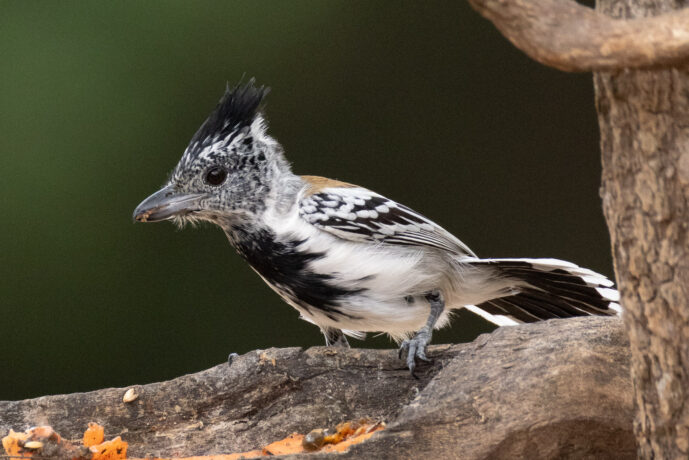
Quick Facts
- Scientific Name: Sakesphorus canadensis
- Spanish Name: Batará crestinegro
- Family: Thamnophilidae
- Known Nicknames: None
- Average Length: 14.5–17 cm (5.7–6.7 in)
- Average Weight: 20–28 g (0.7–1.0 oz)
- Wingspan: 22–26 cm (8.7–10.2 in)
- Key Feature: Prominent erectile black crest in males (rufous in females) and a heavy, hooked bill
- Primary Diet: Insectivore (Insects and other small invertebrates)
- Range: Northern South America, including Colombia, Venezuela, the Guianas, Northern Brazil, and Trinidad
- Habitat: Mangroves, arid scrubland, riverine thickets, and gallery forests
- Social Structure: Usually found in pairs, occasionally solitary
- Nesting/Breeding: Deep cup-shaped nest suspended in a horizontal tree fork
- Statut de conservation : Préoccupation mineure (LC)
- Population Trend: Stable
The Black-crested Antshrike (*Sakesphorus canadensis*) is a striking songbird of northern South America’s lowlands, most famous for the prominent, expressive crest that gives the species its name. This bird displays dramatic sexual dimorphism: the male is a bold study in contrast with a jet-black head, throat, and crest set against a white collar and gray wings, while the female is more subtly adorned with a rich, rufous-brown crest and delicate streaking on her breast. Primarily found in mangroves, arid scrub, and gallery forests, they are often seen in pairs, skulking through dense foliage to forage for insects. Beyond their visual flair, these antshrikes are known for their distinctive vocalizations—an accelerating series of rhythmic, nasal notes—and their ability to raise their feathered crests during social displays, making them both a visual and auditory highlight of their tropical habitats.
Faits amusants
The Black-crested Antshrike is easily recognized by its expressive, punk-rock crest that it fans out or flattens depending on its level of agitation. Despite its name, this bird is a versatile generalist that hunts everything from spiders to small lizards, often performing a signature rhythmic tail-pumping motion while scanning for prey. These birds are also remarkably social within their pairs, frequently engaging in synchronized vocal duets to defend their territory, showcasing a level of coordination that reinforces their long-term pair bonds.
Habitats et répartition
This species is primarily distributed across northern South America, including Colombia, Venezuela, the Guianas, and northern Brazil, as well as on the island of Trinidad. Its range is largely concentrated in tropical lowlands and coastal regions, where it remains a permanent resident throughout the year. It inhabits a variety of semi-open environments, showing a preference for arid to semi-arid scrublands and deciduous forests. Additionally, it is frequently found in mangrove swamps, riverine thickets, and the dense undergrowth along the edges of humid forests or secondary growth areas.
Comportements & Reproduction
This species typically lives in monogamous pairs, maintaining year-round territories through persistent vocalizations and physical displays. They are highly social within their pair bond, often foraging together in the dense undergrowth of mangroves, scrub, or gallery forests. During courtship, the male performs distinctive displays, prominently raising its namesake black crest to attract a mate and signal dominance. These pairs are known for their cooperative nature, working closely together to defend their territory from intruders and maintain their social standing within the local population. Reproduction involves the construction of a deep, cup-shaped nest, which is usually suspended from a horizontal fork in a shrub or low tree. Both the male and female share parental responsibilities, including the gathering of nesting materials like fine fibers and grasses. They typically lay two eggs, and both sexes contribute to incubation and the subsequent feeding of the nestlings. This biparental care is a key strategy for ensuring the survival of their young in competitive tropical environments, reflecting a strong, collaborative reproductive bond.
Alimentation
The Black-crested Antshrike is primarily an insectivore, sustaining itself on a diverse array of arthropods including beetles, ants, caterpillars, spiders, and grasshoppers. It typically hunts within the dense foliage of mangroves and shrubby thickets, where it meticulously gleans prey from the undersides of leaves and along small twigs. An interesting aspect of its foraging behavior is its occasional tendency to follow army ant swarms to opportunistically capture insects flushed out by the column, although it is not considered an obligate ant-follower. While its diet is heavily dominated by animal matter, this bird is also known to supplement its nutritional intake with small berries and fruits when they are seasonally available. Its hunting strategy often involves agile sally-gleans, allowing it to snatch moving targets with precision while remaining concealed in thick vegetation.
Couleurs
The Black-crested Antshrike exhibits strong sexual dimorphism: males possess a prominent black crest and throat, a white collar, and black wings with distinct white wing bars over a grey back. Females feature a rufous crest and crown with buffy facial markings and brownish upperparts, providing effective camouflage in thickets. Both sexes are characterized by a heavy hooked bill and bold plumage patterns that break up their silhouette in dense tropical foliage.