Black-necked stilt
Himantopus mexicanus
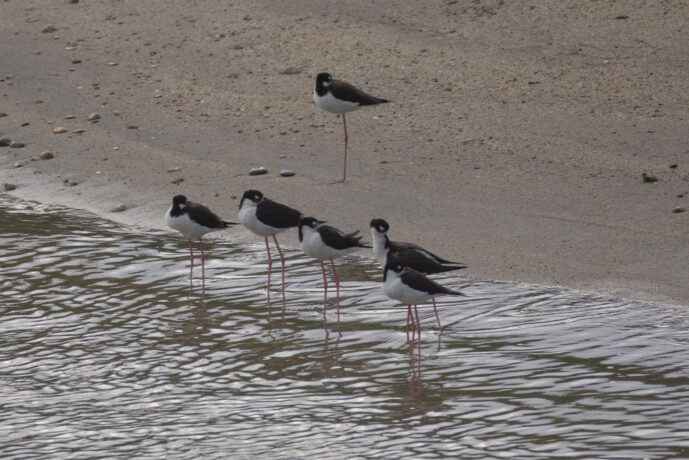
Quick Facts
- Scientific Name: Himantopus mexicanus
- Spanish Name: Cigüeñuela cuellinegra
- Family: Recurvirostridae
- Known Nicknames: Common stilt, Longshanks
- Average Length: 35–39 cm / 14–15 in
- Average Weight: 136–220 g / 4.8–7.8 oz
- Wingspan: 71–76 cm / 28–30 in
- Key Feature: Extremely long, thin reddish-pink legs and a needle-like black bill
- Primary Diet: Insectivore (aquatic invertebrates, crustaceans, and small fish)
- Range: Western and Southern United States through Central America and the Caribbean to Northern South America
- Habitat: Shallow wetlands, salt marshes, mudflats, and flooded fields
- Social Structure: Gregarious; often found in small flocks or loose colonies
- Nesting/Breeding: Ground scrapes or mounds near water
- Statut de conservation : Préoccupation mineure (LC)
- Population Trend: Increasing
The Black-necked stilt (*Himantopus mexicanus*) is a striking shorebird instantly recognizable by its impossibly long, bubblegum-pink legs, which are proportionally longer relative to its body size than those of almost any other bird in the world. This elegant wader sports a sleek, tuxedo-like plumage featuring a jet-black back and neck that contrasts sharply with its crisp white underbelly and distinctive white spots above its dark eyes. Its fine, needle-like black bill is a precision tool, perfectly adapted for daintily picking aquatic invertebrates and small crustaceans from the surface of shallow wetlands and salt pans. Beyond its fragile appearance, the stilt is a fiercely territorial guardian of its nesting grounds, often performing elaborate "broken-wing" displays to distract predators or emitting a persistent, sharp "yip-yip-yip" call to signal alarm.
Faits amusants
Boasting the second-longest legs relative to body size of any bird species, these waders utilize their spindly pink limbs to access deeper foraging grounds than most other shorebirds. They are known for a quirky collective defense called the "popcorn" display, where a group hops and flaps together to confuse predators. When their nests are threatened, they perform convincing "broken-wing" distractions or aggressively dive-bomb intruders with high-pitched shrieks. Additionally, they are proactive engineers; if water levels rise, they will rapidly pile more material onto their nests to elevate their eggs and keep them from flooding.
Habitats et répartition
This species inhabits a variety of shallow aquatic environments, including salt ponds, mudflats, flooded fields, and coastal marshes. They are primarily found in areas with sparse vegetation, where they can easily forage for invertebrates in the mud and shallow water. These birds favor both freshwater and brackish habitats, frequently appearing in man-made environments such as wastewater treatment ponds and agricultural wetlands during the breeding season. The geographical range extends from the western and southern United States through Central America and the Caribbean, reaching as far south as Peru and northeastern Brazil. While populations in southern latitudes and along the coasts often remain year-round, those breeding in the interior regions of North America are migratory, moving to warmer coastal climates for the winter. This wide distribution allows them to occupy diverse ecosystems, from inland alkaline lakes to tropical mangrove swamps.
Comportements & Reproduction
These birds are highly social and often congregate in loose colonies, though they become fiercely territorial during the breeding season. They are known for their aggressive defense of nesting sites, frequently using loud vocalizations and "popcorn" displays—where multiple birds jump and flap simultaneously—to deter predators. When a threat nears the nest, they often perform a "broken-wing" distraction display to lead the intruder away. Their mating rituals involve elaborate synchronized preening and bill-crossing, usually resulting in monogamous pairs for the duration of the season. Nesting occurs on the ground in shallow scrapes or mounds built just above the water level. Both parents share the responsibilities of incubating the eggs and cooling them through "belly-soaking," a unique strategy where they wet their breast feathers to regulate the nest temperature in hot climates. The chicks are precocial, born with downy feathers and the ability to leave the nest to forage for themselves within hours of hatching, though they remain under parental protection for several weeks.
Alimentation
The Black-necked stilt is a specialized carnivore that primarily consumes aquatic invertebrates such as water boatmen, beetles, brine shrimp, and dragonfly larvae, though it also opportunistically eats small fish, tadpoles, and occasionally seeds. Its exceptionally long legs—the second longest relative to body size of any bird—allow it to wade into deeper waters than other shorebirds, where it employs diverse hunting techniques including visual pecking at the surface, probing into soft substrate, and sweeping its bill through the water in a scythe-like motion. An interesting aspect of its diet is its ability to thrive in hypersaline environments, where it may focus almost exclusively on brine flies and their larvae, demonstrating remarkable dietary flexibility. Furthermore, these birds are known to be active foragers both during the day and on moonlit nights, using their keen eyesight to detect movement in the shallow wetlands they inhabit.
Couleurs
The Black-necked stilt displays a high-contrast palette of jet-black upperparts and stark white underparts, face, and neck. It is distinguished by its extraordinarily long, bright pink legs and a small white spot above its red eyes. This sharp countershading helps the bird blend with both murky water and bright skies, while its slender profile minimizes its shadow on the mudflats.