Blue-backed manakin
Chiroxiphia pareola
Quick Facts
- Scientific Name: Chiroxiphia pareola
- Spanish Name: Saltarín dorsiazul
- Family: Pipridae
- Known Nicknames: Blue-backed manakin, Tangará
- Average Length: 13 cm / 5.1 in
- Average Weight: 16.5–24 g / 0.58–0.85 oz
- Wingspan: 20–25 cm / 7.9–9.8 in
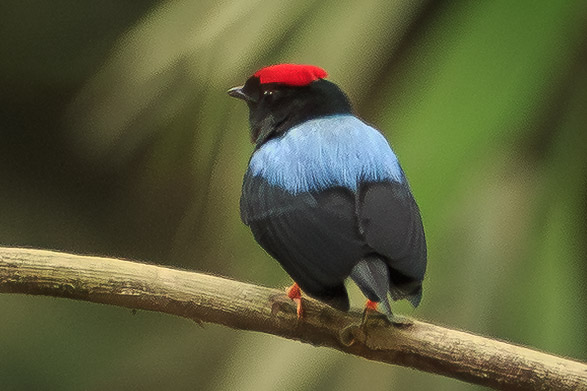
- Key Feature: Vibrant sky-blue mantle and scarlet-red crown patch in males
- Régime alimentaire principal : Principalement frugivore
- Range: Amazon Basin, Guianas, and coastal Eastern Brazil
- Habitat: Lowland Tropical Moist Forest and Secondary Growth
- Social Structure: Polygynous; Cooperative Lekking
- Nesting/Breeding: Shallow cup nests in tree forks
- Statut de conservation : Préoccupation mineure (LC)
- Population Trend: Stable
The Blue-backed manakin (*Chiroxiphia pareola*) is a small, vibrant passerine bird native to the tropical forests of South America, renowned for its striking sexual dimorphism and theatrical social life. While females sport an inconspicuous olive-green plumage for camouflage, the adult male is a visual marvel, boasting a velvety jet-black body contrasted by a brilliant sky-blue mantle and a fiery crimson crown. Beyond its vivid colors, the species is most famous for its extraordinary "cooperative lekking" behavior; two or more males perform highly synchronized, acrobatic dance routines—often involving rapid-fire leaps and "cartwheels" over one another—to woo a single female. This complex social structure, where a subordinate "wingman" helps the alpha male secure a mate through rigorous teamwork, makes the Blue-backed manakin one of the most fascinating examples of avian coordination and evolutionary showmanship.
Faits amusants
The blue-backed manakin is famous for its elaborate, cooperative "cartwheel" dance, where a dominant alpha and a subordinate beta male perform a synchronized leapfrog routine to impress a female. Despite the intense teamwork, only the alpha male is permitted to mate, while the beta male acts as a long-term apprentice, sometimes waiting years to inherit the territory and status. These birds also produce sharp, mechanical snapping sounds by rapidly striking their wings together during their high-speed displays. Their vibrant plumage, featuring a brilliant sky-blue mantle and a crimson crown, creates a high-contrast visual "flash" against the dark forest understory to further captivate potential mates.
Habitats et répartition
This species is widely distributed across the northern and central regions of South America, spanning the Amazon Basin through Brazil, Colombia, Ecuador, Peru, and Bolivia, as well as the Guianas and southern Venezuela. Isolated populations also inhabit the Atlantic Forest of eastern Brazil and the Caribbean island of Tobago. Within these ranges, it primarily occupies the understory and mid-story of moist lowland tropical forests, mature secondary growth, and occasionally shaded plantations.
The preferred habitat consists of dense, humid vegetation, typically at elevations below 1,000 meters. It is most frequently encountered near traditional lek sites, where males gather for communal displays, and in areas with an abundance of fruiting trees. These environments provide the necessary cover and food resources required for its survival and complex social interactions.
Comportements & Reproduction
This species is renowned for its sophisticated cooperative lekking system, where a dominant alpha male and a subordinate beta male form a long-term partnership to perform synchronized courtship rituals. Together, they execute an intricate "leapfrog" dance on a display perch, rapidly switching positions and vocalizing to impress visiting females. Despite this intense teamwork, only the alpha male mates; the beta male participates to gain social status and experience, eventually inheriting the territory and the opportunity to become an alpha.
Once the female selects a partner based on the coordination and quality of the joint display, the beta male departs to allow the alpha to complete the mating process. Following copulation, the female assumes all parental duties, constructing a cup-shaped nest in the forest understory and raising the young entirely on her own. This unique reproductive strategy highlights a complex social hierarchy where male cooperation is the primary driver of reproductive success, even though the immediate biological rewards are not shared.
Alimentation
The blue-backed manakin is primarily a frugivorous species, centering its diet on a wide variety of small, fleshy fruits and berries found within the tropical forest understory. While it heavily relies on the high-energy sugars from fruits like those in the Melastomataceae family, it also acts as an opportunistic insectivore, supplementing its nutritional intake with small arthropods and larvae to obtain essential proteins. An interesting aspect of its feeding behavior is the specialized "pluck and fly" technique, where the bird hovers briefly to snatch fruit directly from branches rather than perching to eat. Furthermore, because these manakins process fruit rapidly and defecate seeds relatively intact, they serve as vital seed dispersers within their ecosystem, playing a crucial role in maintaining the floral diversity of their habitat.
Couleurs
Male blue-backed manakins feature velvet-black plumage contrasted by a vibrant sky-blue mantle and a brilliant crimson crown. In contrast, females are primarily olive-green, providing effective camouflage within dense tropical foliage. Both sexes are further distinguished by their bright orange-pink legs.