Blue-gray Tanager
Thraupis episcopus
Quick Facts
- Scientific Name: Thraupis episcopus
- Spanish Name: Azulejo
- Family: Thraupidae
- Known Nicknames: Blue Tanager, Azulejo de jardín
- Average Length: 16–18 cm / 6.3–7.1 in
- Average Weight: 30–40 g / 1.1–1.4 oz
- Wingspan: 25–30 cm / 10–12 in
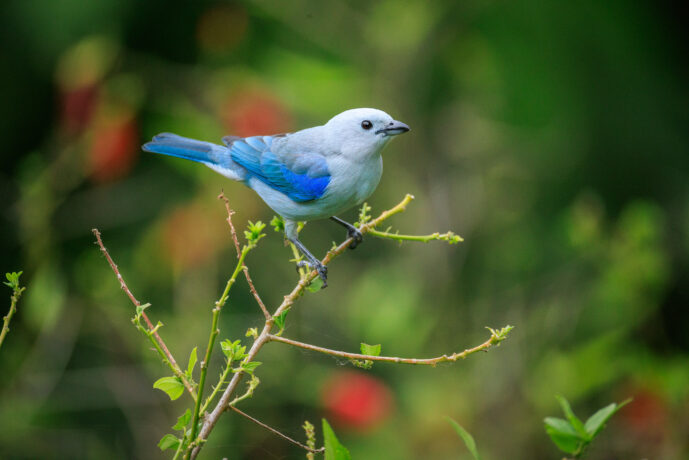
- Key Feature: Uniformly pale blue and gray plumage with darker blue flight feathers
- Primary Diet: Primarily Frugivore (also Omnivorous, consuming insects and nectar)
- Range: Mexico to Northeast Bolivia and Northern Brazil; introduced to Southern Florida
- Habitat: Open woodland, gardens, orchards, and forest edges
- Social Structure: Highly Social (usually in pairs or small groups)
- Nesting/Breeding: Cup-shaped nest in trees or shrubs
- Statut de conservation : Préoccupation mineure (LC)
- Population Trend: Stable
The Blue-gray Tanager (*Thraupis episcopus*) is a vibrant and social songbird native to the region stretching from Mexico to the Amazon Basin, renowned for its striking, monochromatic palette. Its general appearance is characterized by soft, pale blue-gray plumage on the body, which contrasts beautifully with the deeper, more electric cerulean hues found on its wings and tail. Often found in pairs or small, restless groups, this highly adaptable bird is a common sight in tropical gardens and urban parks, where it is easily identified by its high-pitched, squeaky vocalizations and energetic foraging for fruit and insects. A unique feature of this species is its scientific name, *episcopus*, which alludes to the blue-toned robes historically worn by bishops, perfectly capturing the regal yet serene aesthetic of its feathered coat.
Faits amusants
These birds are often nicknamed "Blue Jeans" due to their distinct denim-colored plumage, a shade so specific that their scientific name, *episcopus*, refers to the blue robes historically worn by bishops. Despite their small size, they are remarkably feisty and are known to "mob" much larger predators, such as owls or snakes, to drive them away from their territory. They also exhibit a quirky hunting behavior called "hawking," where they snatch insects out of mid-air with acrobatic precision. Most impressively, their vibrant blue color is not caused by pigment but is actually a result of structural coloration, where microscopic light-reflecting structures in their feathers create a shimmering, metallic effect that shifts as they move.
Habitats et répartition
This species maintains an extensive geographical range that stretches from central Mexico through Central America and across much of northern and central South America, extending as far south as Peru, Bolivia, and the Amazon Basin in Brazil. It is also native to Trinidad and Tobago and has been successfully introduced to parts of southern Florida. In terms of habitat, it is highly adaptable and favors semi-open environments over dense, primary rainforests. It is frequently observed in forest edges, light secondary growth, and agricultural landscapes such as plantations. Due to its high tolerance for human activity, it is a common sight in urban and suburban settings, including city parks, residential gardens, and orchards, where it primarily occupies the canopy and mid-levels of trees.
Comportements & Reproduction
These birds are highly social and are typically observed in pairs or small, active groups of three to ten individuals. They are known for their restless and noisy nature, often moving through the canopy or visiting garden feeders in search of fruit and insects. While they frequently join mixed-species foraging flocks, they remain territorial during the breeding season, defending their nesting sites with vocal displays and occasional physical skirmishes. The species is monogamous, forming strong pair bonds that can last for multiple seasons. During the breeding period, the female constructs a sturdy, cup-shaped nest made of moss, leaves, and spiderwebs, usually tucked away in dense foliage. She typically lays a clutch of two grayish-white eggs with dark speckles, which she incubates for about 14 days. Both parents share the responsibility of feeding the chicks, primarily providing a diet of insects and fruit to ensure rapid growth before the young fledge.
Alimentation
The Blue-gray Tanager maintains a diverse omnivorous diet, though it is primarily recognized as a frugivore that favors a wide variety of cultivated and wild fruits such as papayas, bananas, figs, and berries. Beyond its fruit consumption, this bird actively hunts for animal protein by gleaning insects and spiders from foliage or skillfully catching them in mid-air. An interesting aspect of its feeding behavior is its high level of adaptability to human-altered landscapes; it is a frequent visitor to backyard bird feeders and gardens where it seeks out fruit scraps and nectar. Furthermore, these tanagers play a vital ecological role as seed dispersers, and they have even been observed following army ant swarms to snatch up small invertebrates flushed out by the ants, showcasing a clever and opportunistic foraging strategy.
Couleurs
The Blue-gray Tanager features a predominantly pale, powder-blue body accented by more vibrant turquoise or azure on the wings and tail. It often displays a distinct, brighter blue patch on the shoulders, while its underparts are a lighter, silvery-gray. This soft, monochromatic coloration provides effective camouflage by mimicking the bright tropical sky and dappled canopy light, making the bird less visible to predators from below.