Brown Violetear
Colibri delphinae
Quick Facts
- Scientific Name: Colibri delphinae
- Spanish Name: Colibrí pardo
- Family: Trochilidae
- Known Nicknames: Brown Violet-ear
- Average Length: 11–12 cm / 4.3–4.7 in
- Average Weight: 5.5–7 g / 0.19–0.25 oz
- Wingspan: 12–15 cm / 4.7–5.9 in
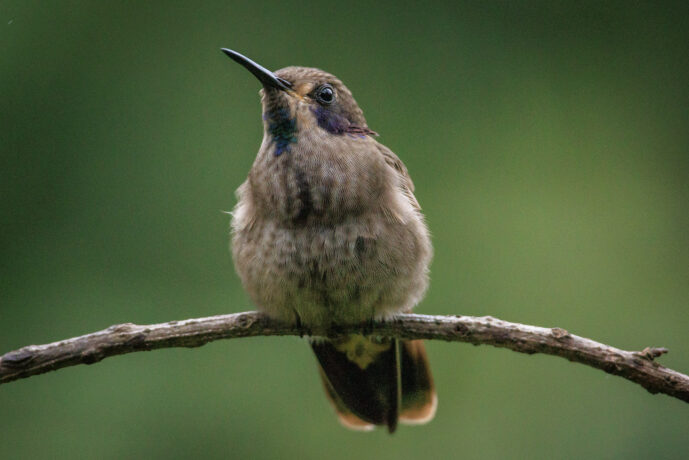
- Key Feature: Violet patch on ear-coverts and iridescent green-to-blue throat
- Primary Diet: Nectarivore and Insectivore
- Range: Central and South America, from Belize and Guatemala to Bolivia and Brazil
- Habitat: Humid forest edges, clearings, and tall second growth
- Social Structure: Solitary and territorial
- Nesting/Breeding: Cup nest made of plant down and spider webs on a horizontal branch
- Statut de conservation : Préoccupation mineure (LC)
- Population Trend: Stable
The Brown Violetear (*Colibri delphinae*) is a medium-sized hummingbird found in the humid forests and canopy edges of Central and South America, distinguished by its sophisticated and understated beauty. While many hummingbirds boast neon hues, the Brown Violetear is primarily dressed in earthy, grayish-brown plumage that provides excellent camouflage; however, this subtle exterior is punctuated by brilliant flashes of color, most notably the shimmering iridescent violet patches on the sides of its head and a radiant malachite-green throat. Beyond its unique aesthetic, this bird is known for its spirited and territorial personality, often asserting dominance at nectar sources with high-pitched, metallic chipping calls. Its agile flight and the surprising "glow" of its violet ear-coverts when it catches the light make it a captivating sight for birdwatchers and nature enthusiasts alike.
Faits amusants
The Brown Violetear is a master of sudden transformation, using specialized muscles to flare its brilliant violet ear patches and iridescent green throat feathers to intimidate rivals. Despite its modest brown plumage, it is exceptionally aggressive and will fearlessly dive-bomb much larger birds to defend its territory. This species is also unique for its vocal social life; males often gather in "leks," which are competitive groups where they sing persistent, metallic songs to attract mates. Furthermore, they are renowned wanderers, occasionally appearing in unexpected locations as far north as Canada, thousands of miles away from their usual tropical habitats in Central and South America.
Habitats et répartition
This species occupies a broad geographical range stretching from southern Belize and Guatemala through Central America into South America. Its distribution encompasses Colombia, Venezuela, the Guianas, and the island of Trinidad, extending south along the slopes of the Andes through Ecuador and Peru to Bolivia, as well as into northern Brazil. Primarily found in humid montane forests and their borders, it typically inhabits elevations ranging from 400 to 1,600 meters. It favors environments such as forest clearings, tall secondary growth, and semi-open habitats including coffee plantations and gardens. Its presence is often associated with the canopy and sub-canopy levels where it searches for nectar and small insects.
Comportements & Reproduction
This hummingbird is notably aggressive and territorial, frequently engaging in aerial skirmishes to defend nectar-rich flowers or feeding stations from both its own species and other competitors. Outside of the breeding season, it is generally solitary, but during the mating period, males exhibit a distinctive lekking behavior. They gather in small groups within the forest canopy, singing persistently from high perches to attract females. Unlike many other hummingbirds that rely on elaborate diving displays, this species focuses on these vocal communal displays to secure a mate. Once mating has occurred, the male plays no further role in the reproductive process, and no long-term pair bond is formed. The female is solely responsible for constructing the cup-shaped nest, which she fashions from soft plant fibers and reinforces with spider silk. She typically hides the nest on a low, horizontal branch or beneath a large leaf for protection. After laying two small white eggs, she incubates them alone and provides all the care for the hatchlings, feeding them a protein-rich diet of regurgitated insects and nectar until they are ready to fledge.
Alimentation
The Brown Violetear primarily sustains itself on a nectar-rich diet sourced from a variety of flowering trees and shrubs, such as those in the Inga and Erythrina genera, as well as various epiphytes. While nectar provides the essential sugars required to fuel their incredibly high metabolism, these hummingbirds also supplement their intake with small insects and spiders to obtain vital proteins and minerals. An interesting aspect of their feeding behavior is their aggressive territoriality; they are known to vigorously defend productive flower patches or nectar feeders from other hummingbirds, regardless of the competitor's size. Additionally, unlike some species that stay low to the ground, the Brown Violetear often forages at mid-levels to the forest canopy and frequently employs a technique called "hawking," where they dart out to catch tiny flying insects mid-air.
Couleurs
The Brown Violetear is primarily clad in dull brownish-gray plumage that provides effective camouflage within shaded forest environments. It is distinguished by iridescent violet patches on its ear-coverts and a glittering malachite green throat. Its bronze-green tail features a dark subterminal band, while subtle rufous tones on the rump add a touch of warmth to its otherwise muted, earthy coloration.