Caiman crocodilus
Caiman crocodilus
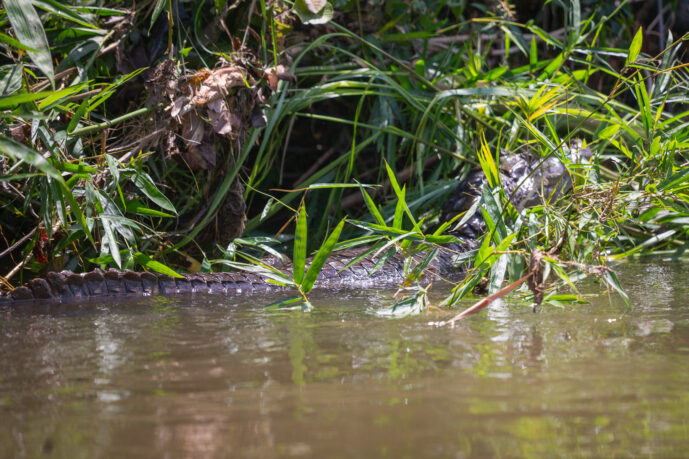
Quick Facts
- Scientific Name: Caiman crocodilus
- Spanish Name: Babilla
- Family: Alligatoridae
- Known Nicknames: Spectacled Caiman, White Caiman, Common Caiman
- Average Length: 1.4–2.5 m / 4.6–8.2 ft
- Average Weight: 7–40 kg / 15–88 lb
- Wingspan: N/A
- Key Feature: Bony infra-orbital ridge between the eyes resembling spectacles
- Primary Diet: Carnivore (Fish, amphibians, reptiles, and small mammals)
- Range: Central and South America, from Southern Mexico to Northern Argentina
- Habitat: Lowland freshwater habitats including rivers, lakes, swamps, and wetlands
- Social Structure: Solitary, but known to congregate in groups during the dry season
- Nesting/Breeding: Mound nests constructed from soil and decaying vegetation
- Statut de conservation : Préoccupation mineure (LC)
- Population Trend: Stable
The *Caiman crocodilus*, commonly known as the Spectacled Caiman, is a highly adaptable crocodilian distinguished primarily by a prominent bony ridge between its eyes that resembles the bridge of a pair of spectacles. Typically reaching lengths of five to eight feet, this reptile features a protective hide of olive-green or brownish scales reinforced with heavily calcified bony plates called osteoderms, which act as a natural suit of armor. A fascinating physiological trait of this species is its ability to change color; during cold weather, the black pigment within its skin cells expands, making the animal appear darker to better absorb heat from the sun. Found throughout the wetlands of Central and South America, these resilient predators are equally at home in freshwater and brackish environments, where they use their camouflaged bodies and keen senses to dominate their aquatic ecosystems.
Faits amusants
The Spectacled Caiman earns its name from a prominent bony ridge between its eyes that mimics the bridge of a pair of spectacles. These reptiles are biological masters of camouflage, possessing the rare ability to change their skin color; during cold weather, their pigment cells expand to turn their skin darker, helping them absorb more solar heat. Beyond their physical traits, they act as essential ecological regulators by preying on piranhas, which prevents the fish from overpopulating. They also exhibit a surprising social behavior known as "creching," where one protective mother will stand guard over a collective nursery containing the hatchlings of several different females.
Habitats et répartition
This species maintains an extensive geographical range across Central and South America, stretching from southern Mexico through the Amazon basin to northern Argentina. It is also widely distributed across the Caribbean and has established non-native populations in regions like Florida and Puerto Rico. Its high level of adaptability has allowed it to occupy a diverse array of tropical and subtropical climates throughout the Neotropics. Primarily inhabiting freshwater environments, it is commonly found in slow-moving rivers, lakes, swamps, and seasonally flooded savannas. While it favors still or sluggish waters, it is notably resilient and can tolerate brackish conditions in coastal mangroves. Additionally, it frequently colonizes human-altered landscapes such as drainage ditches, reservoirs, and irrigation canals, demonstrating significant ecological flexibility in various wetland types.
Comportements & Reproduction
These reptiles exhibit a complex social structure often defined by a dominance hierarchy, particularly among males during the breeding season. While generally solitary, they aggregate in large numbers during dry periods when water sources recede. Communication is achieved through a variety of vocalizations, such as bellows and grunts, as well as physical displays like head-slapping and body vibrations to signal territory or attract mates. Mating typically coincides with the onset of the rainy season, involving elaborate courtship rituals in the water. Females construct large mound nests from soil and decaying vegetation, which provides the necessary heat for incubation. A notable reproductive strategy is temperature-dependent sex determination, where the nest's internal temperature dictates the sex of the offspring. Once the eggs hatch, mothers exhibit significant parental care, often leading hatchlings to "crèches" or communal nurseries where one or more females guard the young from various clutches against predators.
Alimentation
The spectacled caiman is a highly versatile and opportunistic predator with a diet that shifts significantly as it matures. Juveniles primarily focus on small aquatic invertebrates, such as insects, crustaceans, and mollusks, but as they grow, they incorporate a wide range of vertebrates including fish, amphibians, reptiles, and water birds. Adult specimens are even capable of taking down larger mammals like wild pigs or capybaras. An intriguing aspect of their feeding ecology is their role as ecological stabilizers; by preying on piranhas, they help maintain a balance in fish populations within their habitats. Furthermore, during periods of extreme drought when food becomes scarce, these caimans exhibit remarkable survival strategies, such as cannibalism or entering a state of dormancy where they stop eating entirely to conserve energy. They are also known to swallow gastroliths—small stones that remain in the stomach—which are thought to assist in grinding up tough prey like turtle shells while providing ballast for better diving control.
Couleurs
The spectacled caiman features a dull olive-green or grayish-brown hide with dark cross-bands on the body and tail, while juveniles are typically brighter yellow with black spots. A distinctive bony ridge between the eyes resembles spectacles, and their drab, earthy tones offer superior camouflage in murky wetlands. They can also adjust their skin's pigment density to darken or lighten, aiding in both temperature regulation and concealment.