Cicada
Cicadidae
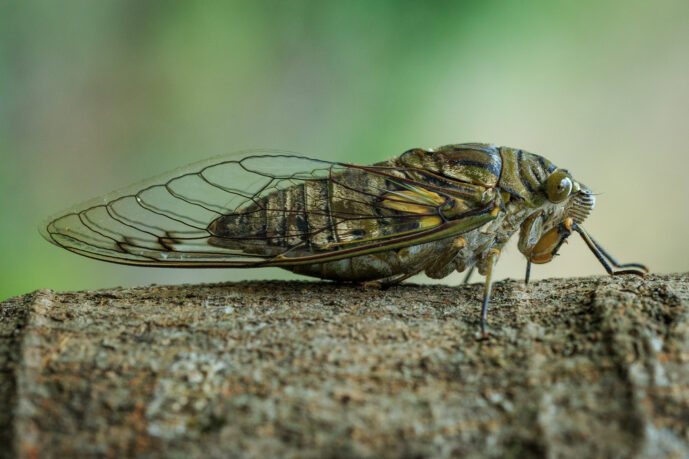
Quick Facts
- Scientific Name: Cicadidae
- Spanish Name: Chicharra
- Family: Cicadidae
- Known Nicknames: Harvestflies, Jarflies, Tree-crickets, Periodic Cicadas
- Average Length: 2–5 cm / 0.8–2 in
- Average Weight: 0.1–2 g / 0.003–0.07 oz
- Wingspan: 5–15 cm / 2–6 in
- Key Feature: Loud sound-producing tymbals and large, transparent membranous wings
- Primary Diet: Herbivore (Xylem sap)
- Range: Global (excluding Antarctica)
- Habitat: Temperate to Tropical Forests, Woodlands, and Grasslands
- Social Structure: Solitary (mass emergence behavior)
- Nesting/Breeding: Slits in tree twigs and branches
- Statut de conservation : Préoccupation mineure (LC)
- Population Trend: Stable
The Cicada, a member of the family Cicadidae, is a remarkable insect best known for its stout body and the deafening, rhythmic drone that defines summer afternoons. These insects are easily recognized by their broad heads featuring wide-set, bulging compound eyes and two pairs of delicate, glass-like membranous wings laced with intricate veins. While their underground nymphal stage can last anywhere from two to seventeen years depending on the species, their adult life is a brief, high-energy period dedicated to reproduction. The most extraordinary feature of the male cicada is its specialized sound-producing organ called a tymbal, located on the abdomen, which vibrates rapidly to create one of the loudest acoustic signals in the insect world. Whether appearing annually or in massive, synchronized "broods," cicadas are masters of survival, using their sheer numbers and piercing songs to dominate their ecosystems.
Faits amusants
Cicadas are the loudest insects on Earth, capable of producing buzzing sounds exceeding 100 decibels using specialized ribbed organs called tymbals. Some species, known as periodical cicadas, spend exactly 13 or 17 years underground—prime numbers that help them avoid syncing with the population cycles of their predators. Their wings are naturally antibiotic and water-repellent due to microscopic spikes that physically puncture bacterial cells upon contact. Additionally, these insects are susceptible to a "zombie fungus" called *Massospora*, which replaces their lower abdomen with a plug of spores and manipulates their behavior, causing them to frantically attempt mating to spread the infection to others.
Habitats et répartition
These insects thrive primarily in temperate and tropical environments where deciduous or evergreen trees and shrubs are present. During their nymphal stage, they live underground, tunneling through the soil to feed on the xylem sap of plant roots. Once they emerge as adults, they inhabit the canopy of forests, woodlands, and urban parks, utilizing woody vegetation for both mating displays and egg-laying. Their geographical range is vast, spanning every continent except Antarctica. While they exhibit the highest diversity in tropical regions such as Southeast Asia and South America, they are also widely distributed across North America, Europe, and Australia. Some species are highly localized to specific islands or mountain ranges, while others, particularly periodical varieties, are found across expansive regions of the eastern United States.
Comportements & Reproduction
These insects are best known for their synchronized mass emergences and the deafening acoustic choruses produced by males to attract mates. Using specialized abdominal organs called tymbals, males generate loud, species-specific songs, while females respond with rhythmic wing flicks to signal receptivity. Although they do not possess a formal social hierarchy, many species employ a "predator satiation" strategy, appearing in such overwhelming numbers that local predators cannot possibly consume them all, thereby ensuring the survival of the population through sheer volume. Following successful mating, the female uses a saw-like ovipositor to cut slits into small tree branches, where she deposits hundreds of eggs. Once the nymphs hatch, they drop to the ground and burrow into the soil, beginning a subterranean existence that can last from two to seventeen years depending on the species. During this time, they remain solitary, feeding on the xylem sap of plant roots until they are ready to emerge, molt into their winged adult form, and begin the reproductive cycle anew.
Alimentation
The diet of the cicada consists exclusively of xylem sap, a watery fluid extracted from the vascular tissues of plants and trees. Both as underground nymphs and winged adults, these insects utilize specialized piercing-sucking mouthparts called a rostrum to tap into roots or branches. Because xylem sap is nutrient-poor and consists primarily of water and minerals, cicadas must consume enormous volumes of it to survive, leading to the interesting phenomenon of "cicada rain," where excess liquid is excreted from their bodies in mist-like droplets. Unlike many other insects that consume leaves or fruit, cicadas never eat solid food and rely entirely on this liquid subsistence throughout their complex life cycles, effectively acting as tiny pumps that process vast quantities of fluid to extract the minimal amino acids required for their development.
Couleurs
Cicadas display cryptic coloration in shades of brown, green, and black, featuring mottled patterns that mimic tree bark and foliage for camouflage. Their large compound eyes range from black to vibrant red or green, and their transparent, membranous wings are lined with intricate dark veins. While many species utilize earthy tones to remain hidden, periodical cicadas are notable for their distinct black bodies and contrasting orange wing veins.