Estern Wood-Pewee
Contopus virens
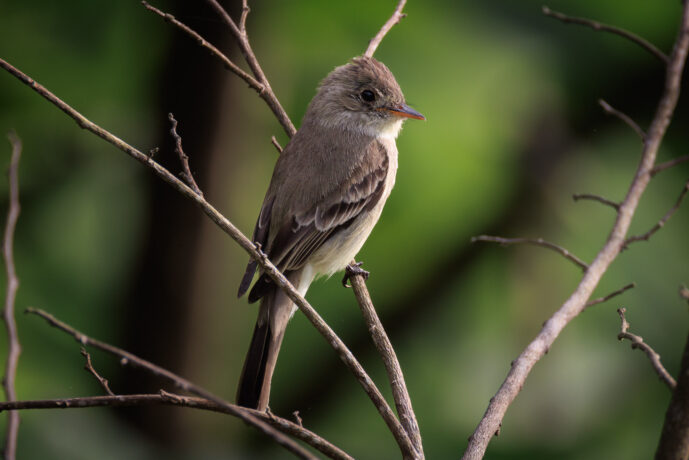
Quick Facts
- Scientific Name: Contopus virens
- Spanish Name: Pibí oriental
- Family: Tyrannidae
- Known Nicknames: Pewee
- Average Length: 13.5–15 cm / 5.3–5.9 in
- Average Weight: 13–15 g / 0.46–0.53 oz
- Wingspan: 23–26 cm / 9.1–10.2 in
- Key Feature: Olive-gray plumage with two conspicuous white wing bars and no eye-ring
- Primary Diet: Insectivore (Aerial flycatcher)
- Range: Breeds in Eastern North America; winters in Northern and Western South America
- Habitat: Deciduous and mixed forests, open woodlands, and forest edges
- Social Structure: Solitary or monogamous pairs during breeding season
- Nesting/Breeding: Horizontal tree branches (shallow cup nest)
- Statut de conservation : Préoccupation mineure (LC)
- Population Trend: Decreasing
The Eastern Wood-Pewee (*Contopus virens*) is a slender, medium-sized flycatcher known for its elegant, upright posture and its haunting, namesake "pee-ah-wee" whistle that echoes through the deciduous forests of eastern North America. Dressed in subtle olive-gray plumage with pale underparts, this bird is characterized by a "vested" appearance—created by darker smudges on the sides of its breast—and the notable absence of a distinct eye-ring, which distinguishes it from many of its lookalike relatives. A master of aerial maneuvers, the pewee is frequently observed perched on exposed dead branches, from which it "sallies" out to snatch flying insects mid-air with a sharp snap of its beak before returning to the same lookout. Its understated beauty and persistent summer calls make it a quintessential, though often camouflaged, fixture of the woodland canopy.
Faits amusants
These birds are masters of camouflage, meticulously decorating their nests with lichen to mimic a natural knot on a tree branch. They are famous for their "sallying" hunting style, where they dart out to snatch insects mid-air before returning to the exact same "favorite" perch. Unlike many other forest birds that go quiet during the afternoon heat, the Eastern Wood-Pewee is a persistent vocalist, often singing its namesake "pee-a-wee" call from dawn until well after dusk. Additionally, they exhibit a distinctive, rapid tail-wagging motion immediately after landing, a quirky trait that helps birdwatchers identify them from afar.
Habitats et répartition
This flycatcher predominantly inhabits deciduous and mixed forests, showing a preference for open woodlands with a clear understory that allows for efficient foraging. It is commonly found in mature forests, woodlots, and suburban parks, often perching on dead branches to scan for insects. During the breeding season, it is widely distributed across eastern North America, ranging from southeastern Canada down to the Gulf Coast and westward to the Great Plains. As a long-distance neotropical migrant, it spends the winter months in northern South America, primarily in the forest edges and clearings of the Andes and the Amazon basin in countries like Colombia, Venezuela, and Peru.
Comportements & Reproduction
During the breeding season, this suboscine passerine is highly territorial and primarily solitary, defending its foraging space through persistent vocalizations. It employs a "sit-and-wait" hunting strategy, perching on exposed dead branches to sally out and capture flying insects before returning to the same spot. While they are socially monogamous, their social structure revolves around the mated pair, with males using their distinctive, three-part whistle to establish boundaries and attract mates. Reproduction is characterized by the female’s meticulous construction of a shallow, cup-shaped nest situated on a horizontal limb far from the tree trunk. A unique reproductive strategy is the use of spider silk and lichens to coat the nest's exterior, camouflaging it to resemble a natural knot or burl on the branch to evade predators. The female typically lays two to four eggs and handles all incubation duties, while the male remains nearby to defend the territory and assist in feeding the altricial nestlings once they hatch.
Alimentation
The Eastern Wood-Pewee is a dedicated aerial insectivore that feeds almost exclusively on a wide variety of flying insects, including flies, beetles, moths, butterflies, bees, wasps, and dragonflies. It employs a specialized hunting strategy known as "sallying" or "hawking," where it sits motionless on a conspicuous dead branch in the mid-canopy, waits for an insect to pass, and then darts out to snatch the prey mid-air with an audible snap of its beak. An interesting aspect of its feeding behavior is its high degree of site fidelity, often returning to the exact same perch after each successful capture to scan for its next meal. While its diet is overwhelmingly comprised of invertebrates, this bird occasionally supplements its nutrition with small amounts of vegetable matter, such as berries or seeds, particularly during migration or periods when insect activity is low.
Couleurs
The Eastern Wood-Pewee displays drab grayish-olive upperparts and pale, yellowish-white underparts that blend seamlessly into forest shadows. Key markings include two distinct whitish wing bars and a bi-colored bill with a dark upper and orange-yellow lower mandible. Unlike similar flycatchers, it lacks a prominent eye-ring, relying on its muted, dusky plumage for camouflage while perched on high, dead branches.