Gartered Trogon
Trogon caligatus
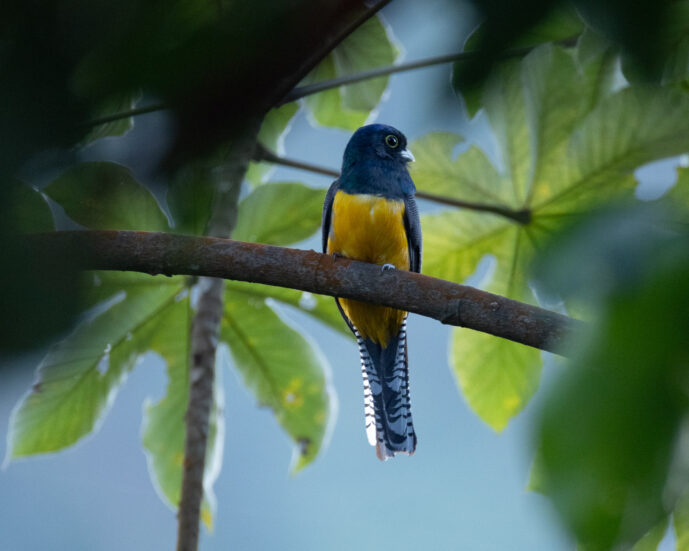
Quick Facts
- Scientific Name: Trogon caligatus
- Spanish Name: Trogón de liga
- Family: Trogonidae
- Known Nicknames: Northern Violaceous Trogon, Yellow-bellied Trogon
- Average Length: 23–25 cm / 9–10 in
- Average Weight: 38–57 g / 1.3–2.0 oz
- Wingspan: 30–35 cm / 12–14 in
- Key Feature: Bright yellow belly and a complete yellow eye-ring in males
- Primary Diet: Omnivore (Insects and small fruits)
- Range: East-central Mexico south through Central America to northwest Colombia and western Ecuador
- Habitat: Humid lowland forests, deciduous forests, and shaded plantations
- Social Structure: Solitary or in pairs
- Nesting/Breeding: Arboreal termite nests or soft decaying wood
- Statut de conservation : Préoccupation mineure (LC)
- Population Trend: Decreasing
The Gartered Trogon (*Trogon caligatus*) is a vibrant jewel of the Neotropical canopy, celebrated for its striking coloration and stoic presence. Males are particularly eye-catching, featuring a deep violet-blue head and breast that gives way to a brilliant yellow belly, all framed by a shimmering metallic green back and intricately barred black-and-white undertail feathers. Its most distinctive physical trait is the vivid yellow eye-ring, or "garter," which encircles its dark eyes and provides a sharp contrast to its dark face. Beyond its beauty, this species possesses a remarkable nesting strategy: it often excavates its home within active wasp or termite mounds, utilizing the stinging or biting insects as a built-in security system against predators. Whether sitting perfectly still on a shaded branch or performing acrobatic maneuvers to pluck fruit and insects, the Gartered Trogon remains one of the most charismatic and resourceful inhabitants of the tropical forest.
Faits amusants
These birds exhibit a bold nesting strategy by excavating cavities directly inside active wasp nests or arboreal termite mounds, relying on the stinging insects to serve as a natural defense against predators. They are also known for their extreme patience, sitting perfectly still for long periods to the point of being nearly invisible despite their brilliant yellow bellies and iridescent plumage. When it is time to eat, they perform acrobatic "hover-gleaning," momentarily suspending themselves in mid-air to pluck fruit or insects from branches with their specialized serrated bills.
Habitats et répartition
This species is widely distributed across Central and South America, ranging from central Mexico through the Caribbean and Pacific slopes down to northwestern South America, specifically in Colombia, Ecuador, and Venezuela. It primarily occupies lowland regions, generally occurring at elevations from sea level up to approximately 1,500 meters. Its preferred habitats include humid tropical forests, deciduous woodlands, and forest edges. It is highly adaptable and can also be found in semi-open environments such as second-growth forests, plantations, and shaded gardens. Within these settings, it typically frequents the middle and upper levels of the canopy, often nesting within arboreal termite mounds.
Comportements & Reproduction
These birds are typically solitary or found in pairs, maintaining a relatively sedentary lifestyle as they sit motionless for long periods before swooping to snatch insects or fruit. Their social structure is primarily centered around monogamous breeding pairs during the nesting season, with communication consisting of repetitive, soft hooting calls used to establish territories. They exhibit a highly specialized and perilous nesting strategy by excavating their homes within active arboreal termitaria or the nests of stinging wasps. This unique choice provides a defensive barrier against predators, as the resident insects help deter potential intruders from the nesting site. Once the cavity is hollowed out, the female typically lays two to three white eggs. Both parents share the responsibilities of incubation and brooding, demonstrating a strong pair bond and cooperative care. This biparental involvement continues after the eggs hatch, as both adults forage for and feed the altricial chicks until they are ready to fledge. By utilizing living insect colonies for shelter, they ensure a more stable microclimate for their offspring and a significant degree of protection, showcasing a remarkable ecological relationship with their hosts.
Alimentation
The Gartered Trogon maintains an omnivorous diet that primarily consists of a variety of small fruits and berries, supplemented by a wide range of invertebrates such as caterpillars, beetles, and orthopterans. A fascinating aspect of their feeding strategy is the "hover-gleaning" technique, where the bird flies out from a perch to snatch fruit or insects mid-air or from foliage without landing. They are also known to exhibit opportunistic behaviors, such as following army ant swarms to capture fleeing prey or raiding the nests of social wasps to consume larvae. By consuming large quantities of fruit and passing the seeds, they play a vital role as seed dispersers within their tropical forest habitats.
Couleurs
The male Gartered Trogon displays a vibrant yellow belly, a violet-blue head and breast, and a metallic green back, accented by a distinctive yellow eye-ring. Its underside features a long tail with fine black-and-white horizontal barring, which serves as disruptive camouflage against dappled forest light. Females exhibit more cryptic slate-gray plumage on the head and breast while maintaining the characteristic yellow underparts and barred tail patterns.