Golden Parakeets
Guaruba guarouba
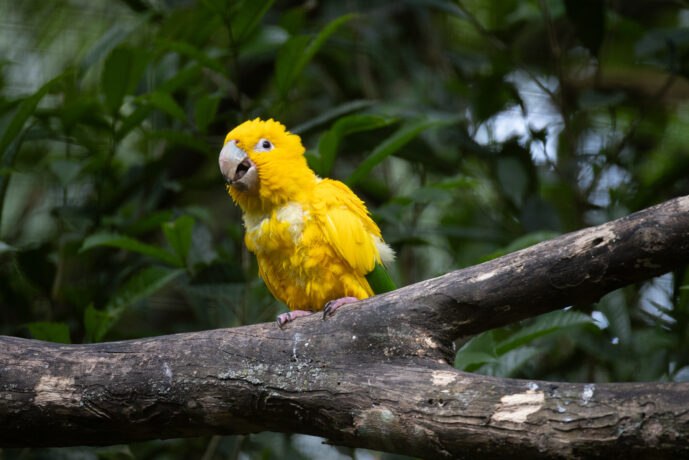
Quick Facts
- Scientific Name: Guaruba guarouba
- Spanish Name: Aratinga amarilla
- Family: Psittacidae
- Known Nicknames: Golden Conure, Queen of Bavaria Conure
- Average Length: 34 cm / 13.4 in
- Average Weight: 270 g / 9.5 oz
- Wingspan: 46–52 cm / 18–20.5 in
- Key Feature: Vivid golden-yellow body plumage with contrasting dark green flight feathers
- Primary Diet: Frugivore and Granivore (seeds, fruits, flowers, and nuts)
- Range: Endemic to northern Brazil, specifically the Amazon Basin south of the Amazon River
- Habitat: Humid lowland tropical rainforests and terra firme forests
- Social Structure: Highly Social; exhibits communal living and cooperative breeding behaviors
- Nesting/Breeding: High tree hollows in tall, often isolated trees
- Conservation Status: Vulnerable (VU)
- Population Trend: Decreasing
The Golden Parakeet, also known as the Queen of Bavaria Conure, is a breathtakingly vibrant bird endemic to the Amazon Basin of northern Brazil. This medium-sized parrot is instantly recognizable by its brilliant, sun-yellow plumage that blankets its entire body, accented sharply by deep forest-green flight feathers on its wings. Beyond its radiant appearance, the Golden Parakeet is distinguished by its unique social behavior; it is one of the few parrot species to practice communal breeding, where a group of individuals works together to raise a single clutch of chicks. Highly intelligent and exceptionally vocal, these striking birds are considered a symbol of Brazilian avian beauty, though they remain a rare and vulnerable treasure of the rainforest due to habitat loss and their specialized nesting requirements.
Faits amusants
Golden Parakeets are famous for their vibrant plumage that mirrors the colors of the Brazilian flag, earning them a reputation as a national symbol. Unlike many other parrots, they exhibit a rare communal breeding system where multiple adults in a social group cooperate to raise a single nest of chicks. These highly social birds are also known for their boisterous "play-wrestling" sessions and their role as forest sentinels, using piercing alarm calls to alert other wildlife to the presence of predators. Their intense curiosity often leads them to hang upside down by a single toe while investigating new objects or foraging in the high canopy.
Habitats et répartition
This species is endemic to the Amazon Basin in northern Brazil, specifically restricted to a relatively small area south of the Amazon River. Its primary range extends between the Tapajós and Tocantins rivers, encompassing parts of the states of Pará and Maranhão. Although historically more widespread, its current distribution is now highly fragmented, with populations primarily concentrated in protected areas and remote forested regions within this specific geographic corridor. These birds predominantly inhabit humid, lowland tropical rainforests, showing a strong preference for primary "terra firme" forests that are not subject to seasonal flooding. They rely on tall, mature trees for both foraging and nesting, often utilizing high tree cavities for communal breeding. While they are most frequently found in dense forest canopies, they may occasionally venture into secondary growth forests or clearings at the forest edge to feed on seasonal fruits, seeds, and blossoms.
Comportements & Reproduction
Highly social and gregarious, these birds live in cohesive groups ranging from three to thirty individuals. They are notable for their rare communal breeding system, a departure from the strictly monogamous behavior seen in most other parrots. In this cooperative structure, several females may lay their eggs in a single tree cavity, and the entire group shares the responsibilities of guarding the nest and feeding the chicks. This "helper at the nest" strategy involves non-breeding members of the flock who assist the parents, significantly increasing the survival chances of the brood. Mating typically occurs during the rainy season, with the group becoming more defensive of their shared nesting territory. Their social bonds are reinforced through mutual preening and loud, synchronized calls that help maintain group cohesion. Juveniles remain with their natal group for several years, benefiting from the protection and collective knowledge of the communal unit until they reach maturity. This integrated social and reproductive approach is essential for navigating the challenges of their specific rainforest ecosystem.
Alimentation
The Golden Parakeet maintains a varied diet primarily composed of seasonal fruits, oily seeds, nuts, berries, and flower buds found within the high canopy of the Amazon rainforest. They show a particular preference for the fruits of the açaí palm and the seeds of Croton trees, utilizing their exceptionally powerful beaks to break through tough husks and shells that many other avian species cannot penetrate. Interestingly, these parakeets are known to be opportunistic feeders; while they typically stay in the treetops, they will occasionally descend to raid agricultural plantations for maize or mangoes. Their feeding behavior is notably communal, as they often forage in small, synchronized groups that communicate constantly to maintain social bonds while locating the most nutrient-dense food sources available in their environment.
Couleurs
The Golden Parakeet is characterized by its brilliant, uniform golden-yellow plumage covering the head and body, which contrasts sharply with its dark green primary and secondary flight feathers. This striking bird features a large, pale horn-colored beak and distinctive white rings of bare skin around its eyes. While its vibrant colors appear conspicuous, they provide effective camouflage within the sun-dappled, high-canopy foliage of the Amazon rainforest.