Golden silk-orbweaver
Trichonephila clavipes
Quick Facts
- Scientific Name: Trichonephila clavipes
- Spanish Name: Araña de seda de oro
- Family: Nephilidae
- Known Nicknames: Banana spider, Calico spider, Giant wood spider
- Average Length: Females: 2.4–5.1 cm / 1–2 in (body), Males: 0.6 cm / 0.25 in
- Average Weight: Females: 1–4 g / 0.035–0.14 oz, Males: < 0.1 g / 0.003 oz
- Wingspan: N/A
- Key Feature: Golden-colored silk and distinct hair tufts on the legs
- Primary Diet: Insectivore (primarily flying insects)
- Range: Southeastern United States to Argentina
- Habitat: Humid forests, swamps, and dense woodlands
- Social Structure: Solitary
- Nesting/Breeding: Egg sacs attached to foliage near the web
- Statut de conservation : Préoccupation mineure (LC)
- Population Trend: Stable
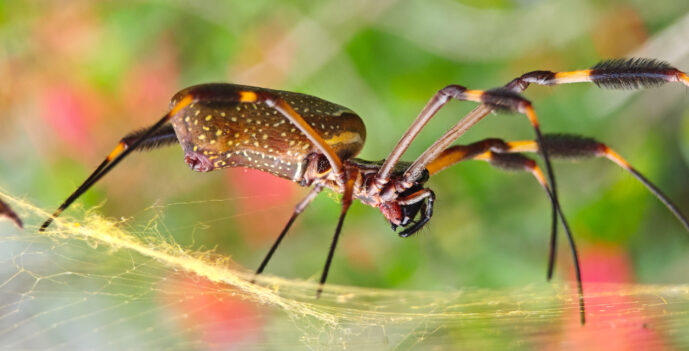
The Golden silk-orbweaver (*Trichonephila clavipes*) is a striking arachnid renowned for its impressive size and the shimmering, golden-hued silk that gives the species its name. Predominantly found in the warmer regions of the Americas, the females are significantly larger than the males, boasting elongated, cylindrical bodies decorated with silver-gray or greenish-yellow patterns and distinctive yellow spots. One of their most recognizable physical features is their long, spindly legs, which are adorned with dark, brush-like tufts of hair known as "gaiters." These spiders are master architects, weaving massive, intricate orb webs that can span several feet; the silk itself is not only beautiful but remarkably resilient, possessing a tensile strength comparable to steel, which has made it a primary subject of scientific study for potential applications in bio-engineering and textiles.
Faits amusants
The Golden silk-orbweaver produces a specialized yellow-tinted silk that glitters like precious metal, a color strategy believed to attract bees or camouflage the web against sun-dappled leaves. This silk is so remarkably strong and durable that it was once harvested to weave a rare, naturally golden textile. Beyond their craftsmanship, these spiders exhibit extreme sexual dimorphism, with tiny males—often a fraction of the female's size—carefully plucking web strands like a harp to signal their presence and avoid becoming a meal. To stay cool in the heat, they engage in "posturing," angling their long abdomens directly toward the sun to minimize surface area exposure and prevent overheating.
Habitats et répartition
The geographical range of this orbweaver spans the Western Hemisphere, extending from the southeastern United States—specifically from North Carolina and Florida westward to Texas—through Central America and the West Indies, and as far south as Argentina. It is most prevalent in regions characterized by warm, humid conditions and high annual rainfall, which support its year-round activity in tropical and subtropical zones. In these regions, it inhabits diverse environments such as the margins of deciduous forests, pine woodlands, mangrove swamps, and coastal hammocks. It thrives in areas with sufficient structural support for its massive webs, often selecting sunny openings between trees or shrubs where flying insects are abundant. It is also frequently encountered in human-modified landscapes, including orchards, parks, and residential gardens.
Comportements & Reproduction
These spiders exhibit a solitary social structure, though multiple tiny males are often found cohabiting on the periphery of a single large female's web. This species is characterized by extreme sexual size dimorphism, with females being significantly larger than their male counterparts. To avoid sexual cannibalism, males must approach the female with extreme caution, often timing their advances for when she is distracted by feeding or is in the middle of a molt. During mating, males may engage in mate guarding to prevent rivals from approaching, frequently remaining on the web for extended periods to ensure paternity. The female's reproductive strategy involves the creation of several egg sacs, each containing hundreds of eggs encased in a protective layer of dense, golden silk. These sacs are typically hidden among nearby foliage to shield them from predators and environmental stress. A unique aspect of their behavior is the use of their namesake golden silk, which serves both as a camouflage against the sky and a lure for specific prey, ensuring the female has sufficient nutrients for egg production. After laying her eggs, the female typically dies, leaving the spiderlings to emerge and disperse via ballooning.
Alimentation
The Golden silk-orbweaver is a generalist predator that primarily consumes a wide variety of flying insects, including flies, bees, moths, butterflies, and grasshoppers that become entangled in its large, durable webs. An intriguing aspect of their feeding behavior is the distinct yellow hue of their silk, which is thought to attract certain pollinators like bees or act as camouflage against the sun, effectively enhancing prey capture. While their diet consists mostly of small invertebrates, these spiders are robust enough to occasionally entrap and consume small vertebrates, such as tiny birds or bats, although this is relatively rare. Furthermore, they exhibit a remarkable efficiency in nutrient management by frequently consuming their own silk webs to recycle the proteins needed for future web construction. When prey is caught, the spider quickly immobilizes it using potent neurotoxins before wrapping it in silk to be consumed immediately or stored for later.
Couleurs
The Golden silk-orbweaver features a silvery-white cephalothorax and an elongated abdomen patterned with vibrant yellow spots against a dark background. Its long, reddish-orange legs are distinguished by prominent black hair tufts at the joints, resembling bottle brushes. This spider produces unique golden-hued silk that camouflages the web in sunlight, while its own contrasting colors provide disruptive countershading against forest foliage.