Great Blue Heron
Ardea herodias
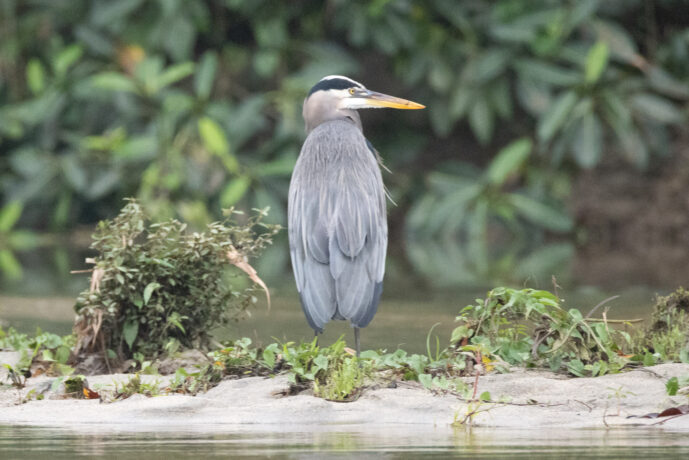
Quick Facts
- Scientific Name: Ardea herodias
- Spanish Name: Garza Morena
- Family: Ardeidae
- Known Nicknames: Blue Crane (misnomer), Great White Heron (white morph), GBH
- Average Length: 91–137 cm / 36–54 in
- Average Weight: 2.1–2.5 kg / 4.6–5.5 lb
- Wingspan: 167–201 cm / 66–79 in
- Key Feature: Long S-curved neck, slate-gray plumage, and a sharp, yellowish dagger-like bill
- Primary Diet: Carnivore (primarily fish, but also amphibians, reptiles, and small mammals)
- Range: North America, Central America, the Caribbean, and the Galápagos Islands
- Habitat: Freshwater and saltwater wetlands, marshes, swamps, and shorelines
- Social Structure: Solitary foragers, colonial nesters (heronries)
- Nesting/Breeding: Large stick nests in trees, shrubs, or occasionally on the ground near water
- Statut de conservation : Préoccupation mineure (LC)
- Population Trend: Stable
The Great Blue Heron (*Ardea herodias*) stands as a majestic sentinel of North American wetlands, easily recognized by its impressive stature as the continent’s largest heron. Cloaked in subtle blue-gray plumage with a distinctive black stripe accenting its crown, this avian predator features a long, S-shaped neck and a formidable, dagger-like yellow bill used for lightning-fast strikes against fish and small mammals. Beyond its elegant appearance, the heron possesses fascinating biological adaptations, such as specialized "powder down" feathers that it crushes into a cleaning agent to remove fish slime, and a serrated middle claw designed for meticulous grooming. Whether seen standing motionless in shallow waters or soaring with slow, rhythmic wingbeats, the Great Blue Heron embodies a perfect blend of prehistoric grace and highly evolved hunting prowess.
Faits amusants
Despite their elegant appearance, Great Blue Herons possess a specialized "comb" on their middle toes called a pectinate claw, which they use to preen and remove fish slime. To aid this grooming, they have patches of "powder down" feathers that crumble into a fine dust, acting as a dry shampoo to neutralize oils and swamp grime. Their distinctive S-shaped necks are powered by modified vertebrae that allow them to strike at prey with the explosive force of a coiled spring. While highly skilled hunters, they are also known for their ambitious appetites, occasionally choking to death by attempting to swallow fish or even large rodents that are far too big for their throats.
Habitats et répartition
Occupying a diverse array of aquatic environments, this species is found in both freshwater and saltwater habitats. It frequently inhabits marshes, swamps, tidal flats, riverbanks, and the shallow edges of lakes or ponds, while also venturing into wet meadows and agricultural fields. These areas provide the necessary shallow water and vegetation required for both stalking prey and nesting in tall trees or shrubs. Its expansive geographical range covers most of North America, extending from southern Alaska and Canada through the United States and Mexico into Central America and the Caribbean. While northern populations are migratory and move south to escape freezing waters, those in milder climates remain year-round residents. Additionally, populations are established along the northern coasts of South America and throughout the Galápagos Islands.
Comportements & Reproduction
These birds are primarily solitary hunters that become highly social during the breeding season, congregating in large colonies known as heronries. They are seasonally monogamous, engaging in elaborate courtship rituals that include bill snapping, rhythmic neck stretching, and the symbolic presentation of twigs by the male to the female. While they defend individual feeding territories with aggressive displays and harsh vocalizations, their colonial nesting strategy provides collective security against predators for their young. The reproductive cycle begins with the male selecting a site and gathering materials for the female to weave into a large platform nest, usually high in trees. A notable reproductive strategy is asynchronous hatching; because eggs are laid over several days, the oldest chicks are significantly larger and more likely to survive if food is scarce, a trait that can sometimes lead to siblicide. Both parents share the duties of incubating the three to six eggs and feeding the young via regurgitation until the juveniles fledge at approximately seven to eight weeks of age.
Alimentation
The Great Blue Heron is a highly versatile carnivore that primarily consumes a wide variety of fish, though its opportunistic nature allows it to hunt amphibians, reptiles, insects, small mammals, and even other birds. Utilizing a patient "stand and wait" or slow wading strategy, this predator strikes with lightning speed, using its dagger-like bill to either impale or grasp prey before swallowing it whole. Interestingly, while they are master fishers, these herons frequently forage in dry fields for rodents like voles and gophers, demonstrating a remarkable adaptability to terrestrial environments. An intriguing aspect of their feeding behavior is their ability to consume surprisingly large prey; however, this occasionally leads to fatal consequences if the heron attempts to swallow something too large to pass through its esophagus, resulting in choking. They are also known to vigorously shake or strike larger prey against rocks or the ground to break bones and soften the meal before ingestion, ensuring it can be swallowed more easily.
Couleurs
The Great Blue Heron features a slate-blue body with a white crown and a distinctive black stripe extending from above the eye to long plumes at the back of its head. Its neck is streaked with white, black, and rust, while the thighs are reddish-brown and the bill is a dull yellow. This muted, grayish-blue coloration provides effective camouflage against water and sky, while the vertical neck streaks help it blend seamlessly into marshy reeds and shoreline vegetation.